The Quantum Leap: How Quantum Computing Could Revolutionize Personalized Psychedelic Therapy
Introduction
The field of **psychedelic therapy**, particularly with substances like **psilocybin**, has been gaining significant attention in recent years for its potential to treat mental health disorders such as **depression**, **PTSD**, and **anxiety**. As the stigma surrounding psychedelics begins to fade, research continues to underscore their effectiveness, especially when therapies are personalized for each individual. However, personalizing such treatment is inherently complex, involving intricate variables from an individual’s genetics to their psychological background and prevailing environmental factors. This is where the monumental capabilities of **quantum computing** come into play.
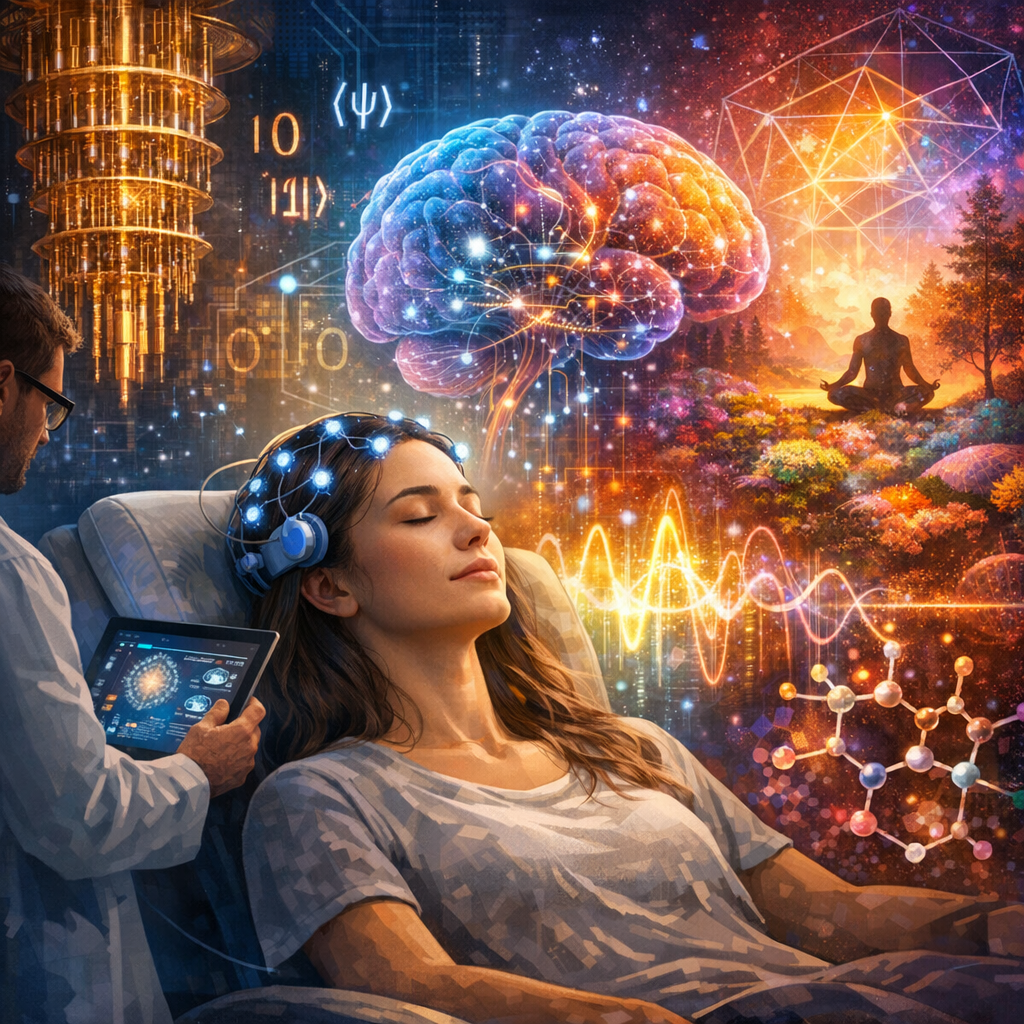
Quantum computing, a technology that leverages the principles of **quantum mechanics**, offers computational speeds and capacities far beyond what is possible with traditional, binary-based computing. A classical computer tries every possible configuration one after the other when faced with complex problems. In contrast, quantum computers can consider many configurations simultaneously, thanks to phenomena such as **superposition** and **entanglement**. This computational prowess could fundamentally revolutionize personalized medicine, including **psychedelic therapy**, by precisely modeling biological systems and simulating how individuals might respond to psychedelic substances.
By processing vast amounts of genetic, neurobiological, and psychological data, quantum computers could provide insights that help in designing highly personalized therapeutic regimens. Such personalized treatments would be tailored to perfectly align with an individual’s unique biochemical and psychological profile, potentially enhancing efficacy and minimizing adverse reactions. The experience of using psychedelics tends to be subjective and influenced by numerous factors, making a personalized approach not just advantageous but essential. As quantum computing becomes more integrated within healthcare, the potential for groundbreaking changes in how treatments are devised and administered will grow exponentially.
Furthermore, with the ability to analyze patterns in massive datasets swiftly, quantum computing could also accelerate the discovery of new therapeutic molecules and pathways, providing a roadmap for future psychedelic drugs. Given the promising results of psilocybin in clinical trials, the synergy between the advancements in **quantum computing** and **psychedelic therapy** holds the potential to redefine therapeutic practices, making care more inclusive and effective for a broader range of patients.
Features: Insights from Professional and Medical Studies
The intersection between **quantum computing** and neuroscience represents a burgeoning frontier that could transform brain research and pharmaceutical development. A 2021 study published in [*Nature*](https://www.nature.com/articles/s41586-021-03925-7) demonstrated quantum computing’s prowess in simulating chemical reactions crucial to drug discovery, offering new possibilities for understanding complex biological interactions. Here lies the potential to tailor psychedelic treatments by simulating and predicting an individual’s response to psilocybin, based on their biochemical individuality.
Psychedelic therapy’s impact on mental health has been reinforced by studies like those published in the [*Journal of Psychopharmacology*](https://journals.sagepub.com/home/jop), which discuss psilocybin’s promising effects on treatment-resistant depression. **MindMed** and similar biotech firms are already investing in technology to map the brain’s response to psychedelic compounds more comprehensively. By integrating quantum computing, these efforts could lead to unprecedented precision.
Another dimension, as elaborated by a [white paper from IBM](https://www.ibm.com/quantum-computing), involves the application of quantum algorithms to model the vast complexity of the human brain, which could allow researchers to decode how psychedelics reshape neural pathways, thereby improving therapeutic approaches. By tackling the brain’s intricate circuitry at a quantum level, we can enhance our understanding of the nuanced ways in which psychedelics induce change, thereby optimizing treatment strategies.
Moreover, as highlighted in a report by the [Quantum Computing Report](https://quantumcomputingreport.com), there is significant interest in utilizing quantum computers to improve the accuracy of models predicting patient responses to drugs, including psychedelics. This could reduce the trial and error typically involved in finding the right therapeutic pathway for individuals, thus accelerating treatment times and improving outcomes.
Conclusion
**Quantum computing** stands on the brink of revolutionizing **psychedelic therapy** by enabling a degree of personalization previously inconceivable. By simulating and predicting individual responses to psychedelic treatments, quantum technology could amplify the therapeutic potential of substances like psilocybin, advancing mental health care into a new era. As research and development in both fields continue to evolve, the fusion of these groundbreaking technologies promises to reshape our approach to personalized medicine, ultimately leading to more effective, precise, and humane treatments for patients worldwide.
Concise Summary
Quantum computing is poised to revolutionize personalized psychedelic therapy by simulating individual responses to psychedelic treatments, such as psilocybin. This will enable highly accurate predictions based on genetic, neurobiological, and psychological data, optimizing treatment outcomes for mental health disorders like depression, PTSD, and anxiety. With quantum computers’ ability to swiftly process massive datasets, the discovery and development of new therapeutic molecules will accelerate. As quantum computing and psychedelic therapy intersect, a new era of personalized medicine will emerge, offering more effective, precise, and inclusive treatments.

Dominic E. is a passionate filmmaker navigating the exciting intersection of art and science. By day, he delves into the complexities of the human body as a full-time medical writer, meticulously translating intricate medical concepts into accessible and engaging narratives. By night, he explores the boundless realm of cinematic storytelling, crafting narratives that evoke emotion and challenge perspectives. Film Student and Full-time Medical Writer for ContentVendor.com