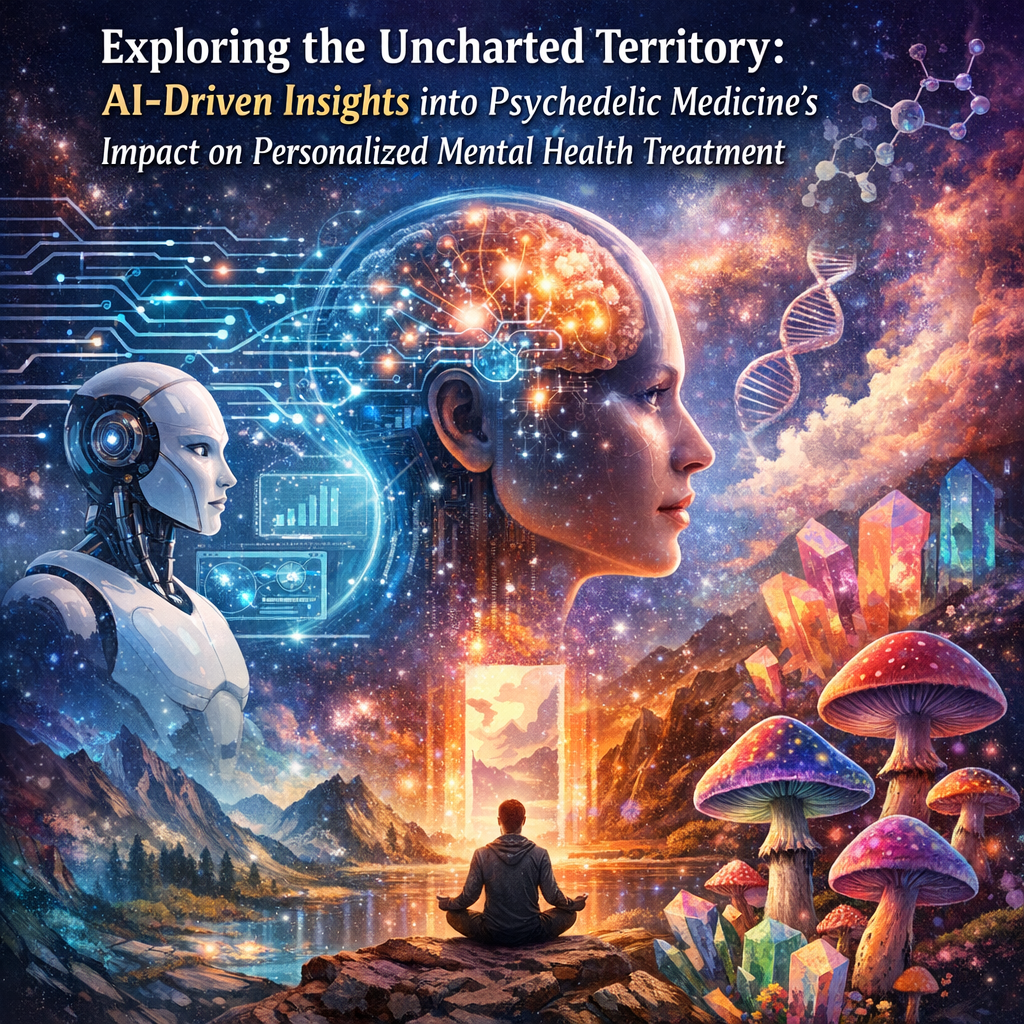
Exploring the Uncharted Territory: AI-Driven Insights into Psychedelic Medicine’s Impact on Personalized Mental Health Treatment
In recent years, the field of **mental health treatment** has seen a surge of interest in **psychedelic medicine**, particularly **psilocybin**, the active compound found in magic mushrooms. As societal perceptions shift and scientific curiosity grows, the potential therapeutic benefits of **psilocybin** and other psychedelic compounds are being reexamined under rigorous scientific scrutiny. At the forefront of this exploration are innovative technologies, such as **Artificial Intelligence (AI)**, which are offering groundbreaking insights into how these compounds can be used in personalized mental health treatment.
The integration of **AI** and **psychedelic medicine** is a relatively new concept but one that promises to revolutionize the way we approach mental health care. AI has the ability to process vast amounts of data much faster and more accurately than human researchers. This allows for the identification of patterns and correlations in clinical trial results, brain imaging studies, and patient responses to treatment that might otherwise go unnoticed. By leveraging AI, researchers are beginning to develop personalized psychedelic therapy protocols that cater to the unique genetic, psychological, and physiological profiles of individual patients.
**Psychedelic compounds**, such as **psilocybin**, have been shown to promote neuroplasticity and open pathways to profound psychological insights, making them promising candidates for treating conditions like **depression**, **PTSD**, **anxiety**, and **addiction**. However, the challenge lies in understanding which treatment approaches will be most effective for which patients. This is where **AI** plays a pivotal role. By analyzing patient data, AI can predict outcomes and optimize dosing and therapeutic settings, enhancing the efficacy and safety of **psychedelic therapies**.
The burgeoning field of **AI-driven psychedelic research** has already begun to bear fruit. Preliminary studies suggest that **AI** can help stratify patients based on their likelihood of responding to psychedelic treatments, thereby reducing trial-and-error prescribing. This not only accelerates the therapeutic process but also minimizes the risk of adverse effects and improves patient outcomes. As research continues, AI could become an indispensable tool in realizing the full potential of **psychedelic medicine** in mental health treatment.
Features: Professional and Medical Studies in AI and Psychedelic Research
A growing body of research supports the efficacy of **psychedelic compounds** in treating mental health disorders, with **AI** increasingly being used to augment this process. A landmark study by the Imperial College London demonstrated the potential of **psilocybin** in treating **depression**, revealing significant improvements in patients who had previously shown resistance to conventional treatments. In this study, brain imaging data revealed that **psilocybin** facilitated a reduction in neural network connectivity typically associated with depressive symptoms. **AI algorithms** are now being utilized to analyze this brain imaging data more comprehensively, identifying biomarkers that predict positive treatment responses.
Another promising study comes from the University of Zurich, where researchers are using **AI** to tailor psychedelic therapies to individual patients. **Machine learning models** have been employed to analyze genetic, behavioral, and imaging data to predict patient responses to psychedelics, allowing for more personalized and effective treatment plans.
In the United States, Johns Hopkins University continues to be a leader in psychedelic research. They have collaborated with **AI developers** to refine **psilocybin** treatment protocols, focusing on conditions such as PTSD and addiction. By employing **AI** to analyze large datasets from their clinical trials, researchers are discovering new insights into the optimal dosages and therapeutic settings necessary to maximize treatment efficacy.
**AI** is not only aiding in the development of personalized treatment plans but is also enhancing patient monitoring. **Wearable technology**, powered by **AI**, is being tested to provide real-time data on patient responses during and after psychedelic sessions, offering clinicians valuable insights that can inform ongoing treatment adjustments.
As more studies incorporate **AI** into psychedelic research, the potential for breakthroughs increases. This integration offers a promising avenue for addressing the complexities of mental health treatment, potentially paving the way for a new era of personalized, effective psychiatric care.
Conclusion
The intersection of **AI** and **psychedelic medicine** represents a pioneering frontier in personalized mental health treatment. By harnessing the power of **AI** to analyze vast datasets, researchers can unlock new insights into how psychedelic compounds like **psilocybin** affect the brain and, more importantly, how they can be tailored to meet the unique needs of individual patients. As this field continues to evolve, it holds the promise of transforming the landscape of mental health treatment, offering new hope for those who have not found relief through traditional therapies.
**Concise Summary**
The integration of Artificial Intelligence (AI) with psychedelic medicine such as psilocybin is transforming personalized mental health care. AI analyzes large clinical datasets to identify individual patient profiles, tailoring treatments for conditions like depression, PTSD, and anxiety more effectively. Institutions like Imperial College London, University of Zurich, and Johns Hopkins University are leading these research initiatives. AI helps refine treatment protocols, predict outcomes, personalize therapies, and monitor patient responses through wearable tech. This cutting-edge approach offers potential breakthroughs in mental health treatment by optimizing therapeutic strategies and reducing trial-and-error prescribing, ultimately enhancing patient outcomes.

Dominic E. is a passionate filmmaker navigating the exciting intersection of art and science. By day, he delves into the complexities of the human body as a full-time medical writer, meticulously translating intricate medical concepts into accessible and engaging narratives. By night, he explores the boundless realm of cinematic storytelling, crafting narratives that evoke emotion and challenge perspectives. Film Student and Full-time Medical Writer for ContentVendor.com