Neuroplasticity Beyond Psilocybin: The Next Frontier in Consciousness Medicine
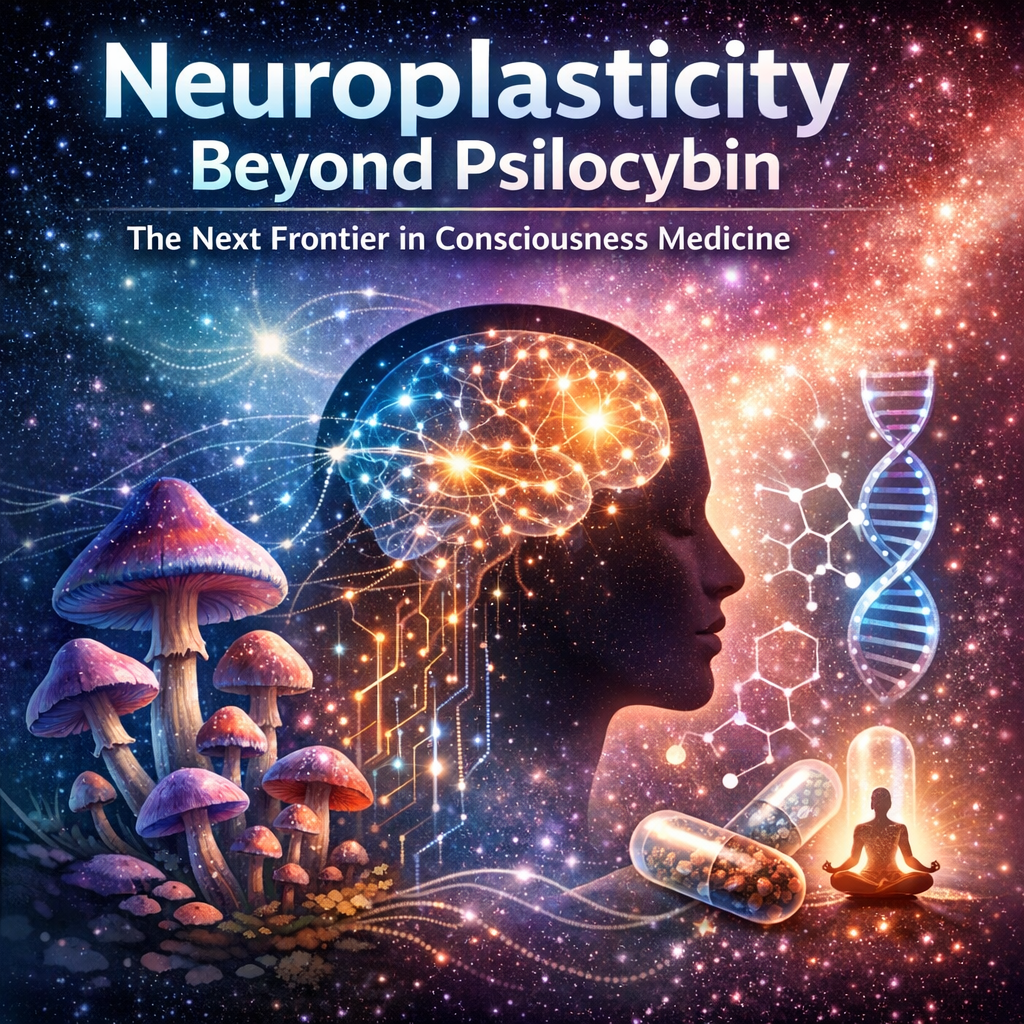
In recent years, **psilocybin**, the psychoactive compound found in certain **mushrooms**, has gained attention for its potential mental health benefits, particularly in promoting **neuroplasticity**. Neuroplasticity is the brain’s ability to reorganize by forming new neural connections. This capacity is crucial for learning, memory, and recovery from brain injuries. **Psilocybin** has shown potential in enhancing neuroplasticity, offering hope for treating conditions such as **depression**, **anxiety**, and **PTSD**.
However, as understanding of **consciousness medicine** progresses, researchers are keen to explore avenues beyond **psilocybin**. The next frontier includes a detailed examination of other **medicinal mushrooms** and natural compounds that might influence neuroplasticity. Thus, while **psilocybin** has been the centerpiece of recent psychedelic research, other lesser-known substances are emerging as potential allies in mental health treatment.
One of these substances is **Lion’s Mane mushroom** (Hericium erinaceus), praised for its **neuroprotective** properties. Preliminary studies suggest that **Lion’s Mane** may stimulate the production of **nerve growth factor (NGF)**, crucial in neuron growth, maintenance, and survival. By promoting nerve health and facilitating neuroplasticity, **Lion’s Mane** holds promise for enhancing cognitive function and protecting against neurological diseases.
Alongside **Lion’s Mane**, compounds such as **Bacopa monnieri**, a herb utilized in **Ayurvedic medicine**, are drawing scientific interest. **Bacopa** is believed to support brain function by modulating neurotransmitter systems and improving synaptic communication, enhancing neuroplasticity. Research indicates that **Bacopa** can improve memory and cognitive performance, especially among older adults.
Additionally, **curcumin**, the active ingredient in **turmeric**, has garnered attention for its anti-inflammatory and antioxidant properties. **Curcumin** is thought to promote neuroplasticity by activating **brain-derived neurotrophic factor (BDNF)**, a protein contributing to brain cell growth and maintenance. **Curcumin’s** potential to alleviate symptoms of depression and anxiety by enhancing neuroplasticity is under investigation. Curcumin’s role in alternative therapies is expanding, with new studies indicating its effectiveness in treating various disorders, including Alzheimer’s disease and chronic inflammatory conditions.
As the field evolves, innovative research is shifting focus from isolated compounds to **combination therapies** that leverage synergistic effects of various natural compounds. Integrative approaches that combine diet, lifestyle changes, and **medicinal mushrooms** are seen as viable pathways to optimizing mental health and enhancing neuroplasticity. These synergistic strategies may provide a holistic way to foster brain health, treat mental health disorders, and combat cognitive decline.
Features:
Several studies support the growing interest in neuroplasticity beyond **psilocybin**. A study published in the [Journal of Alzheimer’s Disease](https://www.j-alz.com/) in 2016 explored **Lion’s Mane’s** potential in cognitive function improvement. The double-blind, placebo-controlled study found that elderly participants who consumed **Lion’s Mane** extract demonstrated significant cognitive function improvements compared to the placebo group.
Another study in [“Phytotherapy Research”](https://www.onlinelibrary.wiley.com/journal/10991573) in 2013 investigated **Bacopa monnieri’s** effects on cognitive performance. The findings suggested that **Bacopa** improved memory retention and reduced anxiety, attributing these effects to enhanced neurotransmitter production and regulation.
**Curcumin’s** impact on neuroplasticity was illustrated in a 2018 study published in the [“American Journal of Geriatric Psychiatry”](https://www.ajgponline.org/). Research on adults aged 50 to 90 years without dementia found that those taking **curcumin** showed significant improvements in memory and attention span, related to increased **BDNF** levels.
Furthermore, novel delivery mechanisms, such as **liposomal delivery** and **nanotechnology**, are being explored to enhance the bioavailability and efficacy of these compounds. Bioavailability refers to the rate at which a substance is absorbed into the bloodstream. These novel methods ensure natural compounds effectively reach the brain, enhancing their therapeutic potential.
Studies are also investigating combinatory effects of different natural compounds. A 2020 study in [“Scientific Reports”](https://www.nature.com/srep) assessed a combined regimen of **Lion’s Mane** and **Bacopa**, finding improved cognitive function and neuroplasticity in rat models. Such findings highlight the promise of integrative therapeutic approaches leveraging synergistic effects of multiple compounds.
Conclusion:
In conclusion, while **psilocybin** has been at the forefront of consciousness medicine for its potential in promoting neuroplasticity, the horizon is widening. Emerging research on **Lion’s Mane**, **Bacopa monnieri**, and **curcumin** exemplifies a new frontier in understanding and treating mental health. As research on these natural compounds continues, their applications in improving cognitive function, enhancing mental health, and enriching lives seem limitless. By fostering a holistic approach embracing both ancient wisdom and modern science, the future of **consciousness medicine** is indeed promising.
**Concise Summary:**
The article explores advancements in consciousness medicine, focusing on enhancing neuroplasticity beyond **psilocybin**, currently known for its mental health benefits. Researchers are now investigating other substances such as **Lion’s Mane mushroom**, **Bacopa monnieri**, and **curcumin** for their neuroprotective properties. Studies have shown these compounds support brain function, improve memory, and combat cognitive decline. Innovative delivery methods and combination therapies are also being explored to maximize therapeutic potential. As research progresses, these natural compounds offer promising applications in mental health and cognitive function improvements.

Dominic E. is a passionate filmmaker navigating the exciting intersection of art and science. By day, he delves into the complexities of the human body as a full-time medical writer, meticulously translating intricate medical concepts into accessible and engaging narratives. By night, he explores the boundless realm of cinematic storytelling, crafting narratives that evoke emotion and challenge perspectives. Film Student and Full-time Medical Writer for ContentVendor.com