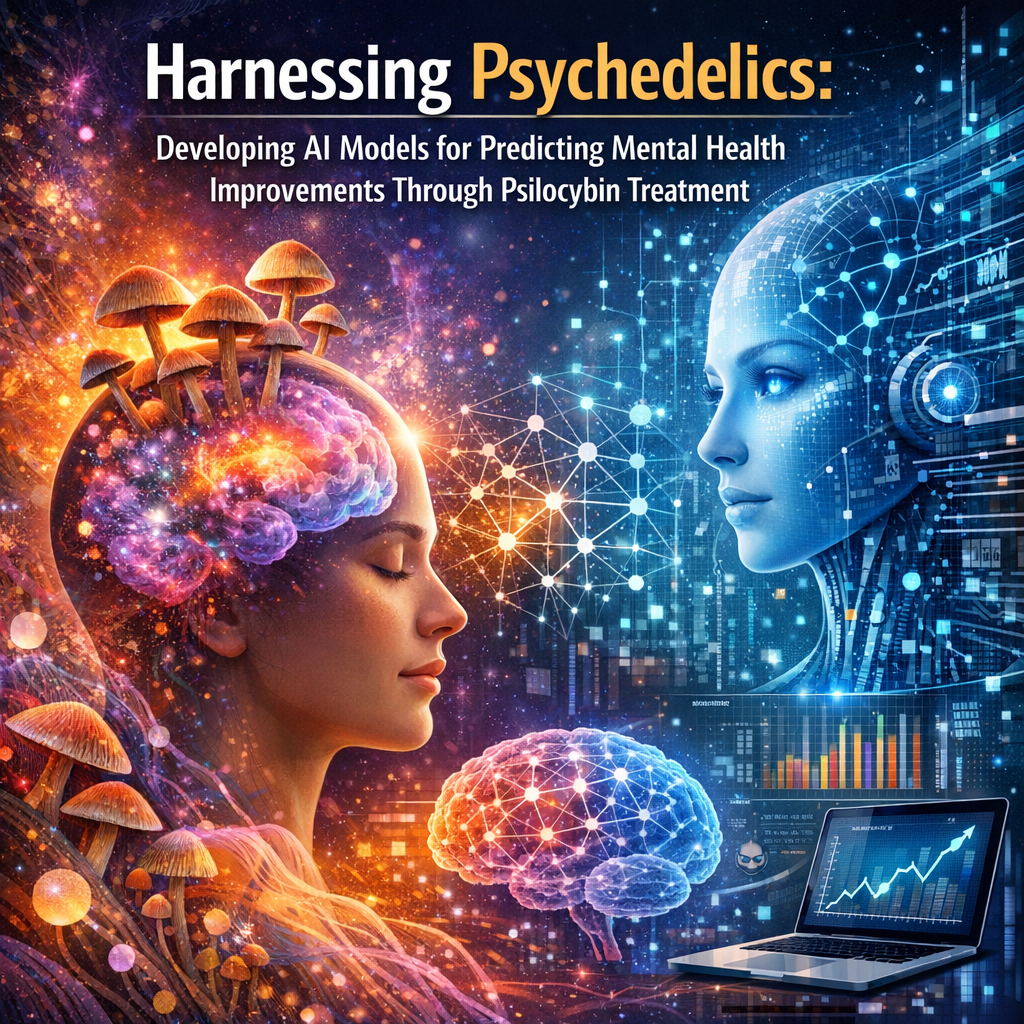
Harnessing Psychedelics: Developing AI Models for Predicting Mental Health Improvements Through Psilocybin Treatment
**In recent years**, the exploration of **psychedelics** as potential therapeutic treatments has taken center stage in both ***medical research*** and mainstream conversations. Among these substances, **psilocybin**—the active compound found in certain mushrooms—has captured significant attention for its potential to treat **mental health disorders**. As interest grows, researchers are employing **advanced technologies**, such as **artificial intelligence (AI)**, to better understand and predict the effects of psilocybin on mental health improvements.
**Psilocybin** has shown promise in treating various mental health conditions, including ***depression, anxiety, and PTSD***. However, individual responses to the compound can vary significantly, due to factors like ***genetics, mental health history, and environmental influences***. This is where **AI technology** steps in. By analyzing vast amounts of data from both clinical trials and personal accounts, AI models can identify ***patterns and predictors*** of ***successful psilocybin therapy***. These models may help **clinicians tailor treatments**, optimizing outcomes while minimizing risks.
The convergence of AI and ***psychedelic research*** signifies a cutting-edge evolution in mental health treatment strategies. AI’s ability to process complex datasets allows for a nuanced understanding of psilocybin’s effects across different populations. **Machine learning algorithms** can analyze participant characteristics and treatment responses, eventually leading to ***personalized therapy plans***. By predicting which individuals are most likely to benefit from psilocybin therapy, AI models enhance the precision of ***mental health care***, paving the way for more individualized and effective treatment protocols.
**This groundbreaking approach** also holds promise for destigmatizing ***psychedelic therapies***. As AI-based predictions gain credibility, they can provide a foundation for integrating psilocybin treatments into ***mainstream medicine***. This shift might reduce reliance on ***traditional pharmaceuticals***, offering alternative pathways for individuals seeking mental health support. As research progresses, the collaboration between AI technologies and psychedelic science could redefine our understanding of ***mental wellness***.
Features
A growing body of research underscores the potential for **psilocybin** to revolutionize mental health treatment. Notably, a study conducted by **Johns Hopkins Medicine** found that psilocybin produced ***substantial and sustained decreases*** in depression and anxiety among patients with ***life-threatening cancer diagnoses***. Participants in the study reported improvements in **mood** and ***general well-being***, some of which lasted more than six months following a single treatment session. The evidence suggests that the compound’s effects are both profound and enduring [Hopkins Medicine](https://www.hopkinsmedicine.org/news/newsroom/news-releases/hallucinogenic-mushroom-compound-psilocybin-reduced-depression-symptoms-in-participants-with-major-depressive-disorder-in-small-study).
In a separate, notable study led by **Imperial College London**, researchers discovered ***changes in brain activity patterns*** among treatment-resistant depression patients after two doses of psilocybin. These changes were similar to those observed with ***traditional antidepressant treatments*** but occurred ***more rapidly and with fewer side effects*** [Imperial College London](https://www.imperial.ac.uk/news/231537/psychedelic-psilocybin-changes-brain-connection-patterns/). The promise of such findings motivates ongoing exploration into the ***neurobiological mechanisms*** underpinning psilocybin’s therapeutic potential.
Researchers are also leveraging **AI** to delve deeper into psilocybin’s efficacy. AI models are being developed to predict outcomes by examining variables such as ***genetic markers, brain imaging data, and patient-reported experiences***. These models hold the potential to discern which individuals are likely to respond favorably to psilocybin therapy. For instance, a recent study at the **University of Toronto** utilized **machine learning algorithms** to analyze the effects of ***psychedelics on brain connectivity patterns***, proposing a correlation between distinct neural networks and therapeutic outcomes. By continually refining these models, researchers can develop more precise treatment plans, potentially enhancing recovery rates for those struggling with ***mental health disorders*** [University of Toronto](https://www.utoronto.ca/news/u-t-researchers-use-ai-model-brain-effects-psychedelics).
The intersection of AI and **psilocybin research** exemplifies a forward-thinking approach to mental health care. As predictive models improve, they promise to unlock the personalized potential of ***psychedelic therapy***, optimizing its benefits while minimizing risks. Leveraging AI in this way accelerates the integration of ***evidence-based psychedelic treatments*** into the realm of conventional medicine, providing hope for those seeking novel and effective mental health interventions.
Conclusion
The integration of **AI technology** with **psilocybin research** marks a significant leap towards ***personalized mental health care***. With the ongoing refinement of **AI models**, predicting individual responses to psilocybin could redefine therapeutic approaches, offering tailored treatments for those in need. This visionary intersection offers a promising avenue for improved mental health outcomes and reduced stigma surrounding ***psychedelic therapies***.
Concise Summary
The union of **AI technology** and **psilocybin research** represents a groundbreaking shift in mental health treatment, offering the potential for **personalized therapeutic approaches**. By analyzing extensive datasets, **AI models** can predict individual responses to psilocybin, optimizing mental health outcomes. Studies from **Johns Hopkins Medicine**, **Imperial College London**, and the **University of Toronto** illustrate psilocybin’s potential to treat conditions like depression, anxiety, and PTSD. This forward-thinking integration aims to reduce reliance on conventional **pharmaceuticals** while destigmatizing **psychedelic therapies**, providing hope for more effective mental health interventions.

Dominic E. is a passionate filmmaker navigating the exciting intersection of art and science. By day, he delves into the complexities of the human body as a full-time medical writer, meticulously translating intricate medical concepts into accessible and engaging narratives. By night, he explores the boundless realm of cinematic storytelling, crafting narratives that evoke emotion and challenge perspectives. Film Student and Full-time Medical Writer for ContentVendor.com