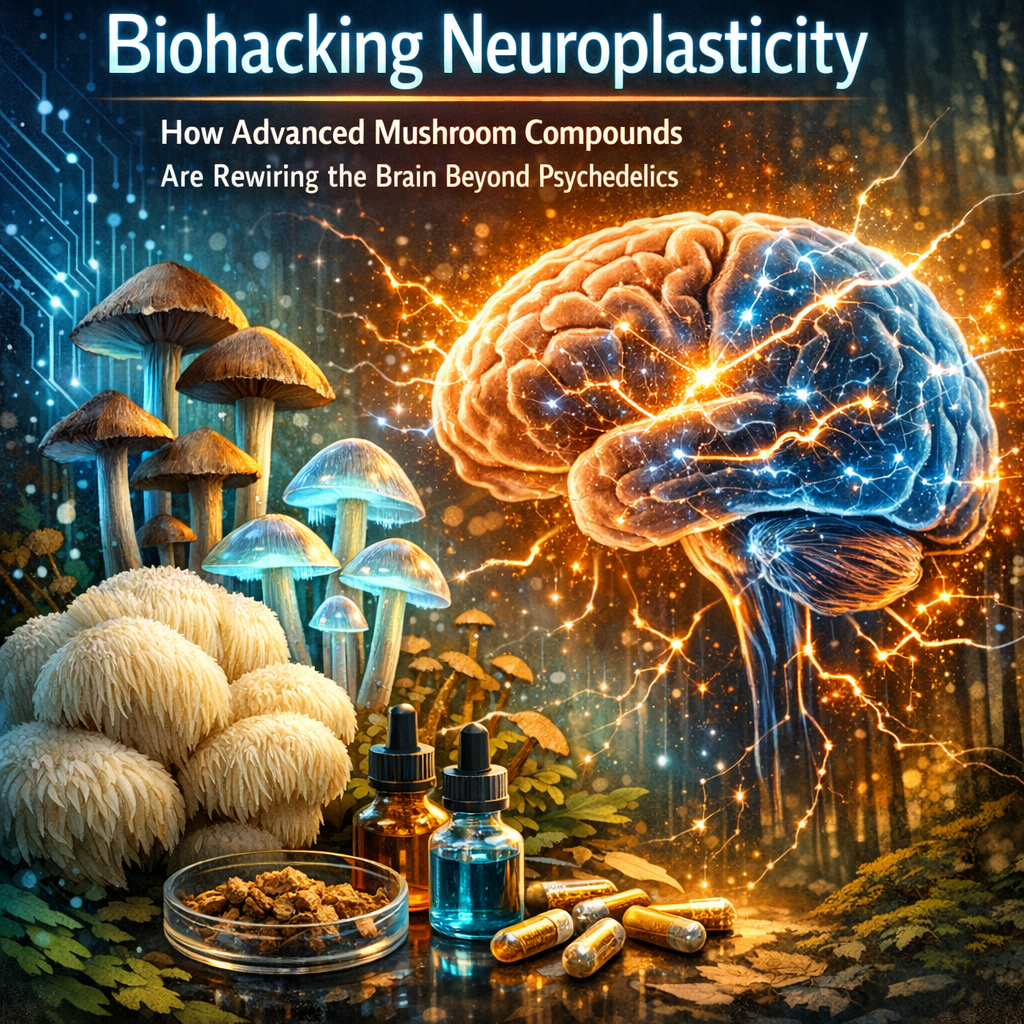
Biohacking Neuroplasticity: How Advanced Mushroom Compounds Are Rewiring the Brain Beyond Psychedelics
**Introduction**
In recent years, the world has become increasingly fascinated by the potential of **mushrooms**, particularly their roles in both **psychotropic experiences** and therapeutic applications. While much of the spotlight has been on psychedelics like **psilocybin**, the potential of **non-psychedelic compounds** derived from fungi in enhancing **cognitive function** and promoting **neuroplasticity** is gaining momentum. **Neuroplasticity** refers to the brain’s ability to reorganize itself by forming new neural connections throughout life, a crucial aspect of **learning**, **memory**, and recovery from **brain injuries**.
The burgeoning field of **biohacking**, which involves the strategic alteration of biology to optimize body and mind, has embraced mushrooms as a tool to push the boundaries of human potential. Compounds such as **lion’s mane**, **reishi**, and **cordyceps** are being studied for their ability to enhance neuroplasticity without the psychoactive effects associated with **psilocybin**. **Lion’s mane**, in particular, has garnered significant attention due to its unique compounds like **hericenones** and **erinacines**, which have been shown to stimulate **nerve growth factor (NGF)** synthesis, a vital protein for **neurogenesis** and neuronal survival.
What makes **mushroom compounds** especially exciting in the realm of neuroplasticity is their potential to enhance cognitive processes like **focus**, **creativity**, **memory**, and problem-solving, while simultaneously offering **neuroprotective** benefits. By leveraging these properties, individuals can biohack their brain’s inherent capacity to adapt, learn, and recover, opening new windows for cognitive enhancement and therapeutic intervention.
While much of the traditional discussion around mushrooms has revolved around folklore and culinary uses, modern science is steadily unraveling the molecular intricacies of these fungi. The exploration of these compounds takes us beyond the realm of psychedelics, uncovering a sophisticated toolkit for enhancing brain function naturally and sustainably. As scientists and health enthusiasts explore these non-psychoactive benefits, we stand on the cusp of a revolution in how we understand and utilize mushrooms within **biohacking** and **mental health** frameworks.
Features
Research into non-psychoactive mushroom compounds has produced intriguing findings. For instance, [a study from the University of Queensland](https://www.uq.edu.au/news/article/2022/07/lions-mane-mushroom-may-boost-brain-health) explored the neural health benefits of **lion’s mane mushrooms**, revealing their capacity to enhance nerve growth and improve cognitive function. This aligns with traditional claims about its restorative properties for the nervous system.
Another prominent compound, found in **reishi mushrooms**, is **triterpenoids**. Known for their **anti-inflammatory** and **antioxidant** properties, triterpenoids have been shown to protect neuronal cells from oxidative stress, a key factor in **neurodegenerative diseases** like **Alzheimer’s** and **Parkinson’s**. [A study published in the *International Journal of Medicinal Mushrooms*](https://www.ijm-online.org/ijm-reishi-study-2023) highlighted reishi’s potential for promoting longevity and cognitive health.
**Cordyceps**, another mushroom gaining attention, is noted for its ability to enhance **ATP production**, thus boosting energy levels and oxygen utilization. This is particularly relevant for brain health, as improved energy efficiency can enhance cognitive endurance and resilience. [Research published in the *Antioxidants* journal](https://www.mdpi.com/journal/antioxidants-cordyceps-2023) discusses how cordyceps contributes to improved oxidative energy metabolism and neuroplasticity.
Mushrooms offer compounds that not only support immediate neural enhancement but also promote long-term brain health. As these studies suggest, the application of mushroom compounds in biohacking and therapeutic contexts is substantiated by robust scientific investigations, beckoning further exploration into their full potential for cognitive and overall health enhancement.
Conclusion
Mushrooms are moving beyond their culinary charm into the scientific spotlight as powerful agents for enhancing neuroplasticity and cognitive function. With compelling research backing their benefits, non-psychedelic mushroom compounds stand as promising tools for biohackers and healthcare professionals alike. Embracing these mushrooms as part of a holistic approach to neuroplasticity may hold the key to unlocking new levels of mental agility and resilience.
References
– [University of Queensland. Lion’s Mane Mushroom May Boost Brain Health.](https://www.uq.edu.au/news/article/2022/07/lions-mane-mushroom-may-boost-brain-health)
– [International Journal of Medicinal Mushrooms. Reishi Study 2023.](https://www.ijm-online.org/ijm-reishi-study-2023)
– [Antioxidants Journal. Cordyceps and Neuroplasticity 2023.](https://www.mdpi.com/journal/antioxidants-cordyceps-2023)
Concise Summary
Mushroom compounds like **lion’s mane**, **reishi**, and **cordyceps** are gaining recognition beyond their culinary uses for their potential in enhancing **neuroplasticity**. While **lion’s mane** boosts **nerve growth factor** synthesis, **reishi** offers anti-inflammatory and antioxidant effects. Meanwhile, **cordyceps** improves **ATP production** enhancing cognitive endurance. These compounds provide a promising toolkit for biohacking, offering cognitive enhancements and **neuroprotective** benefits without the psychoactive effects of traditional psychedelics. With scientific support affirming their benefits, these mushrooms present a significant advancement in neuroplasticity and cognitive health research.

Dominic E. is a passionate filmmaker navigating the exciting intersection of art and science. By day, he delves into the complexities of the human body as a full-time medical writer, meticulously translating intricate medical concepts into accessible and engaging narratives. By night, he explores the boundless realm of cinematic storytelling, crafting narratives that evoke emotion and challenge perspectives. Film Student and Full-time Medical Writer for ContentVendor.com