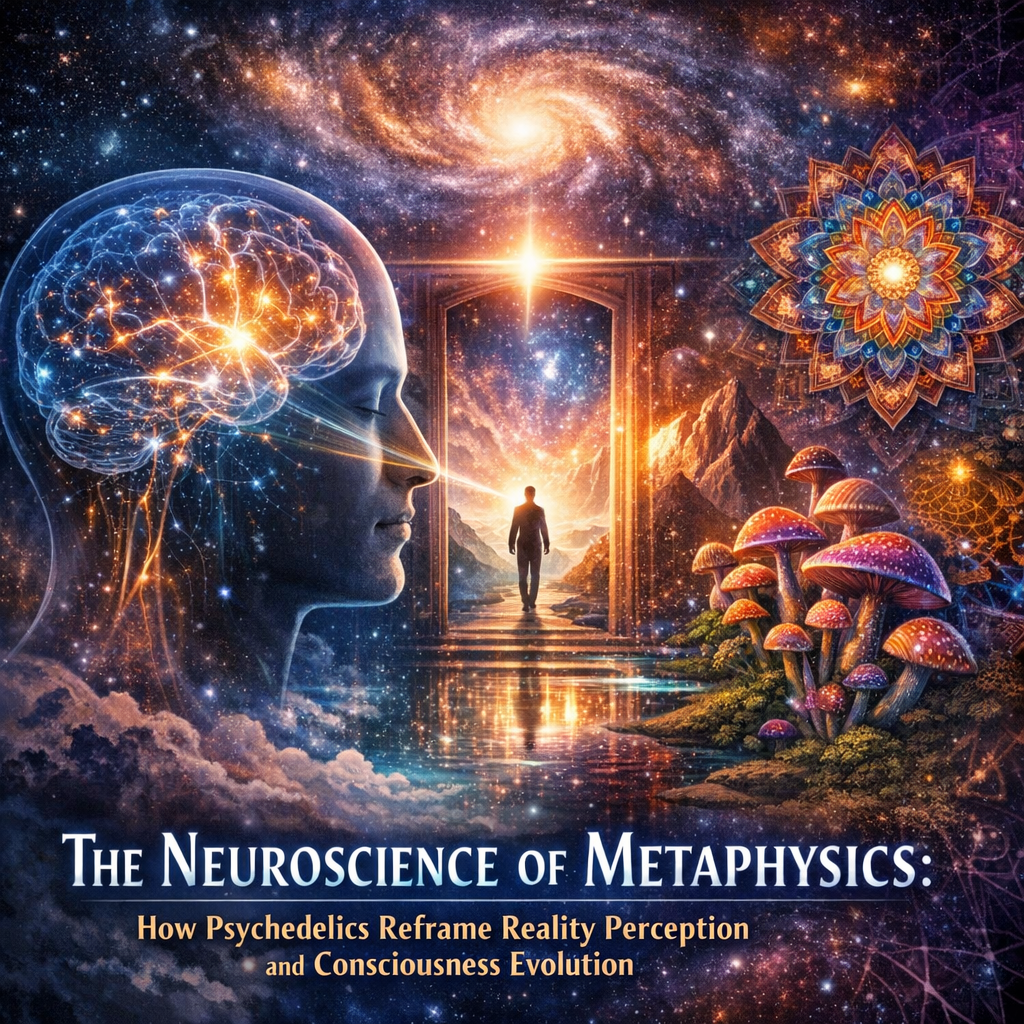
The Neuroscience of Metaphysics: How Psychedelics Reframe Reality Perception and Consciousness Evolution
Introduction
In recent decades, there has been a growing interest in the use of **psychedelics** like **psilocybin**, **LSD**, and **ayahuasca** to explore and potentially expand **human consciousness**. This quest, akin to humanity’s ancient pursuit of understanding the mysteries of existence, intersects with **metaphysics**—a philosophical domain pondering the fundamental nature of reality and existence. Modern **neuroscience** now provides a new lens to study how psychedelics can transform our **perception of reality** and foster an evolution in consciousness.
Psychedelics can induce profound alterations in perception, mood, and cognitive processes. Increasingly, these **substances** are recognized for their potential **therapeutic benefits** and ability to facilitate **mystical** and **transformative experiences**. The concept of metaphysics aligns closely with the experiences many individuals report under the influence of psychedelics. Users often describe feelings of interconnectedness, the dissolution of ego, and an expanded sense of awareness that challenge the everyday perception of self and the world.
At the heart of these experiences lies the brain, a complex organ central to our grasp of consciousness yet still not fully understood. Psychedelics’ role in altering brain activity brings us to the cutting-edge field of the neuroscience of metaphysics. By studying brain wave patterns, neural connectivity, and changes in neurotransmitter systems, scientists are uncovering how these substances might unlock new dimensions of reality and consciousness.
The study of psychedelics is more than a curiosity; it holds potential implications for **psychology**, **spirituality**, and **mental health**. As researchers delve into this exciting frontier, they bring new insights into how these substances can influence the mind’s perception of reality, potentially leading to personal growth and healing. This is encouraging for those seeking alternative treatments for psychological disorders and anyone interested in broader philosophical questions of existence.
Features
Research into psychedelics has progressed with advancements in **neuroimaging techniques** and clinical trials. A landmark study conducted by **Carhart-Harris et al.** at Imperial College London utilized **functional magnetic resonance imaging (fMRI)** to observe the effects of psilocybin on brain activity. Results showed a significant reduction in activity within the **default mode network (DMN)**, associated with self-referential thought processes and ego. This temporary deactivation is believed to lead to experiences commonly reported during psychedelic sessions, such as **ego dissolution** and sensations of transcending one’s physical existence.
In addition to imaging studies, several **clinical trials** have highlighted the potential of psychedelics in treating **mental health disorders**. A study published in the journal [“Psychopharmacology”](https://link.springer.com/article/10.1007/s00213-019-05252-y) found that psilocybin-assisted therapy led to substantial reductions in **treatment-resistant depression** symptoms, with effects lasting longer than traditional antidepressants. Similarly, a **Johns Hopkins University** study showed that a single session of psilocybin significantly decreased **anxiety** and **depression** among patients with life-threatening cancer diagnoses.
Moreover, psychedelics’ capacity to evoke **mystical-type experiences** has been examined for their effects on **spirituality** and **well-being**. A double-blind, placebo-controlled study found that participants given psilocybin reported a greater sense of purpose and life satisfaction, elements often associated with spiritual well-being. These experiences have been characterized as deeply interconnected, with profound insights into the self and reality, indicating potential for long-term psychological growth and understanding.
As interest in psychedelics and their potential benefits grows, so does the research supporting their safe and productive use in controlled, therapeutic settings. However, it is crucial to acknowledge that while promising, psychedelics are powerful substances that demand respect and caution. Ongoing studies continue to unravel their nuanced mechanisms, offering a rich understanding that weaves together the threads of neuroscience and metaphysics.
Conclusion
The convergence of neuroscience and metaphysics through the study of psychedelics is paving the way for a deeper understanding of reality and consciousness. By altering brain function, these compounds open the door to transformative experiences that question conventional perceptions of existence. As scientific inquiry progresses, the therapeutic and philosophical implications of psychedelics unfold, revealing new avenues for personal exploration and healing. With careful research, we may find ourselves on the cusp of a revolution in consciousness, transcending the physical and ushering in a new era of holistic understanding.
References
1. [“Carhart-Harris et al.”](https://www.nature.com/articles/s41598-019-54868-0): “Neural correlates of the LSD experience revealed by multimodal neuroimaging” – Scientific Reports.
2. [“Psychopharmacology Study”](https://link.springer.com/article/10.1007/s00213-019-05252-y): “Psilocybin-assisted therapy for depression: insights from epidemiology and neurobiology.”
3. [“Johns Hopkins University”](https://maps.org/2016/09/06/jhu-psychedelic-research-unit-publishing-major-findings-on-psilocybin-and-anxiety-depression/): “Psilocybin produces substantial and sustained decreases in depression and anxiety in patients with life-threatening cancer.”
4. [“Placebo-Controlled Study”](https://journals.sagepub.com/doi/10.1177/0269881116675513): “Psilocybin occasioned mystical-type experiences: immediate and persisting dose-related effects” – Journal of Psychopharmacology.
—
**Concise Summary:**
The convergence of neuroscience and metaphysics is unfolding new understandings of reality and consciousness through the lens of psychedelics like psilocybin and LSD. These substances alter brain activity, leading to ego dissolution and transformative perceptions, and are being studied for their therapeutic potential in treating mental health disorders. As advances continue in neuroimaging and clinical trials, psychedelics are increasingly seen as having possible benefits in psychology, spirituality, and personal growth, although their powerful effects require careful application.

Dominic E. is a passionate filmmaker navigating the exciting intersection of art and science. By day, he delves into the complexities of the human body as a full-time medical writer, meticulously translating intricate medical concepts into accessible and engaging narratives. By night, he explores the boundless realm of cinematic storytelling, crafting narratives that evoke emotion and challenge perspectives. Film Student and Full-time Medical Writer for ContentVendor.com