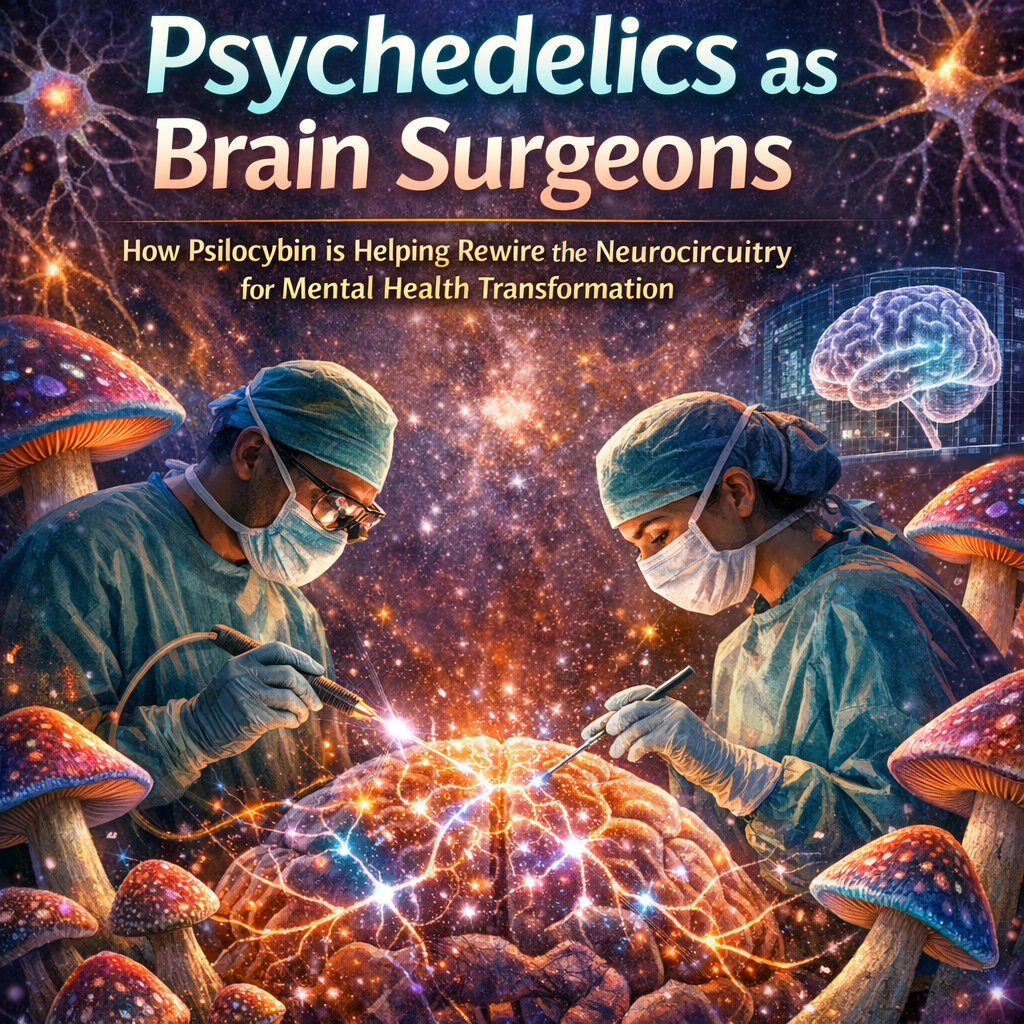
Psychedelics as Brain Surgeons: How Psilocybin is Helping Rewire the Neurocircuitry for Mental Health Transformation
Introduction
In recent years, scientific interest in **psychedelics** has surged, with **psilocybin** emerging as a particularly promising candidate for the treatment of various **mental health disorders**. Historically, psilocybin—the active compound found in several species of mushrooms—has been used by **indigenous cultures** for spiritual and therapeutic purposes. Today, it is gaining recognition among medical professionals as a potential game-changer in **mental health treatment**.
Psilocybin’s transformative potential lies in its unique ability to interact with the brain’s **neural circuits**. More than simply altering perceptions, this compound facilitates an environment conducive to **neuroplasticity**; the brain’s ability to reorganize itself by forming new neural connections throughout life. This characteristic is crucial in treating mental health conditions like **depression**, **anxiety**, and **post-traumatic stress disorder (PTSD)**, where rigid or maladaptive neural patterns often play a critical role.
What differentiates psilocybin from traditional treatment options is its mechanism of action on the brain. It primarily affects **serotonin receptors**, particularly the **5-HT2A receptor**, significantly influencing mood, cognition, and perception. By stimulating these receptors, psilocybin induces a state of **heightened connectivity** between different brain regions. This state often leads to a deep, transformative introspective experience, assisting patients in reconceptualizing negative thought patterns and forming healthier ones.
Furthermore, clinical trials have begun to underline the sustained impact of psilocybin therapy. Unlike traditional antidepressants or anti-anxiety medications that require ongoing use, a single session of **psilocybin-assisted therapy** can yield enduring results. Many participants in studies report decreased symptoms of depression and anxiety for months following treatment. This has led researchers to propose that **psilocybin** could offer a paradigm shift in how we approach **mental health treatment**, focusing more on episodic, intensive interventions rather than chronic medication use.
Features
Recent professional and medical studies have illuminated psilocybin’s potential for profound **mental health improvements**, making it one of the most compelling topics in contemporary psychiatry. One pivotal study conducted by researchers at [Johns Hopkins University](https://www.hopkinsmedicine.org/news/newsroom/news-releases/johns-hopkins-researchers-involved-in-groundbreaking-psilocybin-study) revealed that psilocybin has substantial effects on the treatment of **major depressive disorder**. Their double-blind study concluded that psilocybin-facilitated therapy led to marked improvements in depression symptoms for more than half of the participants, with sustained effects in follow-ups.
Further supporting these findings, a comprehensive study published in the [New England Journal of Medicine](https://www.nejm.org/doi/full/10.1056/NEJMoa2032994) compared psilocybin with a leading **SSRI antidepressant** for treating depression. The study found that both treatments had comparable positive effects, with psilocybin providing faster relief. These results are particularly significant given the slow onset and often limited effectiveness of traditional antidepressants.
Another critical area of exploration has been psilocybin’s impact on patients with **PTSD**. Research from [Imperial College London](https://www.imperial.ac.uk/news/219046/psilocybin-for-ptsd-researchers-secure-first/) demonstrated significant reductions in PTSD symptoms following psilocybin therapy sessions. Patients reported a newfound ability to process traumatic memories and emotions, which they attributed to the enhanced psychological flexibility facilitated by the compound.
The mechanism behind these transformations is attributed to the temporary “rewiring” of brain networks, observed via brain scans of individuals under the influence of psilocybin. These scans show increased communication between normally unconnected neural pathways, promoting a mental state that can foster emotional release and cognitive insight. This unique property allows psilocybin to disrupt entrenched patterns of brain activity, often associated with negative mental health states, enabling sufferers to rewrite their neurocircuitry with healthier patterns.
Conclusion
As the body of evidence supporting psilocybin’s therapeutic potential continues to grow, there is increasing hope that this naturally-occurring compound could revolutionize **mental health treatment**. Reimagining psilocybin as a ‘brain surgeon’ invites a groundbreaking perspective on treating **mental disorders**, offering the promise of healing by reviving the brain’s inherent capacity for change and growth. As research progresses, embracing psychedelics in clinical settings may not only reduce reliance on traditional medications but also redefine what it means to manage mental health long-term.
Concise Summary
The exploration of **psilocybin** in mental health treatment is revealing its potential to enhance **neuroplasticity**, aiding in the treatment of **depression**, **anxiety**, and **PTSD**. Through interaction with **serotonin receptors**, it boosts brain connectivity, offers transformative experiences, and helps reconceptualize negative patterns. Unlike traditional antidepressants, a single session shows long-term benefits. Key studies, including those by [Johns Hopkins University](https://www.hopkinsmedicine.org/news/newsroom/news-releases/johns-hopkins-researchers-involved-in-groundbreaking-psilocybin-study) and [Imperial College London](https://www.imperial.ac.uk/news/219046/psilocybin-for-ptsd-researchers-secure-first/), underscore its efficacy, suggesting a paradigm shift towards episodic, intensive treatments over chronic medication use.

Dominic E. is a passionate filmmaker navigating the exciting intersection of art and science. By day, he delves into the complexities of the human body as a full-time medical writer, meticulously translating intricate medical concepts into accessible and engaging narratives. By night, he explores the boundless realm of cinematic storytelling, crafting narratives that evoke emotion and challenge perspectives. Film Student and Full-time Medical Writer for ContentVendor.com