Psychedelic Neuroadaptation: How Psilocybin Reshapes the Brain’s Default Mode Network for Long-Term Mental Health
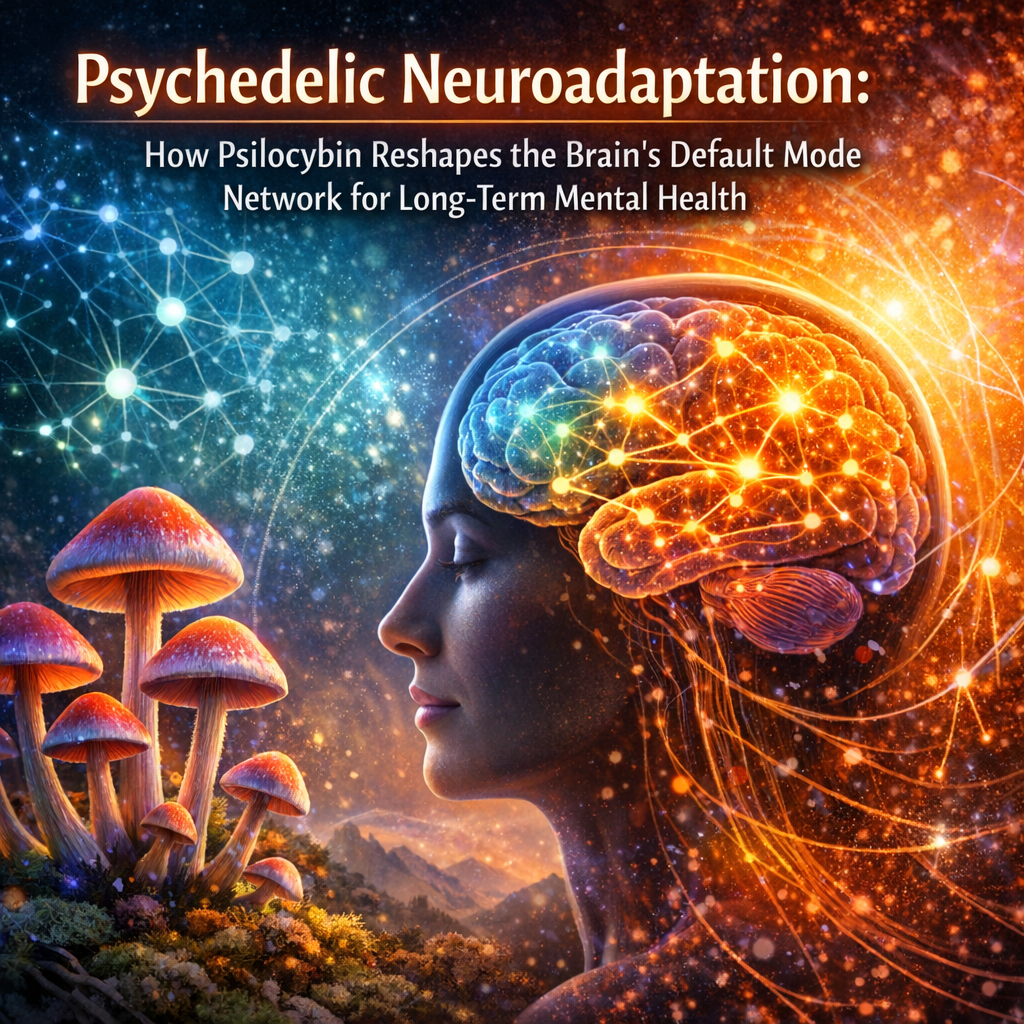
In recent years, the resurgence of **psychedelic research** has opened new avenues for exploring **mental health treatments**. Among the most promising compounds in this realm is **psilocybin**, a naturally occurring psychedelic found in certain species of mushrooms. Psilocybin’s profound impacts on the brain, particularly its interaction with the **Default Mode Network (DMN)**, are capturing the attention of researchers and healthcare professionals alike. The DMN is a network of interconnected brain regions that become active during rest and self-referential thought processes. It is the mind’s “wandering mode,” engaged during introspection, daydreaming, or constructing self-related narratives.
Studies have shown that abnormalities in DMN activity are associated with various **mental health conditions**, including **depression**, **anxiety**, and **post-traumatic stress disorder (PTSD)**. Individuals suffering from these disorders often experience excessively active or improperly synchronized DMNs, leading to persistent negative thought patterns and rumination. Psilocybin, interestingly, has been found to temporarily disrupt the normal functioning of the DMN, creating a window of opportunity for neuroadaptive processes that can facilitate long-term mental health improvements.
When psilocybin influences the DMN, it decreases rigid, habitual thinking patterns and allows for increased connectivity between brain regions that typically do not communicate extensively. This leads to a unique state of fluidity and openness, where entrenched mental frameworks can be reassessed or dismantled. Patients often report experiencing a renewed sense of openness, emotional release, and enhanced creativity following psilocybin sessions.
The alteration of this dynamic can lead to profound shifts in perception and cognition, allowing individuals to break free from mental ruts and adopt new, healthier patterns of thinking. As more people seek alternatives to conventional psychiatric medications, understanding psilocybin’s effects on the DMN and its implications for mental health treatment has become critical. By reshaping how the brain processes information and views the self, psilocybin holds promise as a therapeutic tool, especially for those who have not found relief through traditional means.
Features: Recent Studies and Scientific Insights
The scientific curiosity surrounding psilocybin has led to numerous studies examining its effects on the brain and its therapeutic potential. A noteworthy study conducted by Carhart-Harris et al. in 2012 used **fMRI technology** to observe the effects of psilocybin on the DMN. The findings indicated a marked decrease in DMN activity, which was correlated with participants’ reports of “ego dissolution” and transcendental experiences [source](https://journals.sagepub.com/doi/abs/10.1177/0269881114568042). Such experiences are believed to allow individuals to break free from rigid self-concepts and habitual thought patterns, creating space for mental and emotional growth.
Another pivotal study published in 2016 in **The Lancet**, by researchers from Imperial College London, explored psilocybin’s effects on individuals with **treatment-resistant depression**. Participants received two doses of psilocybin and reported significant reductions in depressive symptoms, persisting for weeks post-treatment [source](https://www.thelancet.com/journals/lanpsy/article/PIIS2215-0366(16)30065-7/fulltext). Functional MRI scans revealed that changes in DMN connectivity correlated with improvements in depression, suggesting that psilocybin’s ability to reset the DMN may underpin its **antidepressant** effects.
In 2020, **Johns Hopkins Medicine** published a follow-up study demonstrating that psilocybin therapy resulted in substantial and sustained declines in depression and anxiety among **cancer patients**, even six months after treatment [source](https://journals.sagepub.com/doi/full/10.1177/2164956120915723). This study emphasized the potential for psilocybin to bring about enduring improvements in mental health, likely through its modulatory effects on the DMN.
Collectively, these studies underscore psilocybin’s potential to transform mental health treatment paradigms, particularly for individuals resistant to conventional therapies. By modulating the DMN, psilocybin fosters a conducive environment for psychological healing and reframes how the brain processes self-related thoughts.
Conclusion
In conclusion, psilocybin’s ability to reshape the brain’s **Default Mode Network** presents a paradigm shift in mental health treatment. It offers a novel therapeutic avenue for individuals grappling with entrenched psychiatric conditions. As scientific exploration continues, psilocybin may become an integral part of mental health care, providing profound, long-lasting benefits where traditional treatments fall short. Embracing this potential requires a holistic understanding of psychedelics and a commitment to responsible, ethically guided research.
**Concise Summary**
Psilocybin, a naturally occurring psychedelic, significantly impacts the **brain’s Default Mode Network (DMN)**, pivotal for mental health treatment. It disrupts rigid thinking patterns and fosters new neural connections, aiding conditions like depression and PTSD. Studies demonstrate that psilocybin decreases DMN activity, promotes ego dissolution, and enhances emotional release. This neuroadaptation leads to enduring improvements, particularly for those unreceptive to conventional therapies. As research advances, psilocybin promises a paradigm shift in mental health care, opening avenues for those seeking alternatives to traditional medications.

Dominic E. is a passionate filmmaker navigating the exciting intersection of art and science. By day, he delves into the complexities of the human body as a full-time medical writer, meticulously translating intricate medical concepts into accessible and engaging narratives. By night, he explores the boundless realm of cinematic storytelling, crafting narratives that evoke emotion and challenge perspectives. Film Student and Full-time Medical Writer for ContentVendor.com