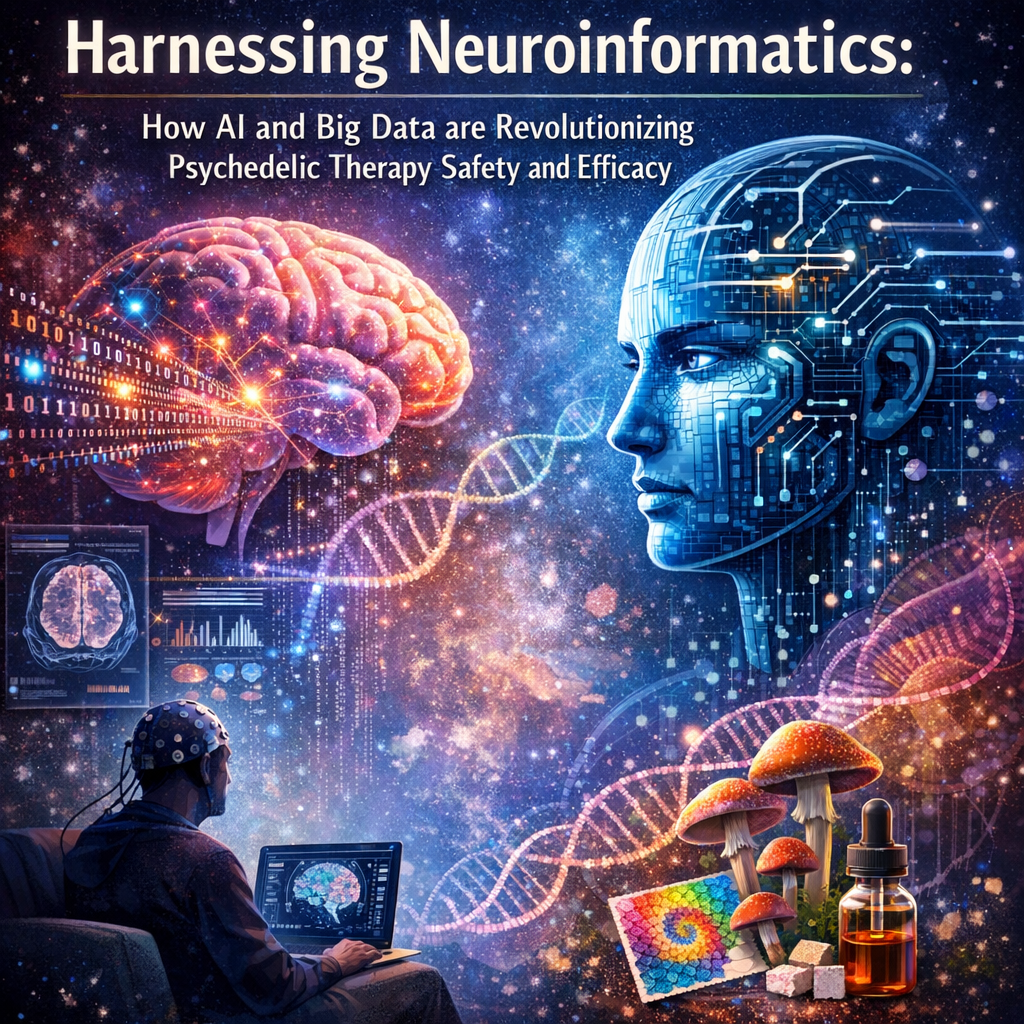
Harnessing Neuroinformatics: How AI and Big Data are Revolutionizing Psychedelic Therapy Safety and Efficacy
Introduction
**Psychedelic therapy**, particularly the use of **psilocybin** and other naturally occurring compounds found in mushrooms, has been gaining attention for its potential to treat a myriad of mental health conditions, including **depression**, **anxiety**, **PTSD**, and **addiction**. While the therapeutic potential is promising, a significant concern is the **safety** and **efficacy** of these treatments. This is where **neuroinformatics**, through the use of **artificial intelligence (AI)** and **big data**, steps in to unveil new frontiers in psychedelic therapy.
Neuroinformatics combines **neuroscience** with **informatics**, leveraging vast data sets to understand how psychedelic substances interact with the brain. AI technologies play a pivotal role in analyzing these complex interactions by processing volumes of data that are beyond human capabilities. By mapping **neural circuits** activated by psychedelics, AI can predict therapeutic outcomes, side effects, and optimal dosages for individual patients.
**Big data analytics** transforms the understanding of patient responses to psychedelic therapy. Clinical trials and observational studies involving diverse populations generate colossal amounts of data. Mining this data provides insights into effective integration of psychedelics in treatment protocols.
Moreover, **AI-driven algorithms** can help in personalizing psychedelic therapy. Each individual’s brain responds differently to psychedelics, much like fingerprints. AI can analyze a patient’s history, genetic makeup, and mental health records to custom-tailor interventions.
As societal stigma around psychedelics diminishes, the alliance between **neuroinformatics** and psychedelic therapy promises a paradigm shift. Combined with **AI** and **big data**, these technologies enhance our grasp on safe, effective use in clinical settings.
Features
Several professional and medical studies underpin the swift advancements in psychedelic therapy. A significant study by **Imperial College London** examines how neuroinformatics helps decode neural mechanisms activated by psychedelics. They developed **AI models** to analyze **fMRI scans** of patients administered with psilocybin, successfully predicting changes in network connectivity within the brain’s **default mode network**. This finding is instrumental in understanding the “reset” mechanism in treating depression. [Imperial College Study](https://www.imperial.ac.uk)
**Johns Hopkins Medicine** has shown interest in deploying **data science** techniques to track patient data from **clinical trials** involving psychedelics. Analyzing this data helps substantiate claims of improved mental health outcomes and identify patient-specific factors. [Johns Hopkins Research](https://www.hopkinsmedicine.org)
Companies like **Mindstrong Health** are pioneering **AI-powered** mental health platforms using data from smart devices to gain real-time insights into a patient’s cognitive state. This technology could integrate with psychedelic therapy for dynamic monitoring and adaptation. [Mindstrong Health](https://mindstronghealth.com)
**Big data** in mapping the human microbiome opens pathways to understanding how the **gut-brain axis** affects responses to psychedelics. AI technologies help tailor dietary and therapeutic measures, enhancing effectiveness and safety.
Conclusion
The intersection of **neuroinformatics**, **AI**, and **big data** heralds a visionary era for psychedelic therapy, offering improved safety, efficacy, and personalized treatment plans. These technologies promise to refine the use of psychedelics in mental health care.
References
1. [Imperial College Study on Psychedelics](https://www.imperial.ac.uk)
2. [Johns Hopkins Research on Psychedelic Trials](https://www.hopkinsmedicine.org)
3. [Mindstrong Health AI Platforms](https://mindstronghealth.com)
Concise Summary
The **integration of neuroinformatics** with **AI** and **big data** is transforming **psychedelic therapy**, offering improved safety and efficacy in treating mental health conditions like depression and PTSD. Studies from institutions like **Imperial College London** and **Johns Hopkins Medicine** highlight AI’s ability to predict therapeutic outcomes and personalize treatments. By analyzing vast data sets, researchers can refine protocols and mitigate risks, paving the way for a new era in mental health care where psychedelics become a safe, effective, and personalized treatment option.

Dominic E. is a passionate filmmaker navigating the exciting intersection of art and science. By day, he delves into the complexities of the human body as a full-time medical writer, meticulously translating intricate medical concepts into accessible and engaging narratives. By night, he explores the boundless realm of cinematic storytelling, crafting narratives that evoke emotion and challenge perspectives. Film Student and Full-time Medical Writer for ContentVendor.com