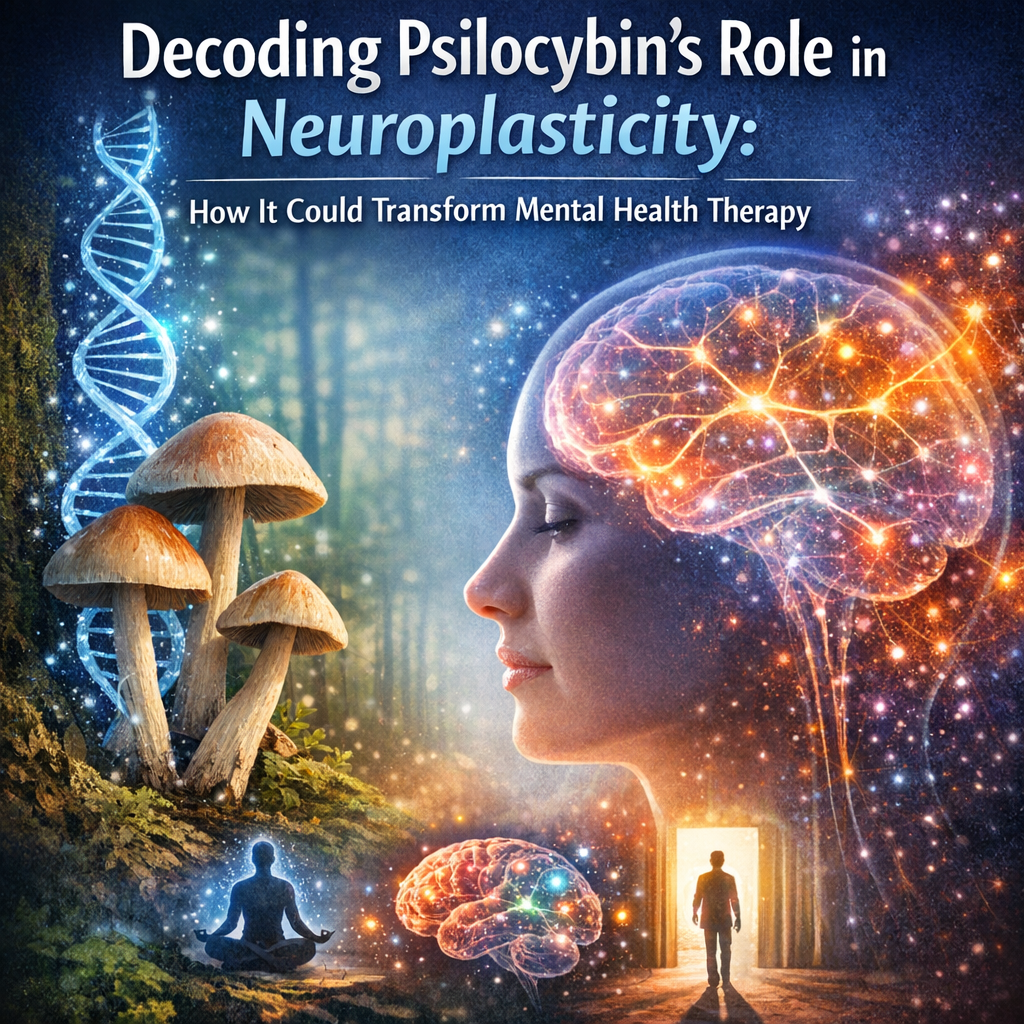
Decoding Psilocybin’s Role in Neuroplasticity: How It Could Transform Mental Health Therapy
Introduction
**Psilocybin**, the psychoactive compound found in certain species of mushrooms, has a storied history. Traditionally used in religious and spiritual rituals by indigenous cultures, it has been catapulted into the spotlight of modern **science** for its potential therapeutic benefits. In recent years, the exploration of psilocybin’s role in **mental health treatment** has moved from the fringes of psychedelic science to the forefront of **neuropharmacology** and **psychiatry**. A critical area of interest is its impact on **neuroplasticity**, the brain’s ability to reorganize itself by forming new neural connections throughout life. Neuroplasticity is a fundamental aspect of how we learn, adapt, and recover from brain injuries. However, its role extends significantly into mental health, affecting conditions such as **depression**, **anxiety**, **PTSD**, and **addiction**.
The limitations of traditional mental health therapies, including medications like **SSRIs**, have prompted researchers to seek alternative treatments. Unlike conventional antidepressants that can take weeks to show results, psilocybin has demonstrated potential for producing rapid, enduring changes in mood and cognition. Intriguingly, these effects seem to be closely linked with enhanced neuroplasticity induced by psilocybin exposure. At a molecular level, psilocybin interacts with **serotonin receptors** in the brain, notably the **5-HT2A receptor**, which is heavily implicated in the regulation of **mood** and **perception**. This interaction appears to trigger a cascade of neurochemical events that culminate in increased **synaptogenesis**—the formation of new synaptic connections. Consequently, psilocybin might effectively “reboot” certain cognitive processes, potentially offering new pathways for alleviating symptoms of mental illness. Given the growing mental health crisis worldwide, a deeper understanding of how psilocybin can enhance neuroplasticity could revolutionize therapeutic approaches, offering hope to millions grappling with conditions resistant to current treatment modalities.
Features
Several professional and medical studies underscore the transformative potential of psilocybin in enhancing neuroplasticity. A pioneering study published in *Cell Reports* in 2018 by Ly et al. revealed that psychedelics, including psilocybin, promote the growth of **dendritic spines**, the small protrusions on neurons that facilitate synaptic communication. This study highlighted the rapid and sustained increase in dendritic spine density following a single dose of psilocybin, suggesting a possibility for long-term improvements in neural connectivity and mental health outcomes [Cell Reports](https://www.cell.com/cell-reports/fulltext/S2211-1247(18)30863-7).
Furthermore, a randomized clinical trial conducted at **Johns Hopkins University** found that psilocybin significantly reduced depression and anxiety symptoms in patients with life-threatening cancer. Published in *The Journal of Psychopharmacology*, the trial demonstrated that these effects were not only significant but also lasting, with reductions in depression sustained for up to six months post-treatment. This suggests that psilocybin’s impact is not a momentary alteration of perception but a durable transformation that may stem from enhanced neuroplasticity [Journal of Psychopharmacology](https://journals.sagepub.com/doi/full/10.1177/0269881116675512).
In another notable study, researchers at **Imperial College London** used fMRI imaging to observe psilocybin’s effects on the brain. Their findings, published in *NeuroImage*, showed that psilocybin led to desynchronization of the **default mode network (DMN)**, a group of brain regions often associated with self-referential thoughts and rumination. The disruption of DMN activity, which is frequently overactive in depression, could promote new patterns of thought and increase cognitive flexibility, relevant to neuroplasticity [NeuroImage](https://www.sciencedirect.com/science/article/pii/S1053811917302627).
Together, these studies suggest that psilocybin may offer a novel mechanism to address mental health disorders through its positive influence on neuroplasticity. The evidence indicates potential utility not only in depression but across various psychiatric ailments, providing a fresh frontier in the treatment of mental health.
Conclusion
The promise of psilocybin as a facilitator of enhanced neuroplasticity is not just an intoxicating notion but one solidified by emerging evidence. As research continues, psilocybin could become a cornerstone in transforming approaches to mental health therapy, providing patients with new hope through neuroplastic rejuvenation. With further validation and understanding, psilocybin may well herald a new era in psychiatric treatment, marking an evolution in how we perceive and treat mental anguish.
**Concise Summary:** Psilocybin, a compound in certain mushrooms, shows promise in enhancing neuroplasticity, which could revolutionize mental health therapy. Unlike traditional treatments, psilocybin offers rapid, durable mood changes by interacting with serotonin receptors and promoting synaptogenesis. Studies highlight its potential in treating depression, anxiety, and other psychiatric conditions by strengthening neural connections and altering brain dynamics. As research progresses, psilocybin may become a key player in mental health treatment, offering new hope for patients resistant to conventional therapies.

Dominic E. is a passionate filmmaker navigating the exciting intersection of art and science. By day, he delves into the complexities of the human body as a full-time medical writer, meticulously translating intricate medical concepts into accessible and engaging narratives. By night, he explores the boundless realm of cinematic storytelling, crafting narratives that evoke emotion and challenge perspectives. Film Student and Full-time Medical Writer for ContentVendor.com