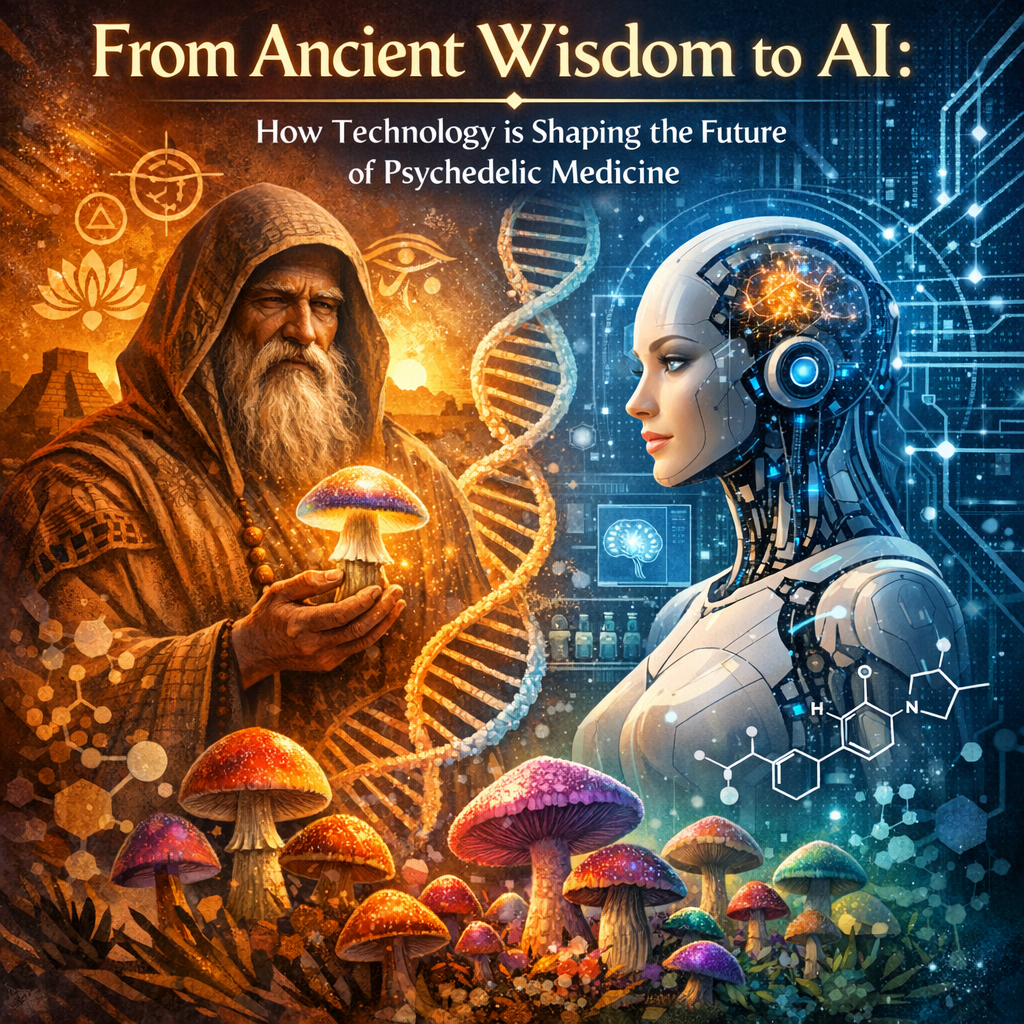
From Ancient Wisdom to AI: How Technology is Shaping the Future of Psychedelic Medicine
Introduction
For centuries, the use of **psychedelic substances** like **psilocybin** has been deeply embedded in cultural and healing practices across the globe. **Indigenous tribes** have long harnessed these natural compounds for spiritual enlightenment and healing purposes. These ancient practices highlighted the potential of psychedelics to alter consciousness and provide profound emotional and psychological insights. However, it wasn’t until the mid-20th century that the scientific community began exploring these substances in a more structured, clinical context.
Recently, there has been a significant resurgence of interest in **psychedelics** within **medicine** and **psychology**. This revival is largely driven by a combination of ancient wisdom and modern **technology**. Today’s research efforts are greatly enhanced by advanced **biotechnologies** and **artificial intelligence (AI)**, enabling scientists to better understand and harness psychedelics’ therapeutic potential.
This modern-day renaissance is marked by rigorous scientific studies focusing on the therapeutic benefits of psychedelics. Conditions such as **depression**, **anxiety**, **PTSD**, and **addiction** are being studied through psychedelic-assisted therapy, producing promising results. The use of AI propels this field forward, enabling researchers to sift through massive datasets to pinpoint optimal uses in mental health treatments.
AI technology not only helps identify key patterns and predict outcomes in psychedelic research but also assists in individualizing treatment plans using personal data. With algorithms that analyze **brain scans** and **genetic information**, AI can tailor psychedelic therapies to individual needs, potentially increasing efficacy while minimizing adverse effects.
On the forefront of this fusion between technology and ancient practice is the aim to legalize and incorporate psychedelics into mainstream medicine. Companies are leveraging AI to develop novel compounds and delivery methods, accelerating drug discovery while enhancing safety profiles. Moving forward, the integration of AI and psychedelic research promises to revolutionize mental health treatment, offering hope to millions suffering from mental health disorders.
Features
Recent professional and medical studies underscore the transformative impact of technology on psychedelic research. A landmark study published in the journal *Nature Medicine* in 2021 demonstrated the potential benefits of psilocybin-assisted therapy for patients with **treatment-resistant depression**. The study revealed that psilocybin, combined with supportive psychotherapy, significantly reduced depressive symptoms in patients where conventional therapies had failed ([Source](https://www.nature.com/articles/s41591-021-01367-6)).
Furthermore, AI is proving to be a game-changer in psychedelic research. Advanced **machine learning algorithms** analyze complex datasets derived from psychedelic studies, including **neuroimaging** and **genomic data**. These technologies enable researchers to pinpoint biomarkers and elucidate mechanisms of action during psychedelic treatment, leading to more targeted therapies. A study from Johns Hopkins University explores how AI models predict patient responses, paving the way for more personalized approaches ([Source](https://maps.org/2021/06/02/ai-in-psychedelic-research/)).
AI also accelerates drug development by identifying new psychedelic analogs with enhanced therapeutic profiles. Technology in this area has led to the discovery of new compounds to effectively treat various psychiatric conditions while minimizing side effects. This novel approach is streamlining the path to clinical trials, where these new compounds can be tested for safety and efficacy.
Moreover, AI technologies are instrumental in optimizing the set and setting conditions of psychedelic-assisted treatments. By analyzing data on environmental and psychological factors affecting patient experiences, AI provides critical insights into creating optimal therapeutic environments for patients.
These synergistic advancements in technology and ancient psychedelic wisdom are moving toward a future where mental health treatment is more effective, humane, and comprehensive.
Conclusion
The confluence of ancient wisdom and cutting-edge technology is redefining psychedelic medicine’s boundaries. As AI continues integrating into research protocols, the future of mental health treatment holds tremendous promise. With greater understanding and tailored applications, psychedelic therapies could provide a profound, paradigm-shifting approach to treating challenging mental health conditions. This innovative fusion is opening doors to genuinely transformative change, rooted in time-honored knowledge and propelled by technological advancement.
Concise Summary
The article outlines the synergy between ancient wisdom and modern technology, notably **AI**, in transforming psychedelic medicine. Historically used for spiritual and healing practices, psychedelics are now being studied for mental health conditions like depression and PTSD. AI enhances this research by analyzing complex datasets, helping tailor treatments, and expediting drug development. The integration of these technologies not only sheds light on the potential of psychedelics in treating mental health disorders but also offers new, personalized therapeutic avenues. As such, the fusion of ancient practices and state-of-the-art technology is poised to reshape mental health treatment.

Dominic E. is a passionate filmmaker navigating the exciting intersection of art and science. By day, he delves into the complexities of the human body as a full-time medical writer, meticulously translating intricate medical concepts into accessible and engaging narratives. By night, he explores the boundless realm of cinematic storytelling, crafting narratives that evoke emotion and challenge perspectives. Film Student and Full-time Medical Writer for ContentVendor.com