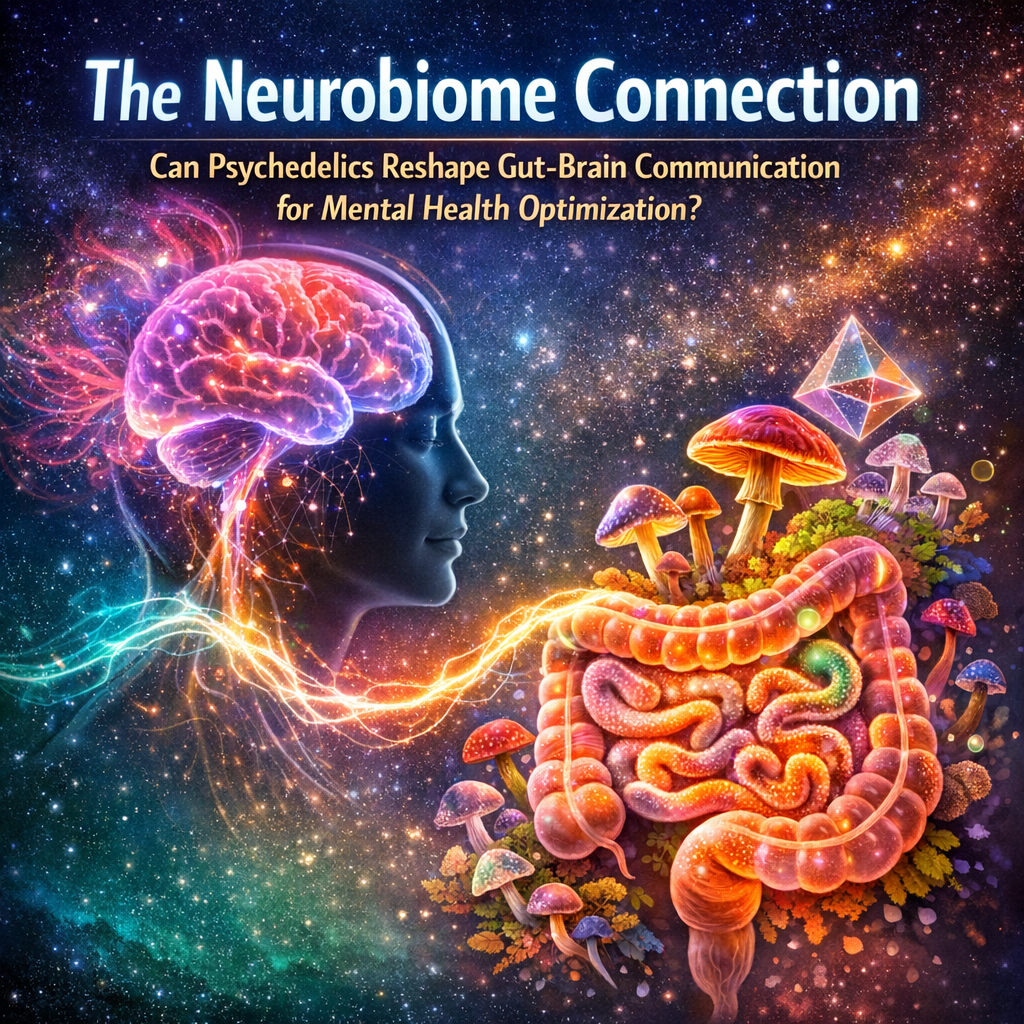
The Neurobiome Connection: Can Psychedelics Reshape Gut-Brain Communication for Mental Health Optimization?
In recent years, groundbreaking research has begun to unravel the intricate connections between the **gut** and the **brain**, often referred to as the “gut-brain axis.” This communication network plays a crucial role in regulating our mood, **mental health**, and well-being. Emerging studies suggest that **psychedelics**, specifically **psilocybin**—a compound found in certain **mushrooms**—might have the potential to reshape this communication, offering promising avenues for **mental health optimization**.
At the intersection of **neuroscience** and **microbiology** lies the concept of the **”neurobiome,”** which refers to how gut microbes influence brain function and vice versa. The gut is home to trillions of microorganisms that produce neurotransmitters like **serotonin** and **dopamine**, which are key regulators of mood and emotion. Current research indicates that any disruption in the gut microbiome can result in imbalances that lead to **mental health disorders**, such as anxiety and depression.
**Psychedelics** have been making a resurgence in the field of mental health, not just for their ability to alter perception and cognition, but also for their potential to facilitate lasting changes in mental health when integrated with comprehensive therapeutic approaches. Of particular interest is the way **psilocybin** can potentially influence the gut microbiome to enhance the gut-brain communication pathway.
Animal and human studies have suggested that psychedelics can foster **neuroplasticity**—the brain’s ability to reorganize itself by forming new neural connections. This property is particularly valuable in mental health treatment, as it may offer new methods to rewire maladaptive pathways that have been contributing to conditions like depression, **PTSD**, and anxiety.
Moreover, psilocybin’s **anti-inflammatory** properties warrant attention. Chronic inflammation in the gut has been implicated in various psychiatric disorders and might be alleviated through the use of psilocybin, resulting in a more balanced microbiome and improved mental health outcomes. Such findings open up exciting avenues for understanding and potentially redefining treatment methodologies within the realm of **psychedelic-assisted psychotherapy**.
Features
One pivotal study by the [Imperial College London](https://www.imperial.ac.uk/news) underscores the potential of psilocybin to mediate gut-brain interactions. In a controlled experiment, patients with treatment-resistant depression were administered psilocybin-assisted therapy, leading to significant improvements in mood and well-being. Interestingly, some participants reported enhanced digestive health, suggesting that psilocybin’s benefits might extend beyond the central nervous system to impact gut physiology.
Further insights come from research conducted at [Johns Hopkins University](https://www.hopkinsmedicine.org), where psilocybin was found to reduce symptoms of anxiety and depression in patients with life-threatening cancer. These mental health improvements were hypothesized to be connected to a modification in gut microbiome composition, perhaps driven by the compound’s ability to promote serotonin and dopamine production in the gut.
Animal studies have also drawn intriguing connections between psychedelics and the gut-brain axis. Research published in the journal [Gut Microbes](https://www.sciencedirect.com/journal/gut-microbes) explored how psilocybin affects the microbiome composition in rats, noting changes that were associated with reduced anxious behaviors. These findings imply a potential mechanism where psychedelics modulate the microbial environment to promote a harmonious neurobiome, thereby optimizing mental health.
In addition, a study featured in the [Neuropsychopharmacology journal](https://www.nature.com/npp/) examined the anti-inflammatory effects of psilocybin on brain-gut signaling pathways. The results suggested that psilocybin’s ability to decrease pro-inflammatory cytokines could be instrumental in balancing the gut-brain axis, ultimately contributing to improved mood regulation and decreased susceptibility to mood disorders.
While the research terrain is still nascent, and rigorous studies are necessary to fully understand the role of psychedelics in gut-brain modulation, the existing literature provides a promising outlook. As the scientific community continues to explore these complex interactions, psychedelics may soon become pivotal in mental health treatments, offering a natural and powerful means to harmonize the neurobiome.
Conclusion
**Psychedelics**, particularly **psilocybin**, hold transformative potential in reshaping gut-brain communication to optimize mental health. By bridging the neuroscience of psychedelics with the microbiome model, this innovative approach could lead to more effective treatments for mental health disorders. As research advances, a new era of integrative therapies could pave the way for enhanced psychological resilience and improved emotional well-being.
**Concise Summary**
Psychedelics, like psilocybin, have shown potential in reshaping gut-brain communication, possibly optimizing mental health. They may modulate the gut microbiome and enhance neuroplasticity, aiding in treating conditions like depression and anxiety. Studies suggest anti-inflammatory effects and improved serotonin production as key mechanisms. Research from institutions like Imperial College London and Johns Hopkins University supports these findings. Though still early, these studies hint at psychedelics becoming significant in mental health treatments, offering new avenues for integrative therapies and improved emotional well-being.

Dominic E. is a passionate filmmaker navigating the exciting intersection of art and science. By day, he delves into the complexities of the human body as a full-time medical writer, meticulously translating intricate medical concepts into accessible and engaging narratives. By night, he explores the boundless realm of cinematic storytelling, crafting narratives that evoke emotion and challenge perspectives. Film Student and Full-time Medical Writer for ContentVendor.com