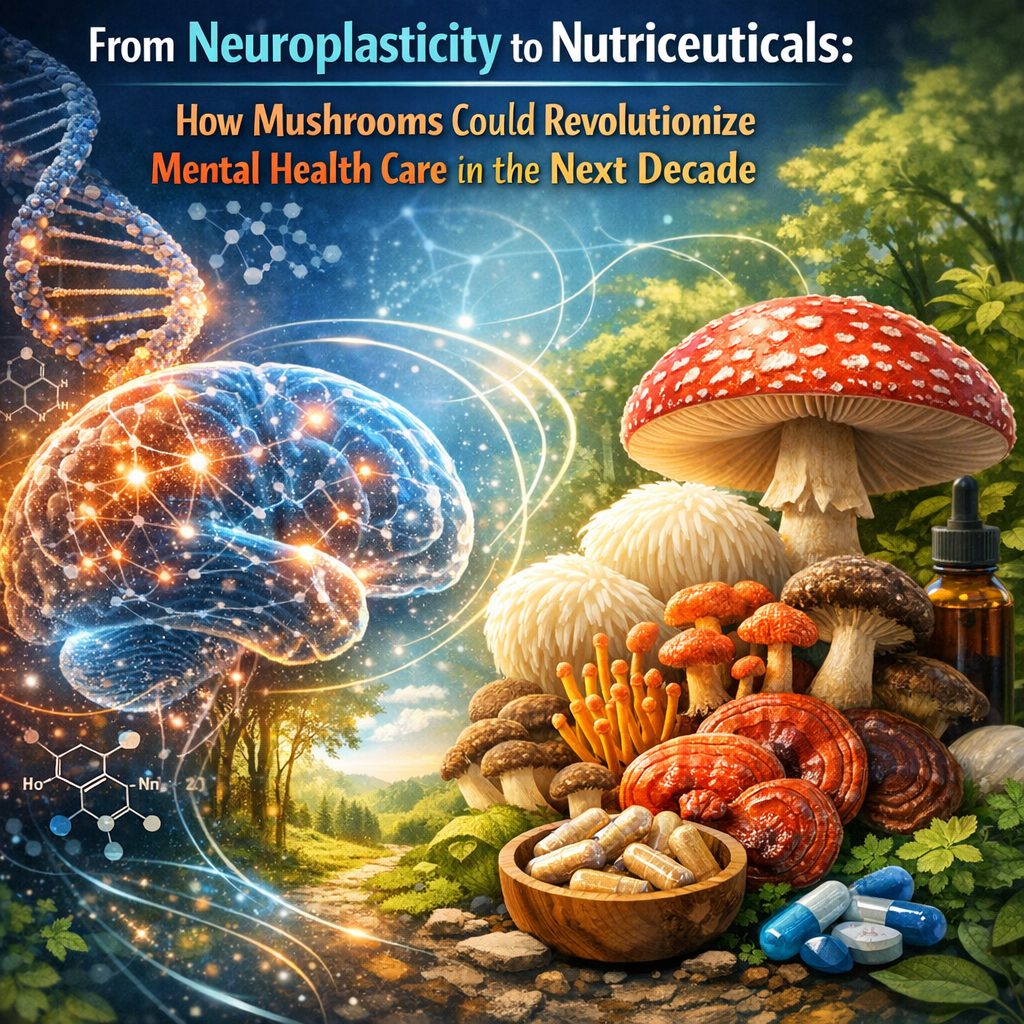
From Neuroplasticity to Nutriceuticals: How Mushrooms Could Revolutionize Mental Health Care in the Next Decade
Introduction
In recent years, there has been a growing interest in the potential of **mushrooms** as a transformative force in **mental health care**. This burgeoning field unites ancient knowledge and modern science, exploring therapeutic applications of fungal organisms. Mushrooms, long revered in traditional medicine systems globally, are being scrutinized through the lens of contemporary neuroscience and nutraceutical development, promising new hope for mental health innovations.
The global **mental health crisis**, characterized by soaring rates of **depression**, **anxiety**, and other **mood disorders**, demands innovative solutions. Conventional treatments, including pharmaceuticals and therapy, while effective for many, often come with drawbacks such as side effects, high costs, and variable efficacy. This scenario has paved the way for alternative approaches that can complement or surpass existing treatments.
Enter mushrooms: nature’s complex organisms, offering a rich profile of bioactive compounds. Among them, species like **Lion’s Mane**, **Reishi**, and **Psilocybe cubensis** are gaining attention not just for their historical usage, but for their scientifically-backed potential to foster mental well-being. These mushrooms are believed to enhance **neuroplasticity**, the brain’s ability to reorganize itself by forming new neural connections. This could lead to significant advancements in treating mental health conditions, potentially improving cognitive functions and alleviating symptoms of depression and anxiety.
Moreover, as **nutraceuticals**—food-derived products with health benefits beyond those of basic nutrition—mushrooms present a tantalizing frontier. They could democratize mental health care by offering accessible, cost-effective, and natural alternatives to traditional medications. Unlike synthetic drugs, which typically aim to alter specific biochemical pathways, mushrooms tend to work synergistically, leveraging a plethora of compounds to support mental health holistically.
The convergence of traditional wisdom, cutting-edge research, and nutraceuticals is shaping mushrooms as potential game-changers in mental health care. As we look ahead to the next decade, the integration of these fungal wonders into clinical practice could herald a new era where mental health care is more personalized, effective, and grounded in nature.
Features
Several promising studies are shedding light on the role of mushrooms in mental health care. For instance, a 2019 study published in the [*Journal of Medicinal Food*](https://www.liebertpub.com/doi/abs/10.1089/jmf.2018.4328) explored the cognitive benefits of **Lion’s Mane** (**Hericium erinaceus**). Researchers found it contains compounds like hericenones and erinacines, which stimulate the production of nerve growth factor (NGF), potentially enhancing cognitive function and memory.
Meanwhile, **Reishi mushrooms** (**Ganoderma lucidum**), renowned for their immunomodulatory properties, have also shown promise in mood regulation. A study published in [*PLoS ONE*](https://journals.plos.org/plosone/article?id=10.1371/journal.pone.0183213) in 2017 found that Ganoderma lucidum spore powder improved quality of life and reduced fatigue in breast cancer patients, hinting at its potential use in managing mental health issues related to chronic stress.
Perhaps the most captivating domain of research revolves around **psilocybin**, the psychoactive compound found in “magic mushrooms” like **Psilocybe cubensis**. Studies conducted at institutions like Johns Hopkins University have documented how psilocybin can significantly alleviate symptoms of depression and anxiety. A 2020 study published in [*JAMA Psychiatry*](https://jamanetwork.com/journals/jamapsychiatry/fullarticle/2772630) reported that two doses of psilocybin, combined with supportive psychotherapy, led to substantial decreases in depressive symptoms in a cohort of participants.
These findings are bolstered by the concept of neuroplasticity. Psilocybin is believed to promote brain plasticity, enabling the brain to rewire itself and break free from entrenched patterns of negative thought—potentially revolutionizing the treatment of mood disorders. As the stigma around **psychedelics** diminishes and regulatory frameworks evolve, psilocybin-assisted therapy could become an integral facet of mental health treatment regimes.
Mushrooms, in their entirety, present an exciting, multifaceted avenue for mental health care. The scientific validation of their therapeutic potential marks a shift toward more holistic and integrative approaches to mental wellness.
Conclusion
As we stand on the cusp of a new decade, the potential of mushrooms to revolutionize mental health care is both profound and palpable. By harnessing their natural, bioactive compounds, we can anticipate safer, more effective treatments that enhance neuroplasticity and support overall mental well-being. As research continues to unveil the therapeutic applications of these fungi, mushrooms could indeed hold the key to a more holistic and accessible future in mental health care.
**Concise Summary:**
The potential of mushrooms to transform mental health care is gaining interest due to their role in promoting neuroplasticity and serving as nutraceuticals. Mushrooms like **Lion’s Mane**, **Reishi**, and **Psilocybe cubensis** are showing promise in alleviating mental health issues like depression and anxiety. Studies reveal mushrooms enhance cognitive functions and mood regulation, with **psilocybin** from magic mushrooms aiding in depression treatment. As more research unfolds, mushrooms may offer innovative, cost-effective alternatives to traditional mental health therapies, heralding a new, holistic era in care.

Dominic E. is a passionate filmmaker navigating the exciting intersection of art and science. By day, he delves into the complexities of the human body as a full-time medical writer, meticulously translating intricate medical concepts into accessible and engaging narratives. By night, he explores the boundless realm of cinematic storytelling, crafting narratives that evoke emotion and challenge perspectives. Film Student and Full-time Medical Writer for ContentVendor.com