Certainly! Here’s a revised version of your article, formatted as requested:
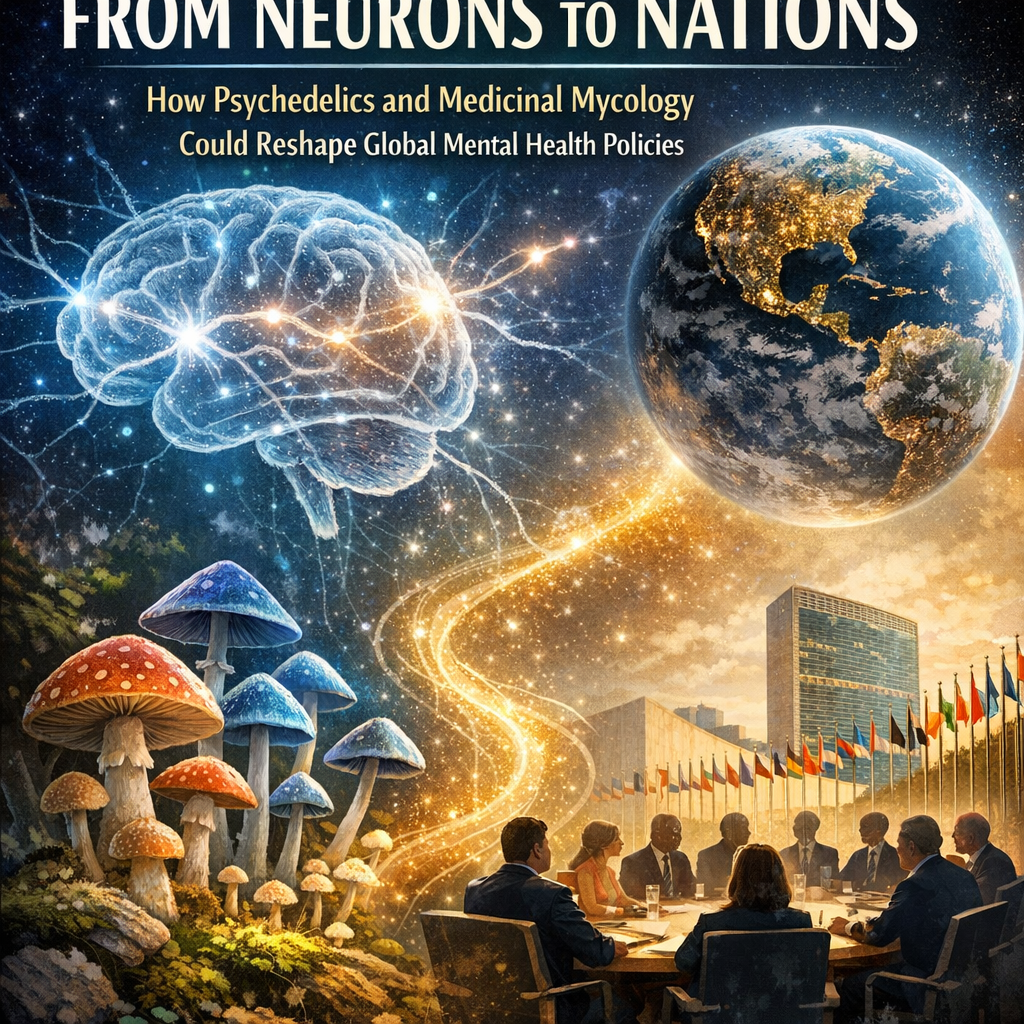
From Neurons to Nations: How Psychedelics and Medicinal Mycology Could Reshape Global Mental Health Policies
In recent years, there has been a resurgence of interest in **psychedelics** and medicinal **mushrooms**, not just as alternative health solutions but as pivotal players in the conversation about **global mental health**. Historically, **psychedelics** like **psilocybin**—found in certain species of mushrooms—have been used in various indigenous cultures for spiritual and healing purposes. Today, their potential goes beyond cultural boundaries, offering hope in treating mental health disorders that modern medicine has struggled to effectively manage.
The **global mental health crisis** is a monumental challenge, with conditions such as **depression**, **anxiety**, and **PTSD** afflicting millions worldwide. Traditional treatment options often include pharmaceutical interventions, which, while effective for some, can come with significant side effects and are not universally successful. This creates a dire need for alternative options that are both safe and efficacious. Enter the realm of **psychedelic therapy** and medicinal **mycology**. Emerging research indicates that compounds like **psilocybin** can lead to substantial improvements in conditions such as **treatment-resistant depression**, **end-of-life anxiety**, and **addiction**.
One of the unique aspects of **psychedelic treatment** is its ability to induce profound cognitive and emotional shifts. Unlike traditional medications, which are often taken indefinitely, **psychedelics** can produce lasting changes in a limited number of sessions, as they facilitate a process often described as a “reset” of the brain’s neural networks. **Psilocybin**, in particular, has been shown to increase the brain’s connectivity, allowing for a reorganization of neural pathways that can help break the cycles of negative thought patterns found in depression and anxiety.
The implications of these findings are vast. Countries around the world are beginning to take note, with nations such as **Canada** and parts of the **United States** entering the early stages of policy reform to integrate **psychedelics** into mental health treatment protocols. As the narrative shifts from a stigmatized past to a politically feasible solution for mental healthcare, there’s a growing momentum to consider how these treatments could be standardized and made accessible to those in need across diverse populations.
Features:
Significant progress in the realm of **psychedelic research** has come from leading academic institutions and professionals in the field. One landmark study conducted at [Johns Hopkins University](https://www.hopkinsmedicine.org/news/newsroom/news-releases/johns-hopkins-researchers-explore-psychedelic-psilocybins-potential-to-aid-depression-relief) found that **psilocybin** has the potential to improve emotional well-being and decrease symptoms of depression. The study, which was one of the first of its kind conducted under rigorous, controlled conditions, vividly illustrated **psilocybin’s** ability to produce substantial therapeutic effects after just one or two doses.
Adding to this burgeoning field, studies published in the [“New England Journal of Medicine”](https://www.nejm.org) and other peer-reviewed journals have reported significant improvements in **anxiety**, **depression**, and **PTSD**, with minimal contraindications when guided by trained therapists. The prominence given to the non-addictive nature of **psilocybin** and its low toxicity profile provides a promising rationale for rethinking long-held perceptions about **psychedelic substances**.
Moreover, another study published by [Imperial College London](https://www.imperial.ac.uk/news/211836/psilocybin-relieves-major-depression-within-weeks/) found that **psilocybin therapy** could effectively treat major depression, reinforcing the notion that **psychedelics** work differently than traditional antidepressants. Instead of merely dampening the symptoms, they seem to fundamentally alter the mind’s perception and processing of emotional trauma.
As we witness the convergence of ancient wisdom and modern science, it becomes imperative that medical policies innovate alongside these revelations. This necessity has spurred discussions regarding the potential of policy frameworks to expand access to these therapies, protect the safety of individuals, and support ongoing research. Policymakers, healthcare providers, and researchers need to collaborate to create systems that can responsibly incorporate these findings to promote mental wellness on a larger scale.
Conclusion:
The burgeoning research on **psychedelics** and **medicinal mushrooms** offers profound promise for mental health treatment, heralding a paradigm shift that could redefine global mental health policies. By focusing on evidence-based approaches and fostering interdisciplinary collaboration, we have the potential to transform the current mental health landscape, offering real hope to millions around the world. Let us move forward with an open mind and a commitment to exploring these unconventional yet powerful avenues for healing.
**Concise Summary**:
Emerging research indicates that psychedelics such as **psilocybin** offer promising treatment for mental health disorders, including **depression**, **anxiety**, and **PTSD**. Unlike traditional pharmaceuticals, psychedelics can lead to profound and lasting changes after limited sessions. Trials by [Johns Hopkins University](https://www.hopkinsmedicine.org/news/newsroom/news-releases/johns-hopkins-researchers-explore-psychedelic-psilocybins-potential-to-aid-depression-relief) and [Imperial College London](https://www.imperial.ac.uk/news/211836/psilocybin-relieves-major-depression-within-weeks/) have illustrated psilocybin’s effectiveness. As countries like **Canada** and parts of the **U.S.** begin to reform policies, the potential for wider acceptance and standardization of these therapies for global mental health treatment grows.
**References**:
1. [Johns Hopkins Medicine – Psilocybin Research](https://www.hopkinsmedicine.org/news/newsroom/news-releases/johns-hopkins-researchers-explore-psychedelic-psilocybins-potential-to-aid-depression-relief)
2. [NEJM – Psilocybin for Depression](https://www.nejm.org)
3. [Imperial College London – Psilocybin for Major Depression](https://www.imperial.ac.uk/news/211836/psilocybin-relieves-major-depression-within-weeks/)

Dominic E. is a passionate filmmaker navigating the exciting intersection of art and science. By day, he delves into the complexities of the human body as a full-time medical writer, meticulously translating intricate medical concepts into accessible and engaging narratives. By night, he explores the boundless realm of cinematic storytelling, crafting narratives that evoke emotion and challenge perspectives. Film Student and Full-time Medical Writer for ContentVendor.com