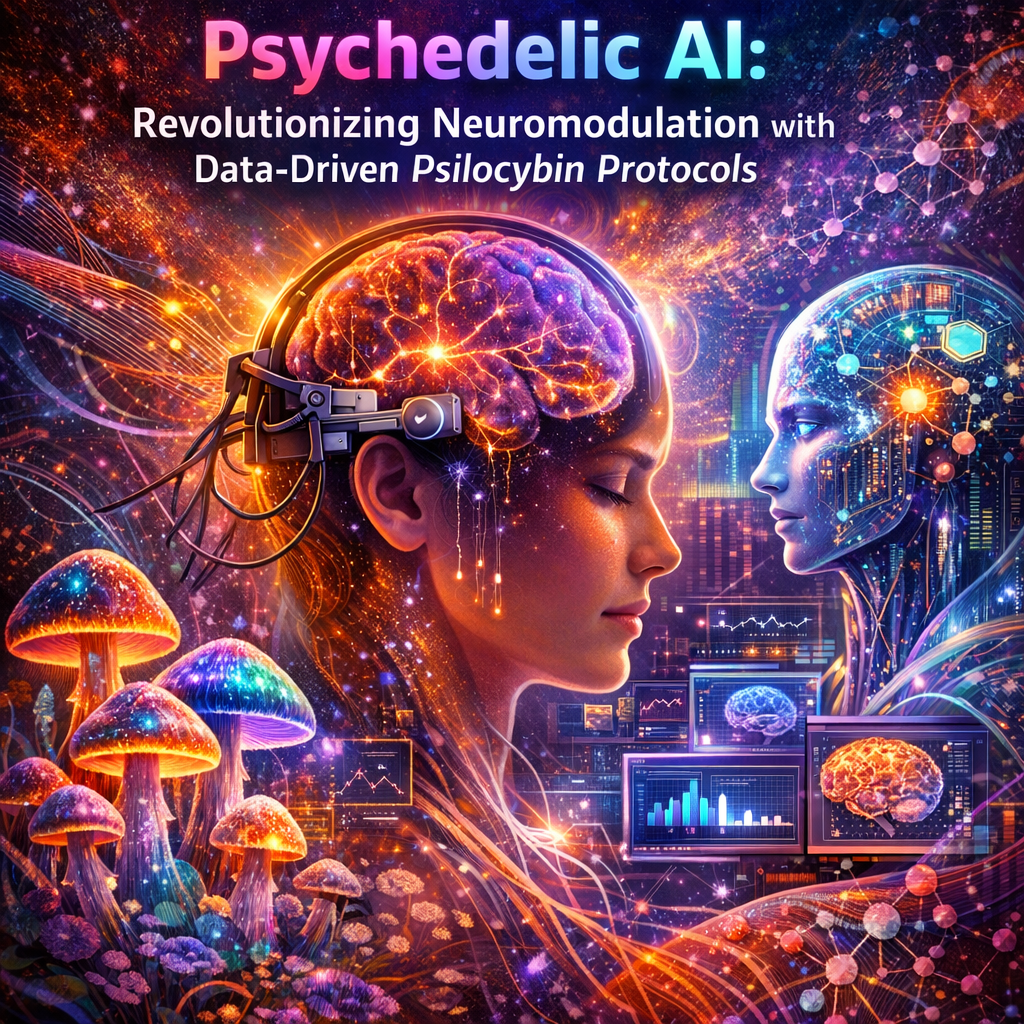
### Psychedelic AI Revolutionizing Neuromodulation with Data-Driven Psilocybin Protocols
**Introduction:**
In recent years, the intersection of **artificial intelligence (AI)** and **psychedelic research** has opened new avenues for advancing **neuromodulation therapies**, particularly through data-driven **psilocybin protocols**. Neuromodulation, which involves altering nerve activity through targeted delivery of stimuli, is an innovative approach to treating various **neurological disorders**. **Psilocybin**, the psychoactive compound found in “magic” mushrooms, has gained significant attention in the medical community for its potential therapeutic benefits, particularly in **mental health**.
With AI’s sophisticated algorithms and data-analytic capabilities, researchers can efficiently analyze vast amounts of data from clinical trials and individual therapy sessions. This synergy between **AI** and psilocybin is revolutionizing the way treatments are personalized, offering the promise of optimized and highly effective intervention protocols. **AI models** analyze patient data to identify patterns, predict outcomes, and tailor individualized treatment plans. The use of AI in understanding and applying psilocybin’s effects is also helping dismantle the stigma surrounding **psychedelics**, recasting them as valuable tools in **mental health treatment**.
Prominent academic institutions and biotechnology companies are heavily invested in understanding how psilocybin can improve connectivity in brain regions implicated in **depression, anxiety**, and **PTSD**. These conditions often involve disrupted neural communication, and psilocybin appears to foster new connections by reshaping the brain’s neural networks temporarily. The integration of **AI** enhances these investigations as AI-driven models can simulate various neural changes induced by psilocybin, help visualize these complex processes, and hypothesize therapeutic outcomes.
The potential reach of AI-driven psilocybin therapies goes beyond individual patient care. By amassing a vast dataset of human neural responses to **psilocybin**, AI programs can contribute to public health strategies and pharmacological advancements. The paradigm shift suggests a future where mental health treatment is more streamlined, predictive, and patient-centric.
**Features:**
Recent studies have provided insights into the revolutionary role of **AI** in enhancing psilocybin-based neuromodulation therapies. A notable project by the [Johns Hopkins Center for Psychedelic and Consciousness Research](https://www.hopkinsmedicine.org) demonstrated the promising effects of psilocybin on **major depressive disorder (MDD)**. In a randomized, double-blind study, patients who received two doses of psilocybin showed substantial decreases in depressive symptoms, with benefits persisting for weeks after treatment. The study emphasized psilocybin’s potential as a rapid-acting antidepressant, significant given the lengthy onset of conventional antidepressants.
**AI** further amplifies these results by processing genetic, phenotypic, and neuroimaging data to identify biomarkers for patients who might benefit most from psilocybin therapy. For instance, machine learning techniques can recognize neuroimaging patterns associated with treatment responses, allowing personalized therapeutic approaches. A study published in [Nature Medicine](https://www.nature.com/nm) highlighted AI’s use in predicting outcomes from psilocybin-based psychotherapy, demonstrating promising accuracy in forecasting individual responses based on pre-treatment brain scans.
Moreover, AI’s role in understanding psilocybin extends to **microdosing**—a growing phenomenon where individuals take sub-perceptual doses of psychedelics to improve mood and cognitive functioning. AI systems analyze user data from digital health tools to assess benefits and risks associated with microdosing, providing a more nuanced understanding of its long-term implications. This can lead to data-informed guidelines that enhance safety and efficacy.
The collaboration between biotechnology firms like [MindMed](https://www.mindmed.co) and digital health companies further paves the way for AI to optimize dosing protocols, reducing risks and enhancing patient outcomes. By pooling experiential data from wide and diverse populations, AI systems refine the understanding of how dosages should vary according to individual needs and psychological profiles.
**Conclusion:**
The fusion of psilocybin research with AI technology is set to redefine mental health treatment paradigms. By leveraging the power of **AI**, clinicians and researchers can develop personalized neuromodulation therapies with unprecedented precision and efficiency. As ongoing studies continue to unveil the therapeutic potential of **psilocybin**, **AI** remains an invaluable ally in transforming these insights into tangible, scalable solutions for mental health globally. This confluence of technology and psychedelics represents a forward-thinking approach to healing the mind, offering hope to individuals navigating the complexities of mental health disorders.
**Concise Summary:**
The integration of **artificial intelligence (AI)** with **psilocybin** research offers a revolutionary path for neuromodulation therapies, particularly in mental health. AI’s data-driven capabilities enable personalized treatment plans by analyzing extensive patient data, enhancing understanding of psilocybin’s effects on conditions like **depression, anxiety**, and **PTSD**. Studies, including those from [Johns Hopkins Medicine](https://www.hopkinsmedicine.org) and [Nature Medicine](https://www.nature.com/nm), show promising results with psilocybin as a rapid-acting antidepressant. The collaboration with biotech firms like [MindMed](https://www.mindmed.co) further optimizes dosing protocols, suggesting a transformative future for mental health treatments through this AI-psychedelic synergy.

Dominic E. is a passionate filmmaker navigating the exciting intersection of art and science. By day, he delves into the complexities of the human body as a full-time medical writer, meticulously translating intricate medical concepts into accessible and engaging narratives. By night, he explores the boundless realm of cinematic storytelling, crafting narratives that evoke emotion and challenge perspectives. Film Student and Full-time Medical Writer for ContentVendor.com