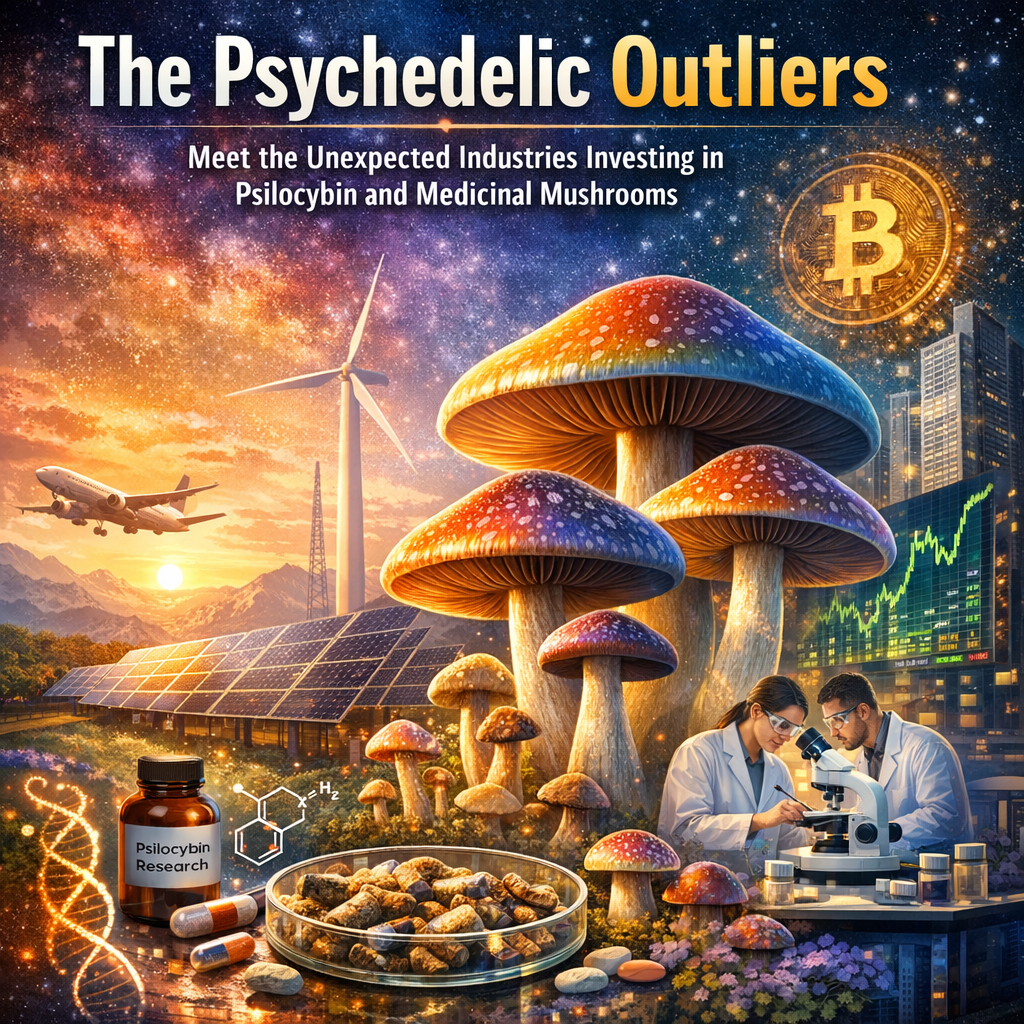
The Psychedelic Outliers: Meet the Unexpected Industries Investing in Psilocybin and Medicinal Mushrooms
In recent years, the world has witnessed a **paradigm shift** in the perception of **psychedelic substances**, particularly **psilocybin** and **medicinal mushrooms**. Far removed from their association with counterculture movements of the 1960s, these natural compounds are now being explored through the lens of **science** and **medicine** for their potential therapeutic benefits. An intriguing consequence of this shift is the influx of investments from unlikely industries, drawn by the promise of groundbreaking applications for **mental health**, **wellness**, and beyond. This article explores the impact of psilocybin and medicinal mushrooms on various industries and identifies the outliers venturing into this captivating domain.
Historically, psilocybin mushrooms have been utilized in various cultures for **spiritual** and **healing** purposes. However, it is only in recent decades that scientific research has rigorously examined their potential impact on **human health**. Findings from key studies have highlighted their efficacy in addressing **mental health disorders**, such as **depression**, **anxiety**, **PTSD**, and **addiction**. This growing body of evidence has spurred interest beyond the pharmaceutical sector, capturing the attention of numerous industries that stand to benefit from these natural compounds.
The **wellness industry**, for instance, has been quick to incorporate **medicinal mushrooms** into its repertoire. Consumers are increasingly seeking natural alternatives for physical and mental well-being, and formulations featuring mushrooms like lion’s mane, reishi, and cordyceps have surged in popularity. These mushrooms, often consumed via powders, tinctures, and capsules, are hailed for their **adaptogenic properties**, which help the body cope with stress and support overall health.
In a surprising turn, the **tech industry** has also shown interest in psilocybin. Leaders in **Silicon Valley** have long been advocates for **cognitive enhancement techniques**, and microdosing psilocybin is seen as a method to boost **creativity**, **focus**, and **problem-solving skills**. This interest has led to investments in startups focused on developing microdosing protocols and products.
Moreover, the investment world has seen a growing number of **venture capitalists** and **hedge funds** dedicating resources to psychedelic research and companies. The promise of new treatment paradigms for mental health, coupled with potential regulatory approval, presents a lucrative opportunity for forward-thinking investors.
Features
The incorporation of psilocybin and medicinal mushrooms in mainstream medicine is supported by an expanding body of scientific evidence. One notable study published in the journal JAMA Psychiatry demonstrated that psilocybin, in a controlled therapeutic setting, can significantly reduce **depressive symptoms**. Participants who received psilocybin showed sizeable improvements compared to those who underwent traditional treatment alone ([source](https://jamanetwork.com/journals/jamapsychiatry/fullarticle/2772630)).
Additionally, research funded by institutions like **Johns Hopkins University** has paved the way for new clinical trials, further elucidating psilocybin’s potential impact on **substance use disorders** and **existential distress** in terminal illness ([source](https://hopkinspsychedelic.org/)). These studies provide compelling preliminary data supporting psilocybin’s role in fostering **neuroplasticity** and emotional reset, a promising development that may redefine the treatment landscape for a variety of psychiatric disorders.
In the realm of non-psychedelic medicinal mushrooms, studies have examined compounds such as **erinacines** and **hericenones** in lion’s mane mushrooms for their neuroprotective effects. Research published in *Biomedical Research* showed that these compounds potentially stimulate **nerve growth factor (NGF) synthesis**, which could offer protective effects against neurodegenerative diseases like Alzheimer’s ([source](https://pubmed.ncbi.nlm.nih.gov/24266378/)).
In addition to mental health applications, medicinal mushrooms are being investigated for **immune support**. Compounds like **beta-glucans** found in reishi mushrooms have been shown to influence immune function, potentially lowering the incidence of certain infections and cancers ([source](https://www.ncbi.nlm.nih.gov/pmc/articles/PMC5691683/)).
As these discoveries continue to accumulate, they reveal a burgeoning field with untapped potential, capturing the interest of unconventional industries seeking to align with this transformative wave.
Conclusion
The intersection of **psilocybin**, **medicinal mushrooms**, and unexpected industries underlines a significant shift in both societal attitudes and scientific approaches to mental health and wellness. By fostering collaborations between scientists, entrepreneurs, and investors, the therapeutic potential of these natural compounds is being driven forward. As research progresses and regulatory landscapes adapt, the future holds promise for innovations that could redefine well-being across a spectrum of applications.
Concise Summary
Psilocybin and medicinal mushrooms have shifted from counterculture symbols to promising therapeutics for mental health disorders like depression and PTSD. Unconventional industries, such as tech and wellness, are investing in these compounds for cognitive enhancement and adaptogenic benefits. Scientific studies, including those by Johns Hopkins University and published in *JAMA Psychiatry*, support their efficacy, encouraging venture capital interest. As regulatory landscapes evolve, the therapeutic potential of these substances may reshape mental health treatment and wellness practices globally.

Dominic E. is a passionate filmmaker navigating the exciting intersection of art and science. By day, he delves into the complexities of the human body as a full-time medical writer, meticulously translating intricate medical concepts into accessible and engaging narratives. By night, he explores the boundless realm of cinematic storytelling, crafting narratives that evoke emotion and challenge perspectives. Film Student and Full-time Medical Writer for ContentVendor.com