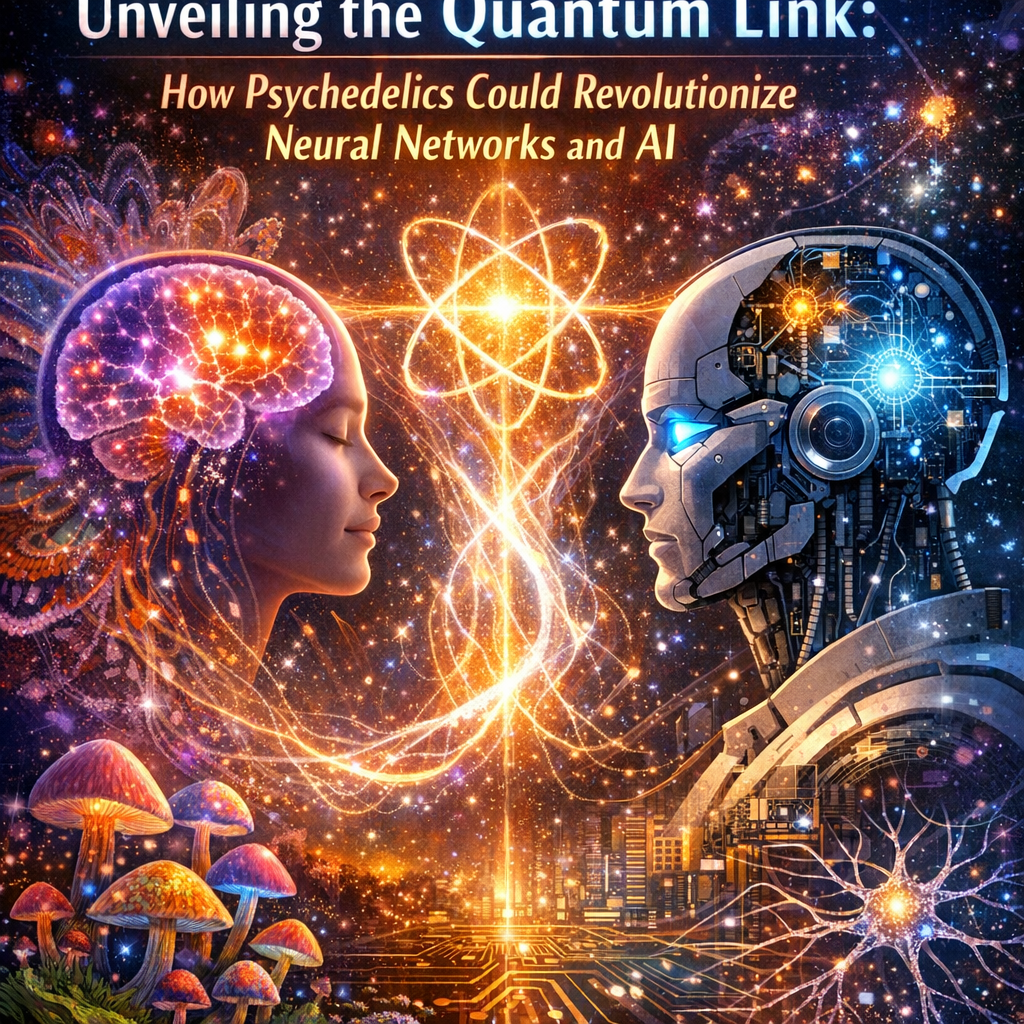
Unveiling the Quantum Link: How Psychedelics Could Revolutionize Neural Networks and AI
In the intricate dance of neurons and synapses within the human brain, researchers have long sought to understand the mechanisms behind **consciousness**, **perception**, and **cognition**. As the digital age advances, parallels are increasingly drawn between the **neural networks** of the mind and **artificial intelligence (AI)**. With the rise of **quantum computing**, the lines between biological and artificial are beginning to blur, offering thrilling possibilities for both **neuroscience** and **technology**. At the forefront of this exploration is a surprising player: **psychedelics**. Traditionally considered as mere recreational substances or therapeutic agents for mental health, psychedelics like **psilocybin** and **LSD** are finding new relevance in the world of AI and neural network research.
Psychedelics have the unique ability to disrupt the ordinary rhythmic firing patterns of neurons, potentially offering insights into the nature of consciousness itself. When individuals take substances like psilocybin, **brain imaging studies** reveal a significant increase in connectivity across different regions of the brain, akin to activating various network nodes in **AI**. Such increased connectivity and communication could mimic the workings of an optimized quantum computer, where multiple pathways are explored simultaneously.
In the realm of AI, current neural networks are modeled after the human brain, but they remain largely linear. The **neural interconnectivity** driven by psychedelics could serve as a testbed for developing more complex, adaptive, and efficient forms of AI. By studying how psychedelics alter human cognition, researchers might be able to design AI systems that can explore non-linear solutions to problems, ultimately reaching higher levels of learning and decision-making capabilities.
As the scientific community delves deeper into the potential link between psychedelics and AI, new frontiers in both fields may emerge. Psychedelics might not only transform mental health treatments but also inspire technological innovations that could reshape our digital future. This quantum link opens the door to a world where AI driven by quantum computing and insights from psychedelics can revolutionize how we understand and interact with the universe.
Scientific Foundations
To appreciate the synergy between psychedelics and neural networks, it’s crucial to examine the scientific foundation provided by recent studies. One landmark study conducted by researchers at [Imperial College London](https://www.sciencedaily.com/releases/2014/07/140703092826.htm) illuminated the profound effects of psychedelics on the brain. Using functional magnetic resonance imaging (fMRI), the study demonstrated that psilocybin increases the brain’s entropy or disorder, allowing for heightened neural connectivity and communication between brain regions that typically operate in isolation. This process mirrors the operation of a **quantum computer**, which simultaneously explores multiple outcomes, leading to new insights and solutions.
Further reinforcing this connection is research from the [University of Zurich](https://www.cell.com/cell-reports/fulltext/S2211-1247(20)30445-8), which explored the impact of LSD on the serotonin 2A receptors in the brain. This study, published in the journal “Cell Reports,” found that psychedelics modulate the brain’s **default mode network**, a critical feature for self-referential thought and metacognition. Such modulation can potentially lead to the kind of non-linear thinking that is highly sought after in the development of **AI algorithms** capable of learning and adapting on their own.
The potential implications for AI extend beyond neuroscience. The renowned AI research institute, [DeepMind](https://deepmind.com/blog/article/neural-networks), is exploring how unconventional models, inspired by psychedelics’ impact on the human brain, could improve AI’s capacity for pattern recognition and problem-solving in areas traditionally considered exclusive to human intelligence. By mimicking the altered states induced by psychedelics, AI could transcend current limitations, accessing an expanded array of solutions and responses to complex issues.
Furthermore, there is a growing body of evidence suggesting that psychedelics may affect processes such as **neuroplasticity** and **creativity**, both of which are integral to the development of sophisticated neural networks. Psychedelics are found to facilitate a reset of brain networks, which could in turn foster the creation of AI systems that are more adaptable and capable of overcoming the rigidity inherent in traditional machine learning models.
Conclusion
The potential quantum link between psychedelics and AI offers a glimpse into a future where the merging of neuroscience and technology could unlock new dimensions of understanding and innovation. By studying how psychedelics alter neural networks, we may inspire a new era of AI development, harnessing the brain’s complexity to push the boundaries of what’s possible. As researchers continue to explore this intersection, the possibilities for advancing both human cognition and artificial intelligence are boundless.
Concise Summary
The intersection of psychedelics and AI explores the potential for substances like psilocybin and LSD to revolutionize neural networks. By increasing brain connectivity and modulating the default mode network, psychedelics mirror quantum computing, opening pathways to advanced AI development. Research highlights their ability to enhance neuroplasticity and creativity, crucial for adaptive AI systems. This synergy may lead to breakthroughs in AI’s capacity for complex problem-solving, transforming both mental health treatment and digital technology. The exploration of this quantum link promises to expand our understanding of consciousness and foster innovative advancements in AI algorithms.

Dominic E. is a passionate filmmaker navigating the exciting intersection of art and science. By day, he delves into the complexities of the human body as a full-time medical writer, meticulously translating intricate medical concepts into accessible and engaging narratives. By night, he explores the boundless realm of cinematic storytelling, crafting narratives that evoke emotion and challenge perspectives. Film Student and Full-time Medical Writer for ContentVendor.com