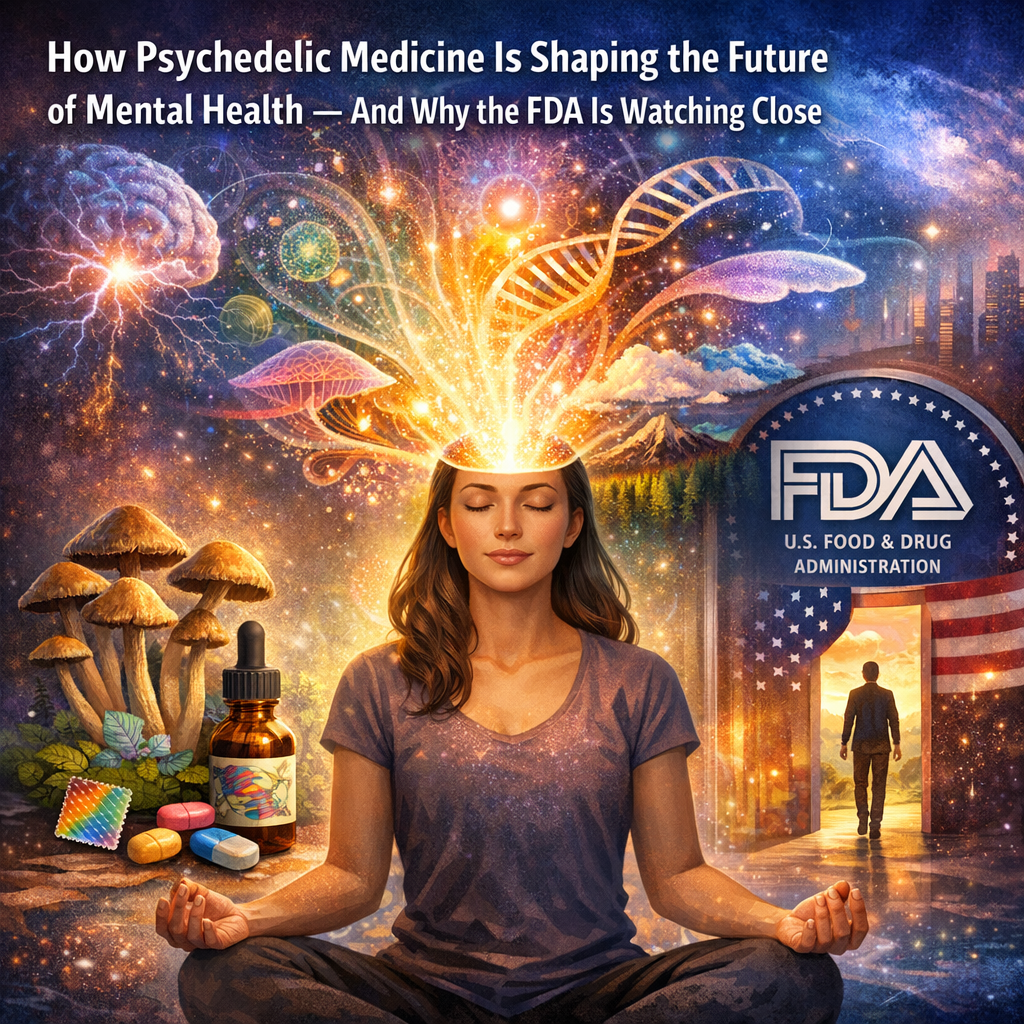
How Psychedelic Medicine Is Shaping the Future of Mental Health — And Why the FDA Is Watching Close
Introduction
In recent years, the landscape of **mental health treatment** has been undergoing a significant transformation, driven largely by emerging research into the therapeutic potential of **psychedelic substances**. Among these, psilocybin—the active compound found in “magic mushrooms”—has surfaced as a potent tool in treating various mental health conditions. Long relegated to the fringes of both scientific inquiry and social acceptance, **psychedelics** are now moving toward the mainstream, capturing the attention of not only the medical community but also regulatory bodies like the U.S. Food and Drug Administration (FDA).
The backdrop to this resurgence is a growing public health crisis characterized by rising rates of **depression**, **anxiety**, **PTSD**, and other mental health disorders. Traditional pharmacological treatments, while beneficial for many, fail to provide relief for a significant subset of patients. As a result, there is an urgent demand for innovative solutions that can offer new pathways to healing. Enter **psychedelic medicine**—a field of study that has its roots in indigenous traditions but which is now being explored through the rigorous lens of modern medical research.
Unlike conventional antidepressants that may take weeks to exert their effects, **psychedelic compounds** like psilocybin are showing promise for rapidly alleviating symptoms of mental illness. The potential of psilocybin and similar compounds lies in their ability to induce profound, mind-altering experiences that can catalyze psychological insights and emotional breakthroughs. This is leading researchers to investigate their efficacy not as mere symptom suppressors but as facilitators of deep, lasting mental and emotional change.
As the science unfolds, the **FDA** is keenly observing this burgeoning field. In recent years, the agency has granted “breakthrough therapy” designation to psilocybin-assisted therapy for depression, signaling its potential to offer significant advantages over existing treatments. This designation fast-tracks the development and review process, underscoring the FDA’s openness to considering new, evidence-backed therapies that can address unmet medical needs.
Features
The intrigue surrounding **psilocybin** and other **psychedelic treatments** largely stems from recent scientific studies that highlight their transformative potential. A landmark study conducted by Johns Hopkins University in 2016, published in the [Journal of Psychopharmacology](https://doi.org/10.1177/0269881116675513), demonstrated the efficacy of psilocybin in treating major depressive disorder. Participants who received just two doses of psilocybin exhibited a significant reduction in depressive symptoms, with benefits lasting up to a year for some respondents.
In another pivotal clinical trial published in [JAMA Psychiatry](https://jamanetwork.com/journals/jamapsychiatry/fullarticle/2772630), patients struggling with major depressive disorder experienced marked improvements after psilocybin treatment combined with supportive psychotherapy. The study’s outcomes were compelling enough that the **FDA** recognized the therapeutic potential of psilocybin and expedited its study in clinical contexts.
Moreover, psilocybin isn’t the only psychedelic capturing scientific interest. A parallel line of research is exploring **MDMA-assisted therapy** for post-traumatic stress disorder (PTSD), showing promise in reshaping how we perceive trauma treatment. A Phase 3 clinical trial published in [Nature Medicine](https://www.nature.com/articles/s41591-021-01336-3) found that MDMA significantly enhances the therapeutic process, leading to substantial decreases in PTSD symptoms compared to traditional therapy alone.
The interest of the **FDA** is not solely academic. Safety is always paramount when it comes to approving new treatments, especially those involving mind-altering substances with historical stigmas and legal barriers. Therefore, comprehensive clinical trials focused on safety, dosage, and long-term effects are integral to the ongoing development of **psychedelic therapies**. The careful scrutiny by the FDA aims to ensure that when these therapies become more widely accessible, they are both safe and effective for patients in need.
Conclusion
As we stand on the cusp of a new era in mental health treatment, **psychedelic medicine** offers a promising yet cautious path forward. With significant scientific backing and **FDA** involvement, the potential for psilocybin and other psychedelics to revolutionize mental health care is becoming an exciting reality. While challenges remain in deconstructing decades-long stigma, the promise of these therapies invites optimism for a future where mental health treatment is more inclusive, innovative, and effective than ever before.
Concise Summary
The mental health treatment landscape is evolving with breakthroughs in **psychedelic medicine**, particularly **psilocybin** from “magic mushrooms.” Rising mental health issues like **depression** and **PTSD** are fueling interest in these compounds due to their rapid and lasting effects compared to traditional treatments. With landmark studies highlighting their potential, the **FDA** has granted “breakthrough therapy” status to psilocybin-assisted treatments, expediting their development. Further research is also exploring **MDMA** for PTSD, reinforcing the promise these substances hold. The focus remains on ensuring clinical safety, efficacy, and overcoming historical stigmas for broader application.

Dominic E. is a passionate filmmaker navigating the exciting intersection of art and science. By day, he delves into the complexities of the human body as a full-time medical writer, meticulously translating intricate medical concepts into accessible and engaging narratives. By night, he explores the boundless realm of cinematic storytelling, crafting narratives that evoke emotion and challenge perspectives. Film Student and Full-time Medical Writer for ContentVendor.com