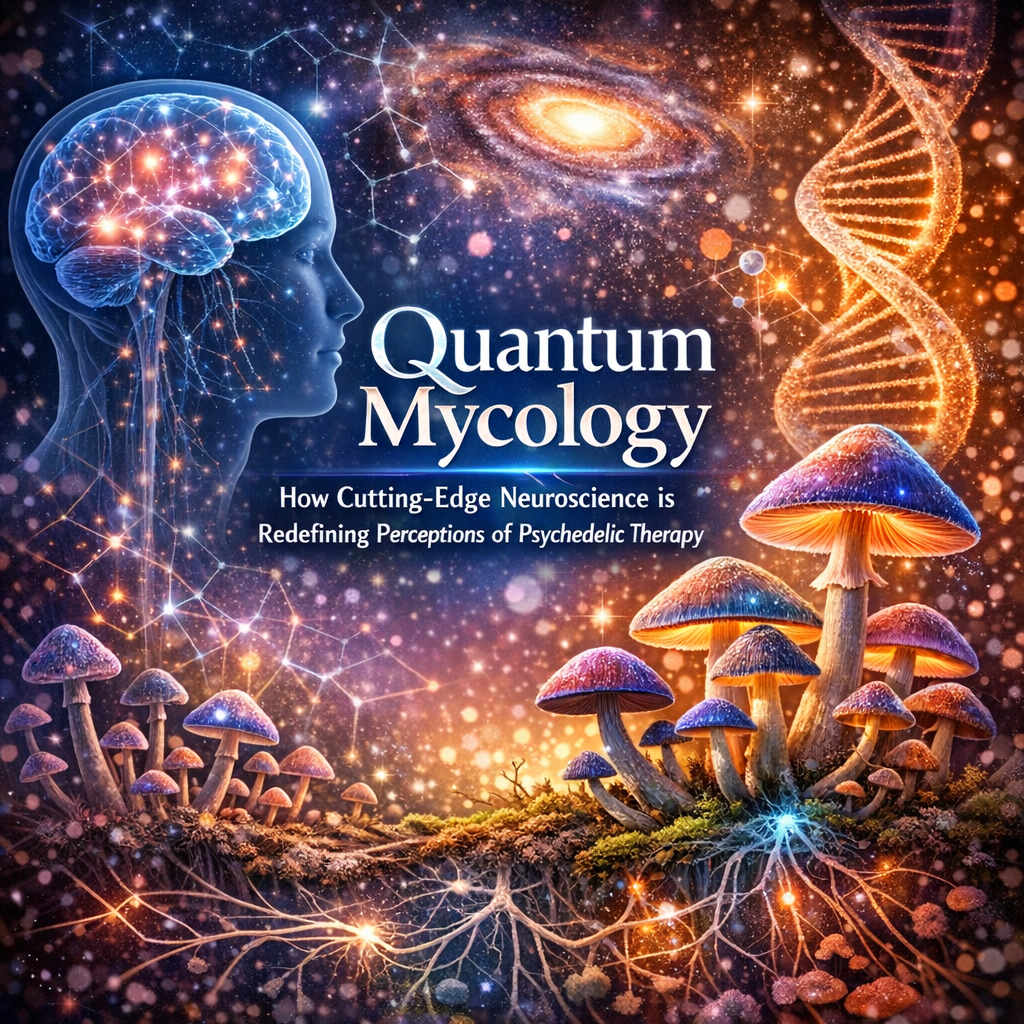
Quantum Mycology: How Cutting-Edge Neuroscience is Redefining Perceptions of Psychedelic Therapy
In recent years, the therapeutic potential of **psychedelics**, particularly **psilocybin**, the active compound in certain mushrooms, has captured the interest of scientists, clinicians, and the general public alike. This burgeoning interest is driven by a pressing need to find alternative therapies for **mental health disorders** that resist conventional treatments. Yet, what is genuinely transforming the landscape is the intersection of **quantum mycology** with modern neuroscience. This multifaceted approach offers unprecedented insights into how psilocybin mushrooms can be harnessed to promote mental well-being.
The concept of **quantum mycology**, which integrates elements of quantum physics with the study of fungi, challenges conventional boundaries. At its core, it explores the exotic idea that psilocybin interacts with brain functions in ways that mirror principles found in **quantum mechanics**—such as **entanglement** and **superposition**. When individuals consume psilocybin mushrooms, altered states of consciousness are achieved, unveiling new patterns of thought and perception. These states are hypothesized to “reset” neural networks, offering potential relief for conditions such as depression, PTSD, and anxiety—all of which have proved difficult to treat through standard pharmacological approaches.
The world of **psychedelic therapy** is further being revolutionized by advanced neuroimaging technologies, such as **fMRI** and **PET scans**. These tools allow researchers to visualize in real-time how psilocybin restructures neural pathways. The “default mode network” (DMN), a critical brain system involved in self-referential thought processes, becomes relaxed and synchronized, fostering a sense of unity and openness. This can dramatically reduce symptoms of mental illness where patients feel trapped in maladaptive thought patterns.
As we delve deeper into the intersection of quantum principles and neuroscience in the context of mycology, we’re witnessing an era where ancient knowledge meets modern science. This alliance proposes groundbreaking opportunities to facilitate inner peace and psychological healing, redefining what is possible in mental health care.
Features
The scientific exploration of psilocybin mushrooms in therapeutic contexts is backed by a growing body of empirical research. A landmark study conducted by [Johns Hopkins Medicine](https://www.hopkinsmedicine.org/news/media/releases/single_dose_of_psilocybin_relieves_anxiety_and_depression_in_patients_with_advanced_cancer) found that psilocybin led to substantial reductions in depression and anxiety in patients with life-threatening cancer after just one dose. The participants reported not only immediate relief but sustained improvements over several months.
Additionally, concurrent research from [Imperial College London](https://www.imperial.ac.uk/news/190993/brain-scans-reveal-how-lsd-affects/) has used fMRI scans to provide evidence of how psilocybin reduces activity in the brain’s DMN, allowing patients to break free from destructive mental loops. These brain scans have also illustrated an increase in connectivity between different brain regions, promoting novel ways of thinking and heightened emotional awareness.
The role of **quantum entanglement** here serves as an intriguing metaphor for how neural pathways may synchronize in novel patterns during psilocybin therapy. Fundamentally, quantum mycology posits that the intersection of these pathways can create a domino effect, prompting transformative experiences that extend beyond individual neural processes to holistic changes in perception and cognition.
Furthermore, a randomized control trial featured in the [New England Journal of Medicine](https://www.nejm.org/doi/full/10.1056/NEJMoa2032994) compared the effects of psilocybin with traditional antidepressants, demonstrating comparable efficacy, with considerably fewer side effects for the former. Such evidence underscores the therapeutic potential of psychedelics as viable treatments for mental health disorders. Quantum mycology, by integrating diverse scientific disciplines, ensures that the therapeutic journey is well-supported by rigorous science, encouraging a more comprehensive understanding of consciousness itself.
Conclusion
Quantum mycology and its fusion of mycological exploration with neuroscience herald a new age for mental health treatment. As scientific inquiry continues to validate and expand our understanding of psilocybin, we find ourselves at the cusp of a paradigm shift in psychedelic therapy. By embracing both ancient wisdom and cutting-edge science, we have the potential to profoundly alter perceptions of mental wellness, offering hope where traditional approaches have faltered. The future of psychedelic therapies is not only promising but also fundamentally transformative.
**Concise Summary**
Quantum mycology merges quantum physics with fungi study, influencing mental health therapies, especially psilocybin’s role in psychedelic therapy. The fusion with neuroscience provides insights into psilocybin’s interaction with the brain, potentially treating resistant mental disorders like depression or PTSD. Using neuroimaging, it’s shown psilocybin affects the default mode network, promoting unity and reduced illness symptoms. Studies from Johns Hopkins and Imperial College highlight its efficacy over traditional antidepressants, providing transformative mental health solutions. This innovative approach combines ancient wisdom and modern science, offering new opportunities in psychological healing and wellness transformation.

Dominic E. is a passionate filmmaker navigating the exciting intersection of art and science. By day, he delves into the complexities of the human body as a full-time medical writer, meticulously translating intricate medical concepts into accessible and engaging narratives. By night, he explores the boundless realm of cinematic storytelling, crafting narratives that evoke emotion and challenge perspectives. Film Student and Full-time Medical Writer for ContentVendor.com