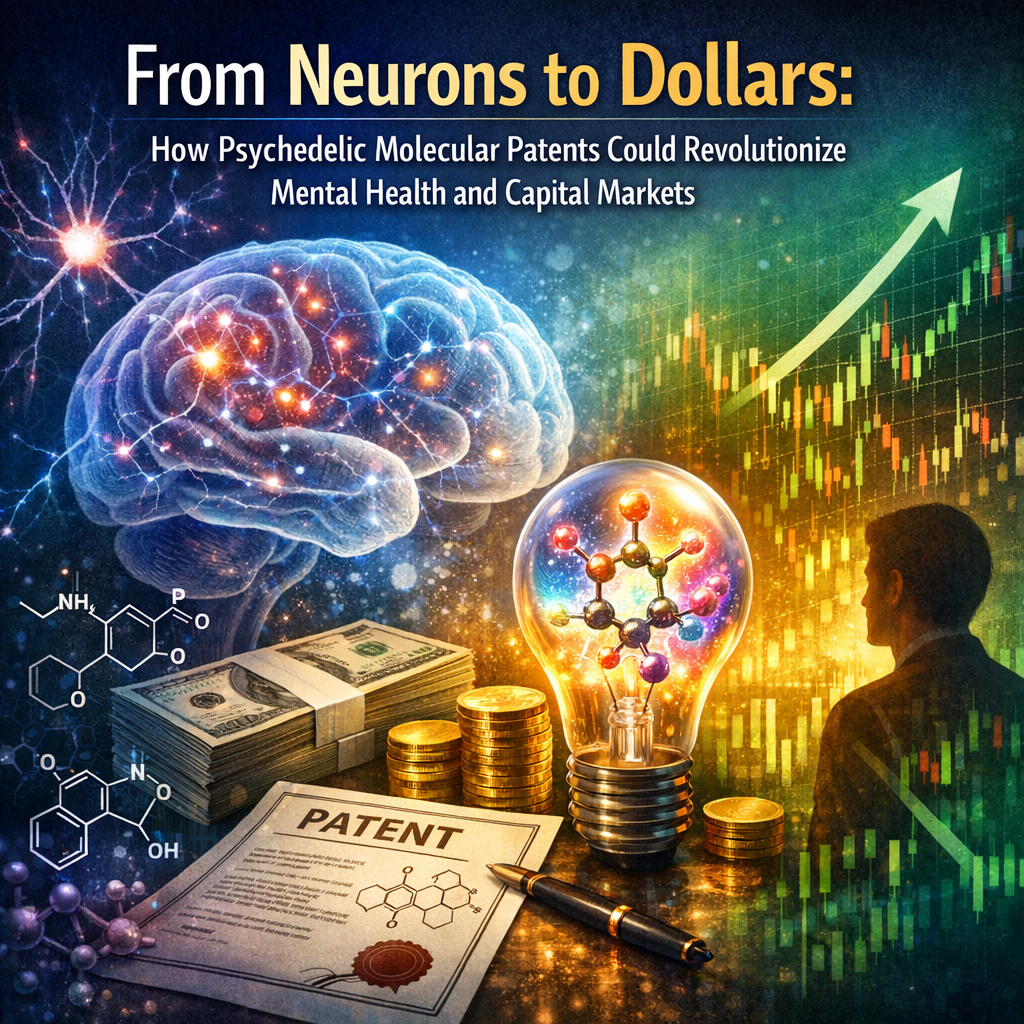
From Neurons to Dollars: How Psychedelic Molecular Patents Could Revolutionize Mental Health and Capital Markets
Introduction:
In recent years, the exploration of **psychedelics**, particularly **psilocybin**, has emerged as a beacon of potential in the treatment of **mental health disorders**. Conditions like **depression**, **anxiety**, **PTSD**, and **OCD** have plagued individuals worldwide, often with limited efficacy from traditional treatment modalities. As the **medical community** continued its search for more effective solutions, the rediscovery of psychedelic substances has brought forth revolutionary possibilities. Once relegated to the fringes of scientific respectability due to cultural stigma and legal barriers, these substances are now the subject of rigorous academic inquiry and clinical research.
This renewed interest is not merely academic. The capitalist engine senses opportunity, evidenced by the expanding number of **patents** filed for psychedelic compounds. A patent provides exclusive rights to the makers of a novel drug or therapy, allowing companies to recoup research and development costs effectively while enjoying market exclusivity. Interestingly, the implications of this patent frenzy extend beyond innovation; they could significantly impact the wider **capital markets**.
The intersection of mental health treatment and market dynamics is particularly intriguing. As scientists unveil groundbreaking findings on the potential of psychedelics to remodel neural pathways and induce lasting changes in mental health conditions, investor interest has sparked, leading to a wave of funding into biotech and pharmaceutical companies focused on psychedelic research. Corporations and startups are racing to develop new derivatives and methods, with patents as their shield against competitors. The idea is not only to capture market share but also to pioneer a novel class of medications that could transform both therapeutic landscapes and financial projections.
This article dissects how patents on psychedelic molecules might not only advance **clinical psychiatry** but also stimulate financial markets, drawing parallels to past drug innovations and exploring future scenarios for these intriguing compounds.
Features:
The momentum behind psychedelic therapies is built on promising findings from multiple studies that underline their potential efficacy and safety. A pivotal study published in *The New England Journal of Medicine* (2021) compared the effects of **psilocybin** to a leading antidepressant, with results showing the former’s advantageous effects. Within a structured therapeutic setting, participants receiving psilocybin reported greater overall psychological functioning and reduced depressive symptoms when compared to those on traditional medication ([source](https://www.nejm.org/doi/full/10.1056/NEJMoa2032994)).
Furthermore, a 2020 Phase II clinical trial conducted at **Johns Hopkins University** tested psilocybin on patients with **major depressive disorder**. The trial results were encouraging, with 67% of the participants experiencing a reduction in depression symptoms a week after treatment and 71% maintaining these changes at the four-week follow-up ([source](https://clinicaltrials.gov/ct2/show/NCT03429075)). Such findings bolster the argument for psilocybin’s potential as a revolutionary treatment, prompting interest in patenting and licensing opportunities as companies vie to advance these therapies through the pipeline to commercialization.
The expansive interest is further reflected in market forecasts. According to a report by **Research and Markets**, the psychedelic drugs market is projected to grow at a CAGR of 14.5% from 2021 to 2026, highlighting the intertwining interests of scientific breakthroughs and capital ventures ([source](https://www.researchandmarkets.com/reports/5329622/psychedelic-drugs-market-forecast-to-2026-global?utm_source=GNOM&utm_medium=PressRelease&utm_code=ppk6mv&utm_campaign=1511401+-+The+Global+Psychedelic+Drugs+Market+Forecast+to+2026&utm_exec=fgni18prh)). The financial sectors are keenly watching this space, aware that the **FDA approval** and integration of psychedelic therapies into mainstream medicine could catalyze a significant paradigm shift, akin to the arrival of **SSRIs** in the late 20th century.
Importantly, these developments underscore the complexity of patenting in this rapidly evolving domain. A multilateral approach combining scientific rigor, ethical considerations, and robust business strategy is essential to ensure that the future of psychedelic therapies aligns with medical imperatives as well as economic sustainability.
Conclusion:
The convergence of psychedelics and capital markets heralds a new era, one where revolutionary mental health treatments may redefine therapeutic boundaries. As we stand on the brink of this transformation, the challenge lies in navigating the intricate dance between neurons and dollars, ensuring that the breakthroughs in psychedelic therapy are ethically managed and economically fruitful for the benefit of global society.
**Concise Summary:**
The article explores how the resurgence of interest in psychedelics, especially psilocybin, is revolutionizing both mental health treatments and financial markets. As research highlights their potential against disorders like depression and PTSD, firms are patenting these compounds, sparking a surge in market activity. Key studies show promising results, drawing parallels to past innovations like SSRIs. The market for psychedelic drugs is growing, projected at a 14.5% CAGR until 2026, marking a significant shift. The successful integration of these therapies could redefine psychiatric treatment and economic landscapes, posing both ethical and financial considerations.

Dominic E. is a passionate filmmaker navigating the exciting intersection of art and science. By day, he delves into the complexities of the human body as a full-time medical writer, meticulously translating intricate medical concepts into accessible and engaging narratives. By night, he explores the boundless realm of cinematic storytelling, crafting narratives that evoke emotion and challenge perspectives. Film Student and Full-time Medical Writer for ContentVendor.com