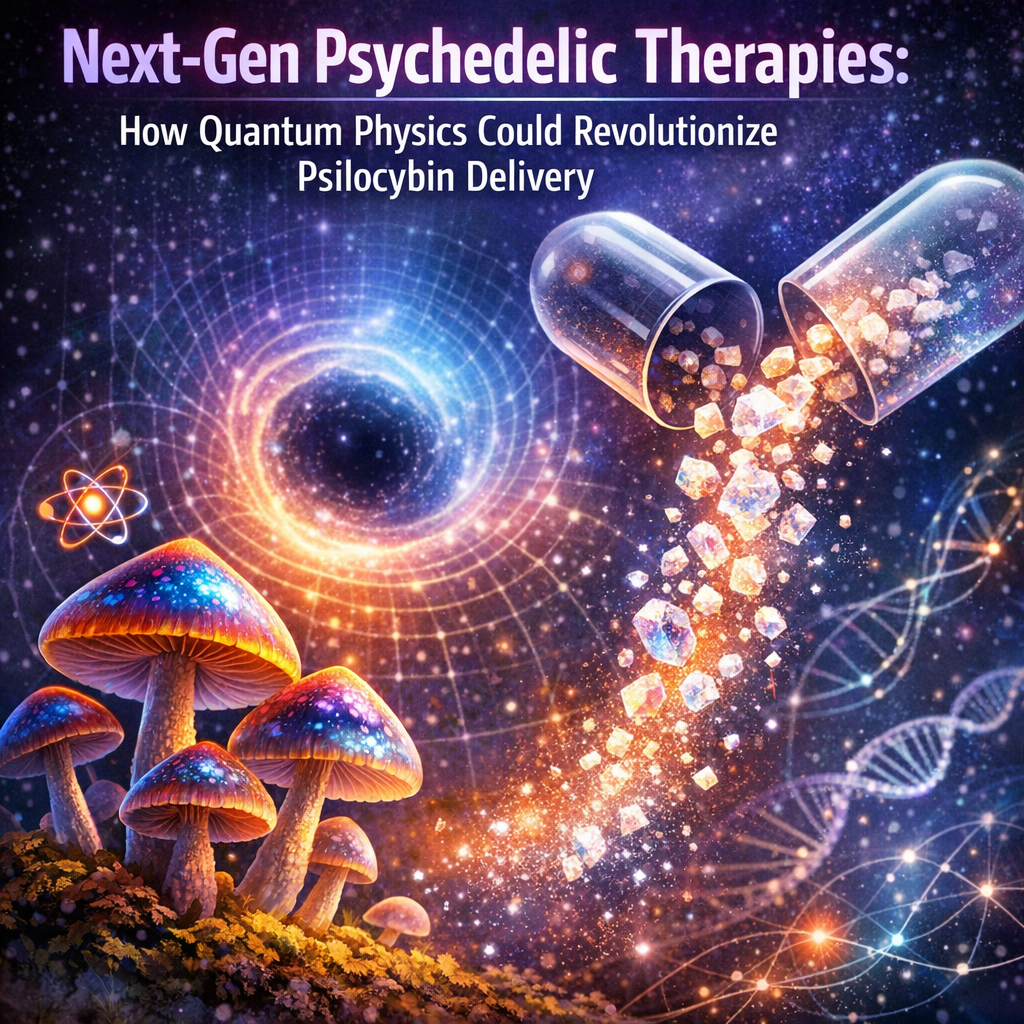
Next-Gen Psychedelic Therapies: How Quantum Physics Could Revolutionize Psilocybin Delivery
Introduction
The exploration of **psychedelics** for therapeutic purposes is experiencing a renaissance. Among these substances, **psilocybin**—the active component in **”magic mushrooms”**—has gained significant attention for its potential to treat various mental health disorders, such as **depression**, **anxiety**, and **PTSD**. Traditional delivery methods are effective but come with challenges that limit their therapeutic potential. Imagine a future where these challenges are transcended through the integration of **quantum physics**—a field typically linked with subatomic particles and the cosmos—into psychedelic therapy. This may sound like science fiction, but groundbreaking advances suggest it’s entirely plausible.
**Quantum physics**, with its principles of **superposition**, **entanglement**, and **quantum tunneling**, could provide revolutionary new ways to understand and optimize **psilocybin delivery mechanisms**. Utilizing quantum mechanics in medicine is not an entirely new idea. **Quantum computing**, for instance, is already being used to discover novel drugs and enhance current treatment modalities. Applying these principles to psilocybin therapy could increase its efficacy, minimize side effects, and personalize treatment plans in a manner that was unimaginable mere decades ago.
**Quantum tunneling** could enable psilocybin molecules to penetrate cellular barriers more efficiently, ensuring the drug acts precisely where needed while reducing side effects. **Quantum superposition** might also permit the formulation of psilocybin in its most potent states, utilizing multiple pathways in the brain simultaneously for a more robust therapeutic impact. Furthermore, **quantum entanglement** offers the intriguing possibility of real-time monitoring and adjustment of therapeutic protocols, using quantum sensors to track the biochemical responses of patients and tailor treatment dynamically.
As we stand on the brink of a new era in psychedelic therapy, the intersection of **psilocybin** and **quantum physics** presents a tantalizing frontier. The potential to optimize psilocybin delivery through this sophisticated scientific lens could revolutionize mental health treatment, offering hope to countless individuals who have not responded to conventional therapies.
Features
Recent research into **psilocybin** underscores its potential as a transformative mental health treatment. A pivotal study conducted by the **[Johns Hopkins Center for Psychedelic and Consciousness Research](https://hopkinspsychedelic.org/)** demonstrated significant reductions in **depression and anxiety symptoms** after just one or two doses of psilocybin, with effects lasting for months. However, these studies also highlight the challenges associated with psilocybin’s bioavailability and the need for precise dosing, which **quantum physics** may address.
Quantum mechanics offers a theoretical foundation for improving **drug delivery systems**. The phenomenon of **quantum tunneling** could facilitate the efficient passage of psilocybin molecules through biological membranes, enhancing their absorption and targeting specific brain regions more precisely than traditional methods allow. This could lead to increased efficacy and fewer systemic side effects, addressing significant current barriers in psilocybin therapy.
Additionally, utilizing **quantum superposition** may provide multiple overlapping states of psilocybin, translating into enhanced therapeutic versatility. According to research published in the journal **[NPJ Quantum Information](https://www.nature.com/npjqi/)**, such principles are already paving the way for innovations in drug delivery technologies, suggesting that psilocybin could benefit similarly from these advancements.
Furthermore, **quantum entanglement** raises the possibility of instantaneously tracking the physiological responses of patients to psilocybin in a clinical setting. Such real-time data could facilitate rapid adjustments to treatment protocols, ensuring that each patient receives the most effective personalized care. This is crucial, as the subjective nature of psychedelic experiences often requires adaptable therapeutic strategies.
Integrating quantum physics into **psilocybin therapy** is an emerging field, yet its feasibility and transformative potential are substantial. By leveraging the unique properties of quantum phenomena, healthcare providers could soon deliver psilocybin interventions with unprecedented precision and effectiveness.
Conclusion
The fusion of **quantum physics** with **psilocybin therapy** presents a pioneering opportunity to redefine mental health treatment. As research progresses, these next-gen psychedelic therapies could provide precise, personalized, and highly effective interventions for individuals suffering from a range of psychiatric disorders. With the potential to overcome existing limitations of traditional treatments, the marriage of quantum mechanics and psilocybin promises to open new pathways in the quest for mental wellness.
References
1. **[Johns Hopkins Center for Psychedelic and Consciousness Research](https://hopkinspsychedelic.org/)**
2. **[NPJ Quantum Information: Quantum superposition for drug delivery](https://www.nature.com/npjqi/)**
3. **[Quantum Computing and Drug Discovery](https://www.forbes.com/sites/bernardmarr/2021/04/12/the-amazing-ways-how-quantum-computing-impacts-drug-discovery-and-healthcare/)**
Concise Summary
The integration of quantum physics into psilocybin therapy offers a groundbreaking frontier for mental health treatment. By employing quantum principles like tunneling, superposition, and entanglement, psilocybin delivery could become more precise and effective. This fusion promises to address current limitations in conventional treatments, providing targeted, personalized interventions for disorders like depression and anxiety. As research advances, these next-gen psychedelic therapies could offer significant hope to patients who have not found relief through traditional methods, marking a transformative era in mental health care.

Dominic E. is a passionate filmmaker navigating the exciting intersection of art and science. By day, he delves into the complexities of the human body as a full-time medical writer, meticulously translating intricate medical concepts into accessible and engaging narratives. By night, he explores the boundless realm of cinematic storytelling, crafting narratives that evoke emotion and challenge perspectives. Film Student and Full-time Medical Writer for ContentVendor.com