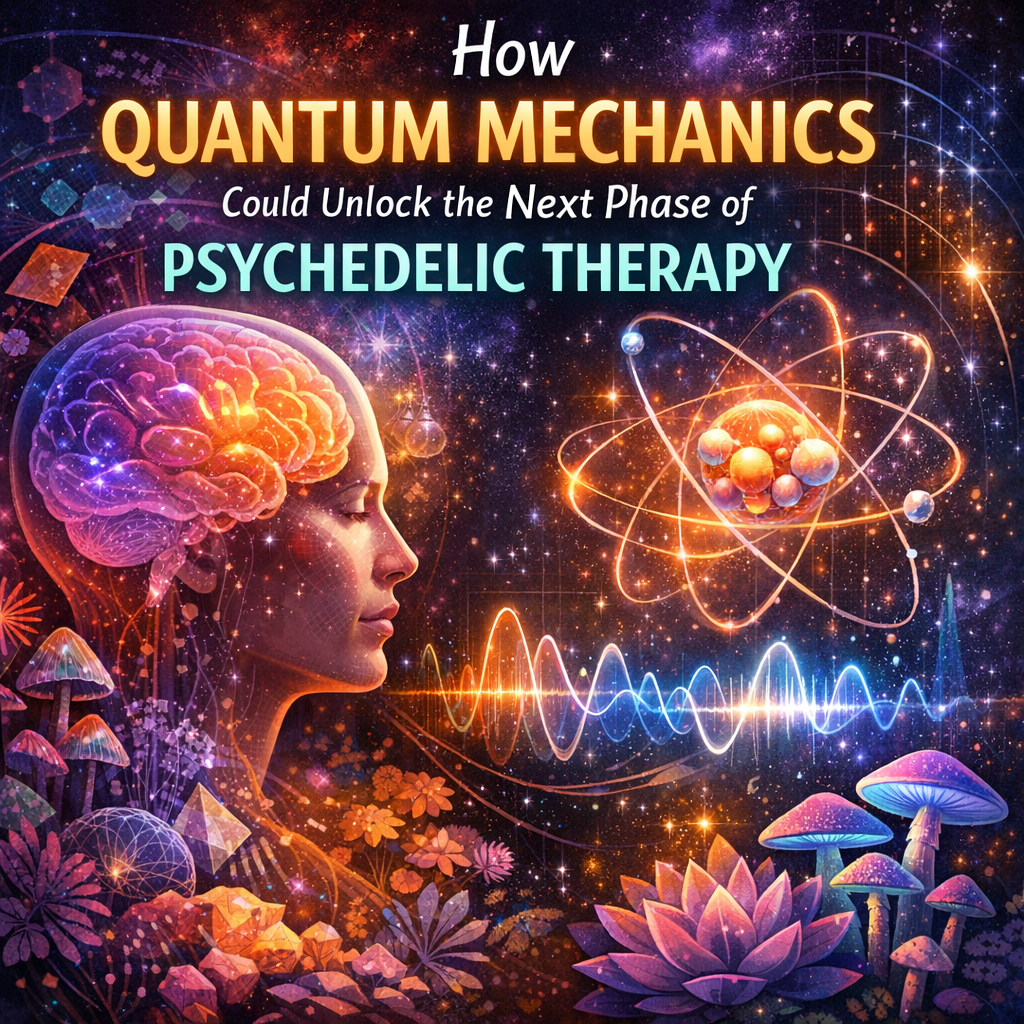
How Quantum Mechanics Could Unlock the Next Phase of Psychedelic Therapy
Introduction
In recent years, the realm of **psychedelic therapy** has gained recognition as a promising frontier in mental health treatment. **Psilocybin**, a naturally occurring psychedelic compound found in certain mushrooms, has been at the forefront, showing potential in alleviating conditions like **depression**, **anxiety**, and **PTSD**. While traditional studies have focused on biochemical pathways, a novel perspective is emerging: intertwining the enigmatic world of **quantum mechanics** with psychedelic-assisted therapy.
Quantum mechanics, the physics of subatomic particles, governs the core of matter and energy. Though seemingly distant from the world of mental health, quantum mechanics might hold potential keys to understanding and optimizing the effects of **psychedelics** on the brain. This fusion represents an interdisciplinary breakthrough offering new insights and generating therapeutic practices.
At the heart of this intersection lies the concept of **quantum consciousness**, proposing that quantum processes in the brain could influence consciousness. Researchers are exploring how altered states induced by psychedelics like **psilocybin** relate to quantum phenomena like **entanglement** and **superposition**. When ingested, psilocybin facilitates experiences where normal consciousness boundaries dissolve, enhancing the brain’s potential to operate at a quantum level.
Furthermore, **quantum biology**—investigating quantum phenomena in biological processes—provides insights into how psychedelics act at the microscopic scale. Such revelations could revolutionize perceptions of mental health disorders, offering strategies that transcend traditional biochemical reactions studied in neuroscience.
As researchers delve deeper, the goal is developing therapeutic approaches utilizing quantum principles to enhance psychedelic treatment efficacy. Integrating quantum mechanics and psychedelic therapy could lead to refined, personalized, and effective mental health care solutions.
Features
Several cutting-edge studies scaffold the potential synthesis of quantum mechanics and psychedelic therapy. One study published in “Frontiers in Psychology” delves into the hypothesis of **quantum entanglement** in consciousness, proposing that entangled neuronal states may facilitate sensory information binding during psychedelic experiences [link](https://www.frontiersin.org/articles/10.3389/fpsyg.2019.00507/full). This paper suggests that entanglement could explain the heightened interconnectedness and novel perceptual experiences reported under psilocybin therapy.
The University of Sussex contributed research indicating less predictable yet more globally integrated brain activity during psychedelic experiences, reflecting increased brain **entropy**—a concept associated with **quantum systems** [link](https://onlinelibrary.wiley.com/doi/full/10.1111/psych.12286). The increased connectivity between brain regions, observed during psychedelic states, mirrors **quantum superposition**, where particles exist in multiple states before measurement.
Moreover, a study in the “Journal of Consciousness Studies” explores how **quantum biology** principles, like those involving microtubules in neurons, could be significant in consciousness and psychedelics’ actions [link](https://philpapers.org/rec/HAMQRC). Microtubules, part of the cell’s skeleton, might act as quantum gates, processing quantum information and influencing cognitive processes during psychedelic experiences.
**Psychedelics** may therefore enhance the brain’s capacity for quantum computation, potentially leading to greater cognitive flexibility and creative problem-solving abilities. This quantum-oriented perspective offers a new lens to optimize psychedelics’ therapeutic effects for mental health disorders.
Conclusion
Integrating quantum mechanics into psychedelic therapy offers groundbreaking avenues for mental health treatment advancement. Embracing the potential of quantum processes in the brain induced by psilocybin and other psychedelics, researchers and clinicians can unveil new pathways to understanding consciousness and developing effective, personalized therapeutic strategies. As science explores these connections’ depths, the next phase of psychedelic therapy could revolutionize perceptions and treatments of the human mind.
**Concise Summary:**
The integration of **quantum mechanics** and **psychedelic therapy** presents an innovative frontier in mental health treatment, suggesting that psychedelic compounds like **psilocybin** could enhance brain function at a quantum level. Exploring concepts like **quantum consciousness**, **entanglement**, and **superposition**, researchers propose revolutionary approaches for understanding and treating mental health disorders. Cutting-edge studies support the idea that psychedelics might positively influence brain connectivity, cognitive flexibility, and problem-solving skills. This emerging interdisciplinary field could pave the way for personalized, effective therapeutic strategies, significantly advancing mental health care.

Dominic E. is a passionate filmmaker navigating the exciting intersection of art and science. By day, he delves into the complexities of the human body as a full-time medical writer, meticulously translating intricate medical concepts into accessible and engaging narratives. By night, he explores the boundless realm of cinematic storytelling, crafting narratives that evoke emotion and challenge perspectives. Film Student and Full-time Medical Writer for ContentVendor.com