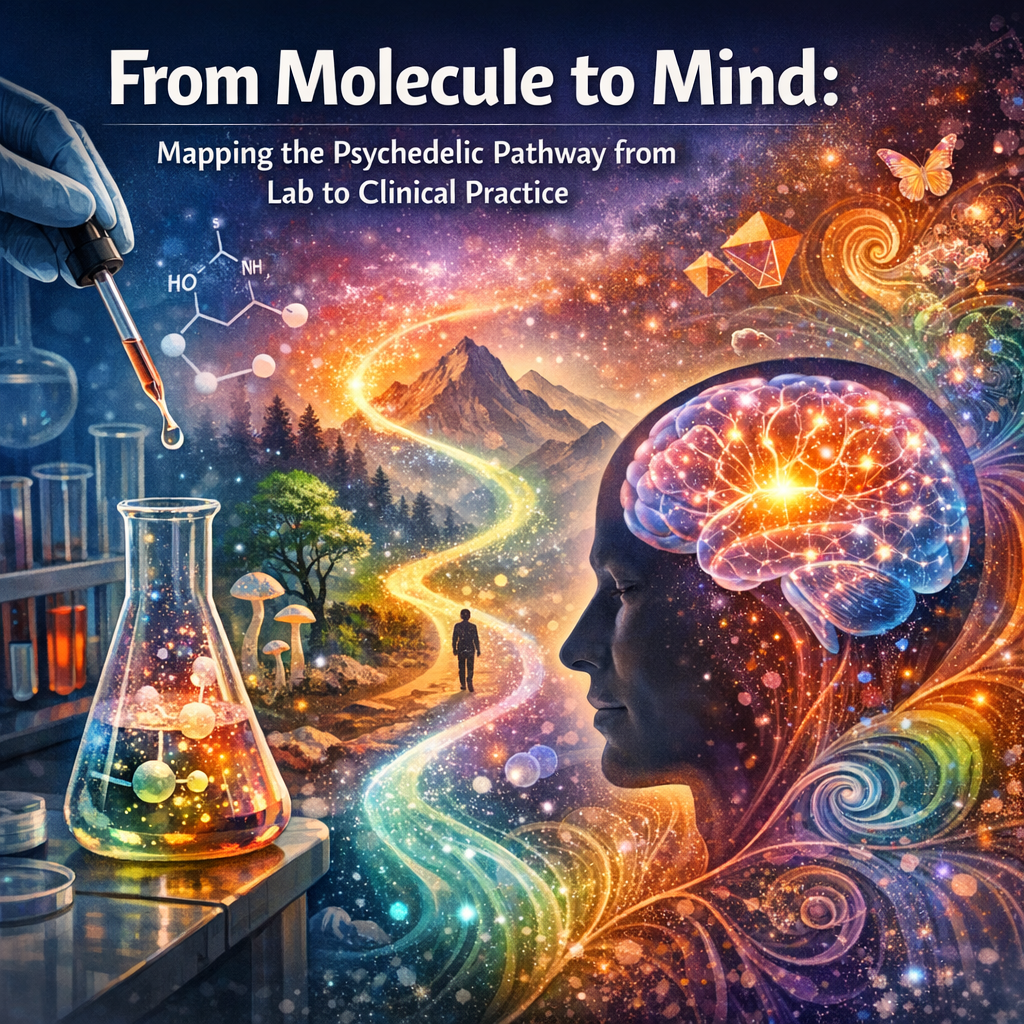
From Molecule to Mind: Mapping the Psychedelic Pathway from Lab to Clinical Practice
The frontier of **medical science** is continuously expanding, and one of the most promising areas of exploration is the use of **psychedelic substances** for **therapeutic purposes**. At the intersection of **chemistry, neurology, and psychology** lies **psilocybin**, a compound drawing significant attention for its potential role in revolutionizing **mental health treatment**. Derived from certain species of mushrooms, psilocybin is a psychedelic compound used for centuries in traditional healing practices. Today, it is being rigorously examined in laboratories and clinical trials worldwide.
Interest in **psilocybin** and other **psychedelics** has surged, fueled by their potential to treat a range of **psychiatric illnesses**, including **depression, anxiety, PTSD, and addictions**. The journey from **molecule to mind** begins in the lab, where scientists dissect these compounds to understand their **psychopharmacological effects**. Unlike traditional medications that may require a prolonged time to take effect, psilocybin is observed to facilitate rapid and profound changes in perception and mood. This ability to afford a **transpersonal experience** is the keystone of its therapeutic potential.
From a pharmacological perspective, psilocybin functions as a **prodrug**. Upon ingestion, it is metabolized into **psilocin**, which exhibits an affinity for **serotonin receptors** in the brain, particularly the **5-HT2A receptor**. This interaction alters the signaling pathways and connectivity between different neurotransmitter systems, which is believed to underpin the subjective psychedelic experience. The alterations in brain network connectivity can lead to increased emotional release, cognitive flexibility, and novel insights—attributes that can be harnessed for therapeutic rejuvenation.
In the clinical arena, psilocybin is transitioning from theoretical allure to empirical validation. Rigorous studies are underway, examining its efficacy and safety in a controlled setting. As public interest and scientific validation align, navigating the regulatory, ethical, and social implications becomes crucial. Consequently, understanding the nuances of these psychedelic therapies is vital for healthcare professionals, policymakers, and potential patients alike. With proper guidance and administration, the **molecule-to-mind** pathway has the potential to reshape the therapeutic landscape, offering relief to millions struggling with mental health disorders.
Features: Medical Studies on Psychedelic Therapies
The ascent of psilocybin into the realm of **clinical practice** is rooted in robust scientific inquiry. Preclinical and clinical studies provide evidence for its safety and efficacy, setting the stage for broader application. One landmark study conducted by **Johns Hopkins University** demonstrated psilocybin’s potential in alleviating **treatment-resistant depression**. In this study, published in JAMA Psychiatry, participants who received psilocybin-assisted therapy experienced significant reductions in depressive symptoms, with effects lasting up to four weeks post-treatment [source](https://jamanetwork.com/journals/jamapsychiatry/fullarticle/2772630).
Similarly, research conducted at **Imperial College London** underscored psilocybin’s promise in treating depression by comparing its effects head-to-head with those of **escitalopram**, a conventional antidepressant. The findings suggested comparable efficacy, with psilocybin offering advantages in terms of emotional processing and quality of life improvements [source](https://www.nejm.org/doi/full/10.1056/NEJMoa2032994).
Moreover, studies focused on psilocybin’s impact on **anxiety and substance use disorders** are yielding encouraging results. A pilot study led by **New York University** found that **cancer patients** experiencing anxiety and depression due to their diagnosis showed marked improvement in symptoms following psilocybin treatment [source](https://journals.sagepub.com/doi/10.1177/0269881116675513).
The regulatory landscape is evolving as well, with the **U.S. Food and Drug Administration (FDA)** designating psilocybin as a breakthrough therapy for treating **major depressive disorder**. This designation is reserved for treatments that demonstrate substantial improvement over existing options, reflecting the transformative potential psychedelics possess.
As the scientific community continues to explore these avenues, safety remains a paramount concern. Since the psychedelic experience can be profoundly disorienting, clinical protocols emphasize the importance of set (mindset) and setting (environment) as well as the integration phase following the experience. The comprehensive approach to psilocybin-assisted psychotherapy requires careful attention to the psychological and emotional needs of participants.
Conclusion
The trajectory from **molecule to mind** illustrates a paradigm shift in mental health treatment, where **psychedelic therapies** are gaining empirical support and mainstream attention. Psilocybin’s potential to unlock new therapeutic pathways cannot be overstated; however, its integration into clinical practice mandates balanced consideration of ethical, legal, and sociocultural factors. As studies continue to affirm and expand the therapeutic horizons of psychedelic compounds, the future invites a reimagining of mental health care and its potential to alleviate the burdens carried by millions worldwide.
Concise Summary:
Psilocybin, a compound found in certain mushrooms, is drawing attention for its potential in treating psychiatric disorders like depression and anxiety. This psychedelic is undergoing rigorous study, promising rapid therapeutic effects through its interaction with brain serotonin receptors. Landmark studies by Johns Hopkins and Imperial College demonstrate its efficacy in treating depression and anxiety, with the FDA designating it a breakthrough therapy. As research progresses, ethical and regulatory considerations are crucial to integrating these therapies into mainstream healthcare, offering hope for reshaping mental health treatment.

Dominic E. is a passionate filmmaker navigating the exciting intersection of art and science. By day, he delves into the complexities of the human body as a full-time medical writer, meticulously translating intricate medical concepts into accessible and engaging narratives. By night, he explores the boundless realm of cinematic storytelling, crafting narratives that evoke emotion and challenge perspectives. Film Student and Full-time Medical Writer for ContentVendor.com