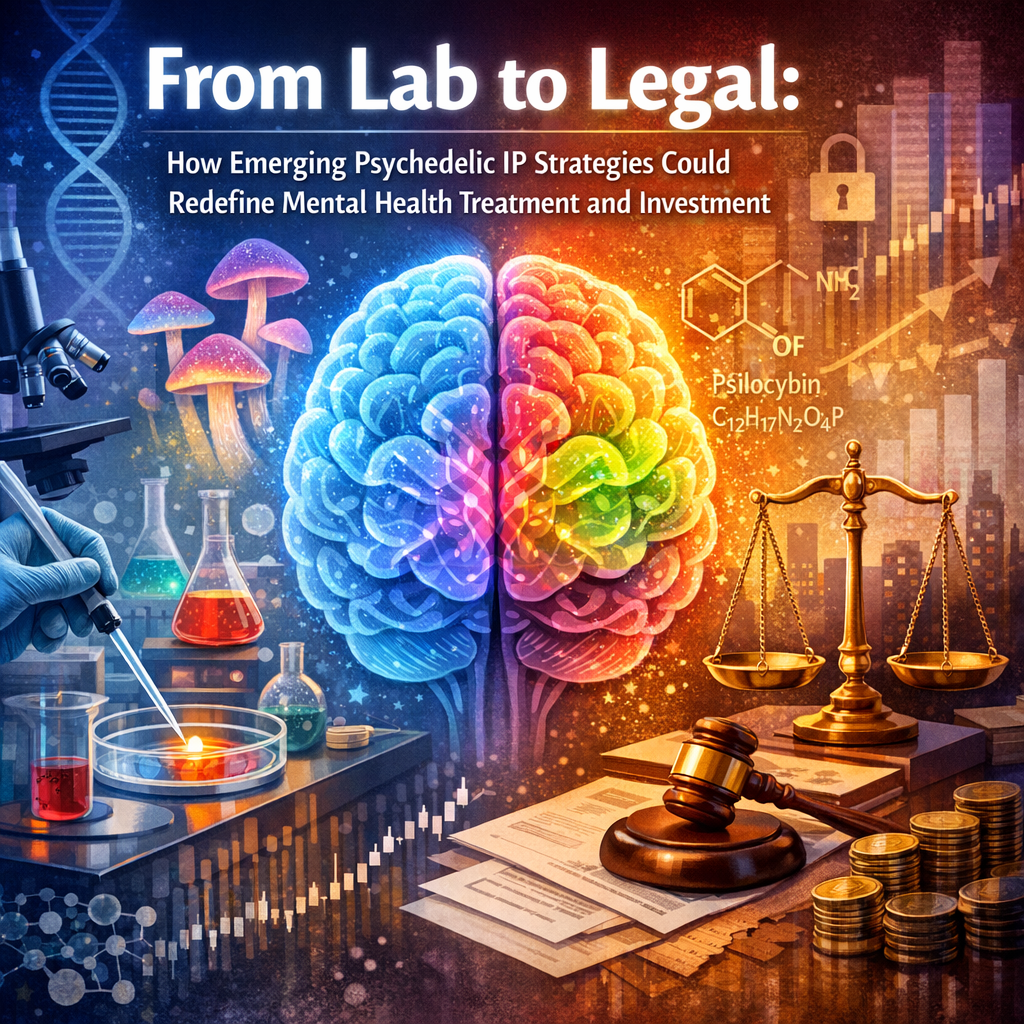
From Lab to Legal: How Emerging Psychedelic IP Strategies Could Redefine Mental Health Treatment and Investment
In recent years, the world of **mental health treatment** has begun to witness a paradigm shift, driven largely by groundbreaking research into **psychedelic compounds** like **psilocybin**, **ketamine**, and **MDMA**. Once confined to the fringes of society and associated with counterculture movements, these substances are now being **re-examined through a scientific lens**. The potential of these compounds to treat a range of mental health disorders, including **depression**, **PTSD**, and **anxiety**, has caught the attention of researchers, medical professionals, and investors alike. As the body of evidence supporting the **therapeutic benefits of psychedelics** continues to grow, so too does the interest in developing effective treatment protocols that can be brought legally and ethically into the mainstream.
This burgeoning field is not only attracting attention from the medical community but also generating significant interest as a promising area for **venture capital investment**. As countries begin to adopt more lenient regulatory stances toward **psychedelic substances**, investment opportunities are becoming increasingly abundant. A key factor in this trajectory is **intellectual property (IP) strategy**, which is rapidly emerging as a critical aspect of setting companies apart in the psychedelic treatment landscape. **Biotech firms** and research institutions are actively pursuing **patents** related to the extraction, formulation, and therapeutic application of these compounds, which may have a profound impact on future mental health treatment protocols and market competition.
In this article, we journey into the strategic IP approaches that are helping to shape the field of psychedelics. We’ll explore how companies are positioning themselves in a market once constrained by legal barriers, focusing on how intellectual property rights can be leveraged to not only secure **competitive advantages** but also promote wider access and affordability. By delving into recent studies and emerging business models, we shed light on how innovative IP tactics could play a pivotal role in the next evolution of mental health care, possibly leading to more personalized and effective treatment options for patients worldwide.
Features
Medical and scientific communities are taking note of the potential for psychedelic compounds to revolutionize mental health treatment. Several studies have explored the profound effects these substances can have on conditions that traditional pharmaceutical approaches have struggled to adequately address. For instance, a study conducted by [Johns Hopkins University](https://www.hopkinsmedicine.org) found that **psilocybin**, the active ingredient in psychedelic mushrooms, produced rapid and sustained reductions in depression and anxiety among participants who had not responded to conventional treatment protocols.
Similarly, the [Multidisciplinary Association for Psychedelic Studies (MAPS)](https://maps.org/research/mdma) has conducted extensive research on **MDMA-assisted therapy**, showing promising results for patients with PTSD. Their Phase 3 trials demonstrate that participants receiving MDMA-assisted therapy showed significant improvements in their PTSD symptoms as compared to those who underwent therapy without the drug.
From a commercial perspective, companies like **Compass Pathways** and **MindMed** are at the forefront of leveraging intellectual property strategies to carve out niches in the psychedelic treatment space. Compass Pathways, for example, has secured patents on specific methods for synthesizing psilocybin, which could not only bolster their market position but also facilitate further research and development efforts to optimize therapeutic applications. [Compass Pathways](https://www.businessinsider.com/psychedelic-medicine-startup-compass-pathways-preps-nasdaq-ipo-2020-4)
Investment is another area experiencing rapid growth, with players like **Peter Thiel** and major venture capital firms entering the market, recognizing the lucrative potential of psychedelics as mental health treatments become destigmatized. Companies are navigating complex legal and ethical landscapes, employing unique IP strategies not only to safeguard their innovations but also to push the boundaries of current medical practices.
The confluence of scientific validation and strategic IP positioning is catalyzing a new era of mental health treatment, where **psychedelics** could transition from being fringe alternatives to mainstream therapeutic options. By nurturing collaborations between **academic researchers** and **biotechnology companies**, the potential exists to redefine not only how mental health disorders are treated but also how investment in this sector could be structured for long-term societal benefits.
Conclusion
As psychedelics steadily gain acceptance within both the scientific community and the general public, their potential to revolutionize mental health treatment is becoming more apparent. By focusing on pioneering IP strategies alongside rigorous scientific research, the field stands poised to spearhead major advancements in mental health care. Ultimately, as these approaches mature, they offer not only lucrative investment opportunities but also the chance to make significant positive impacts on global mental health outcomes.
**Concise Summary**
The exploration of **psychedelic compounds** like psilocybin, ketamine, and MDMA is reshaping mental health treatment. As research highlights their potential to treat conditions like depression, PTSD, and anxiety, interest from both the medical community and investors intensifies. With more lenient regulations and strategic IP positioning, companies are leveraging patents to advance treatment and secure market positions. Investment in this burgeoning field is bolstered by potential therapeutic breakthroughs, attracting significant venture capital. As psychedelics gain mainstream acceptance, they promise transformative impacts on mental health care, alongside lucrative investment opportunities.

Dominic E. is a passionate filmmaker navigating the exciting intersection of art and science. By day, he delves into the complexities of the human body as a full-time medical writer, meticulously translating intricate medical concepts into accessible and engaging narratives. By night, he explores the boundless realm of cinematic storytelling, crafting narratives that evoke emotion and challenge perspectives. Film Student and Full-time Medical Writer for ContentVendor.com