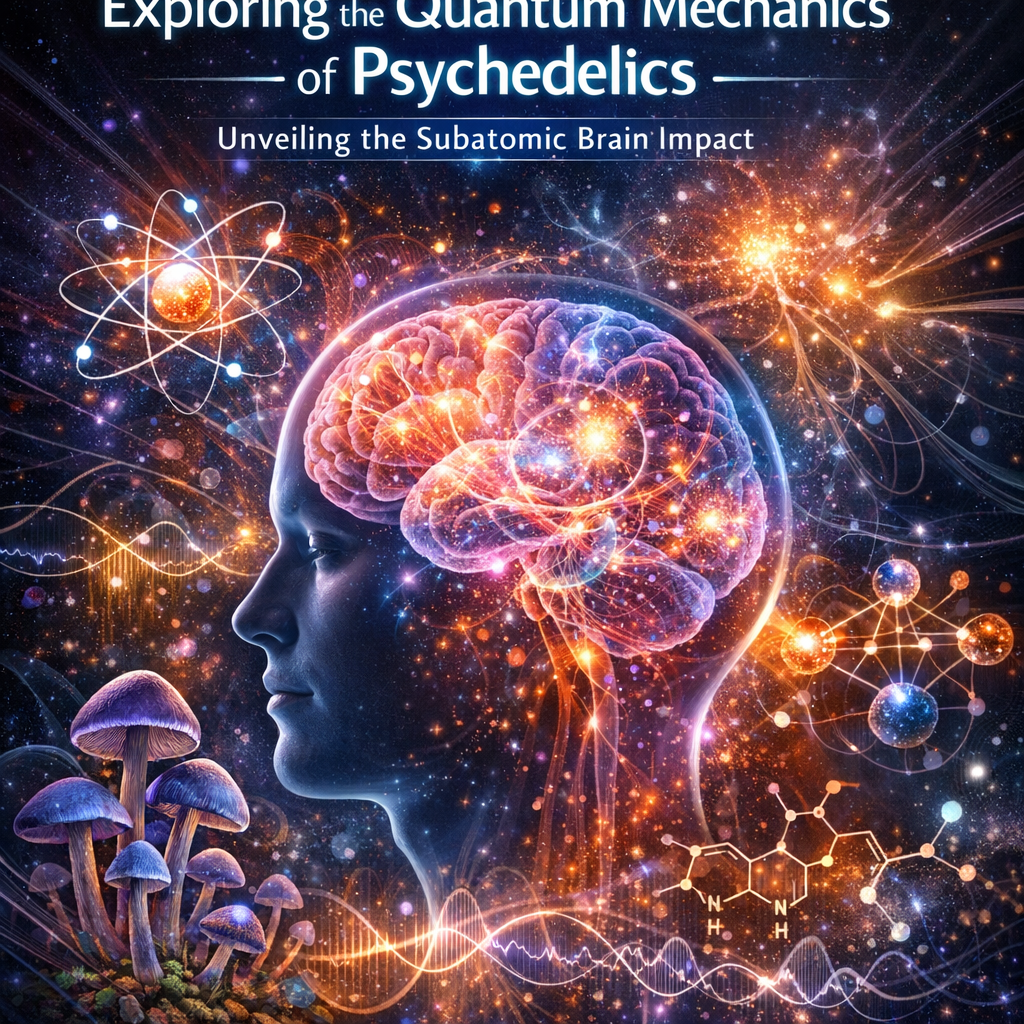
Exploring the Quantum Mechanics of Psychedelics: Unveiling the Subatomic Brain Impact
Introduction
In recent years, the exploration of **psychedelics** has captured the attention of researchers, medical practitioners, and individuals seeking personal growth. Among the most compelling aspects of this exploration is the intersection between psychedelics and **quantum mechanics**, which offers a fascinating perspective on how these substances influence **consciousness** at a subatomic level. Psychedelics, such as **psilocybin**, have demonstrated profound effects on human **perception**, **cognition**, and **emotional processing**. These effects are often attributed to their ability to alter **neural connectivity**, but emerging theories suggest the involvement of **quantum processes** within the brain.
The concept of quantum mechanics provides a framework for understanding the behavior of matter and energy at the smallest scales—those of atoms and subatomic particles. When applied to **neuroscience**, it opens new avenues for deciphering the complex processes behind consciousness and cognitive functions. Could it be that psychedelics are tapping into these quantum processes, altering the brain’s energetic or informational systems?
Research in the field of **quantum brain dynamics** suggests that consciousness might involve quantum processes. This concept is partly rooted in the observed phenomena of “quantum entanglement” and “superposition,” which could theoretically influence cognitive states at the macro level when initiated at the micro level. Psychedelics may act as catalysts, intensifying or altering quantum processes that contribute to consciousness and perception. The vivid hallucinations and the profound sense of interconnectedness commonly reported may be manifestations of unconventional information exchange at the quantum level.
Furthermore, psilocybin and similar **psychedelics** might enhance the brain’s quantum coherence, facilitating greater synchronization across neuronal assemblies. This enhanced coherence could allow the brain to operate in a more integrated, holistic manner. While conventional neuroscience often focuses on **neurotransmitter systems**, such as serotonin receptor binding, the potential quantum dimension offers a paradigm shift, promoting broader questions on the nature of consciousness and the full spectrum of human cognition.
Features
Numerous studies have ventured into the effects of **psychedelics** on neural activity, offering glimpses into their potential quantum dimensions. The work of researchers like Dr. H. Kieran Fox at Stanford University and Dr. Robin Carhart-Harris at Imperial College London has provided pivotal insights. Studies involving functional magnetic resonance imaging (**fMRI**) and electroencephalography (**EEG**) on individuals under the influence of psychedelics reveal increased global connectivity in the brain, indicating a breakdown of normal network hierarchies [Source: **Carhart-Harris et al., 2012, Neuropsychopharmacology**](https://www.nature.com/articles/npp2012233).
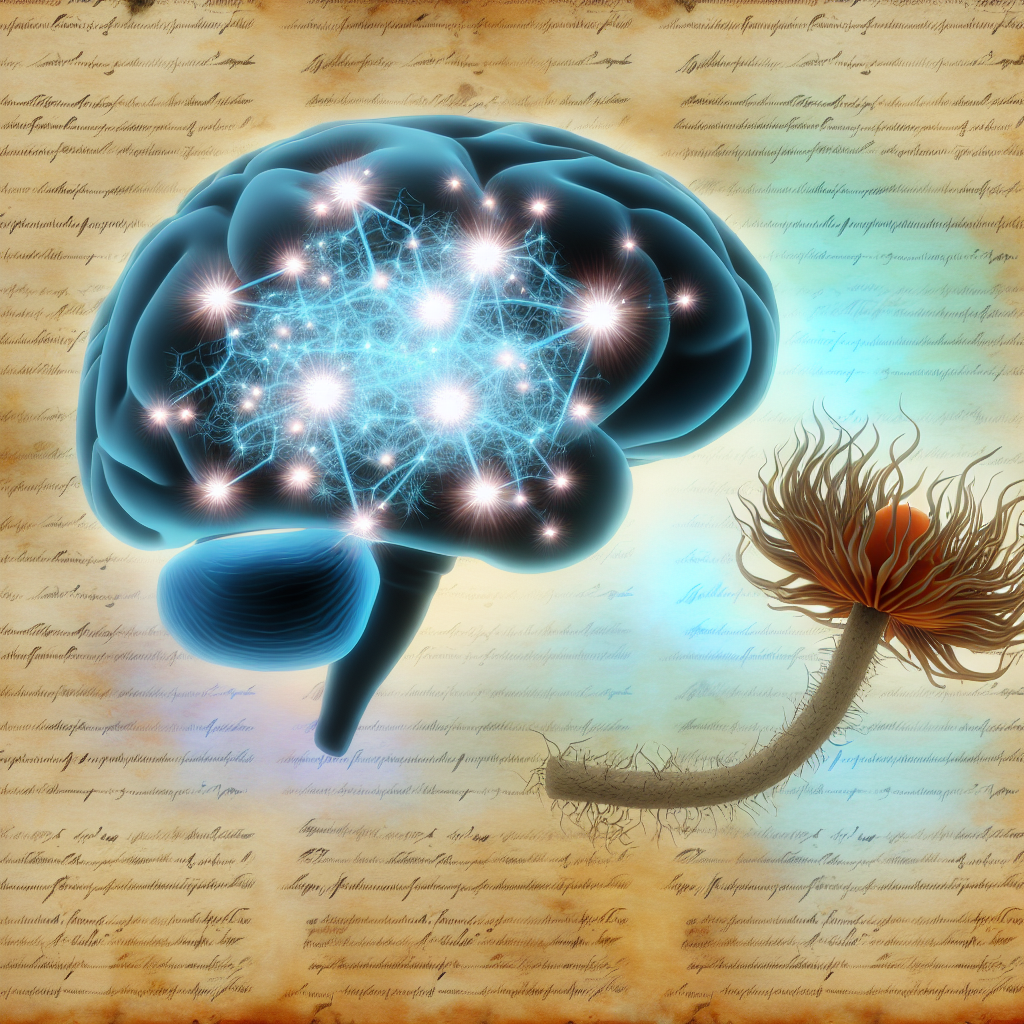
While mainstream neuroscience attributes these effects to neurotransmitter interactions, the overlap with quantum theory emerges when considering the **microtubule theory of consciousness** proposed by Dr. Stuart Hameroff and physicist Sir Roger Penrose. Their theory, often referred to as **Orchestrated Objective Reduction (Orch-OR)**, postulates that quantum processes within the microtubules of neurons contribute to consciousness. The intriguing proposition is that psychedelics may influence these microtubule structures, promoting states of unified consciousness or altered perception by enhancing quantum coherence [Source: **Hameroff & Penrose, 2014, Physics of Life Reviews**](https://www.sciencedirect.com/science/article/abs/pii/S1571064513001188).
Additionally, studies in psychopharmacology suggest that psilocybin can promote **neuroplasticity** and synaptic growth. While these changes are measurable through conventional scientific approaches, the quantum mechanics perspective posits that such biological modifications might also be linked to alterations at the quantum scale, where psychedelics modify probabilistic realities at a subatomic level [Source: **Ly et al., 2018, Cell Reports**](https://www.cell.com/cell-reports/pdf/S2211-1247(18)31400-5.pdf).
It is essential to highlight that the quantum influence of psychedelics is still speculative, requiring more exploratory research for conclusive evidence. However, the potential for future scientific advancements in this interdisciplinary arena is vast and might redefine how we understand both consciousness and the therapeutic potential of psychedelic substances.
Conclusion
The exploration of **psychedelics** through the lens of **quantum mechanics** is an innovative frontier poised to provide deeper insights into consciousness and cognitive function. As research continues to unveil the link between psychedelics and subatomic processes, we may soon gain a better understanding of the fundamental relationship between the microcosm of quantum particles and the macrocosm of human experience. This burgeoning field holds the promise of not only advancing psychedelic science but also transforming our perception of reality and the potential for healing at the deepest levels of human consciousness.
Concise Summary
This article explores the intersection of **psychedelics** and **quantum mechanics**, proposing that substances like **psilocybin** affect consciousness at a subatomic level. While traditionally attributed to neural connectivity changes, emerging research suggests psychedelics could influence **quantum processes** in the brain, enhancing **quantum coherence** and altering perception. Studies highlight increased brain connectivity and potential modifications at the quantum level, though these ideas are still speculative. The article calls for further research, highlighting the potential of this interdisciplinary approach to redefine our understanding of consciousness and the therapeutic potential of psychedelics.

Dominic E. is a passionate filmmaker navigating the exciting intersection of art and science. By day, he delves into the complexities of the human body as a full-time medical writer, meticulously translating intricate medical concepts into accessible and engaging narratives. By night, he explores the boundless realm of cinematic storytelling, crafting narratives that evoke emotion and challenge perspectives. Film Student and Full-time Medical Writer for ContentVendor.com