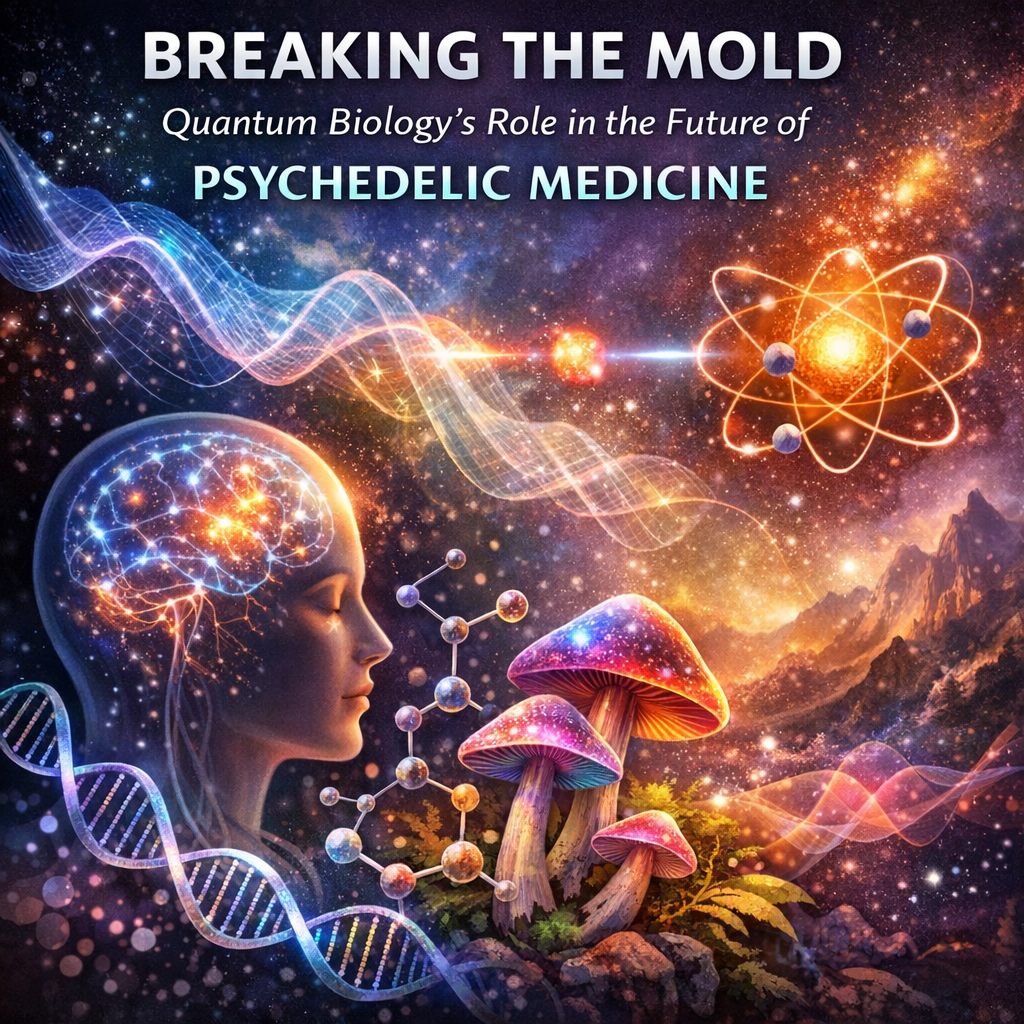
Breaking the Mold: Quantum Biology’s Role in the Future of Psychedelic Medicine
Introduction:
In the shifting landscape of modern medicine, the intersection of traditional healing practices and cutting-edge science has never been more exciting—or promising. One of the most intriguing crossovers is occurring between the ancient art of using **psychedelic mushrooms** and the pioneering field of **quantum biology**. Psychedelic substances like **psilocybin**, found in certain mushrooms, have been used by various cultures for centuries to facilitate spiritual experiences and heal the mind. Today, these natural compounds are stepping into the limelight as serious contenders in the realm of psychological and neurological treatment.
**Quantum biology**, on the other hand, is the study of how **quantum mechanics**—principles that describe the bizarre, subatomic behaviors of particles—intricately influence biological processes. Recent advancements suggest that **quantum effects** could be deeply embedded in biochemical reactions, potentially affecting everything from how plants harness light to how animals navigate the globe. If quantum biology factors into fundamental biological processes, might it also influence how psilocybin interacts with the brain?
The promise of **psychedelic medicine** must be revisited. Psilocybin, being a promising natural cure, represents a new paradigm in mental health treatment, especially in areas where conventional approaches fall short. It interacts with **serotonin receptors** to create altered states of consciousness, which can yield therapeutic outcomes such as the alleviation of **depression**, **anxiety**, and **PTSD**. However, the integration of quantum biology into this conversation introduces a revolutionary lens to explore how these interactions occur at a molecular level, providing unprecedented insight into the mechanics of the human mind.
The potential for quantum biology to illuminate the pathways through which psilocybin operates could herald a new era of personalized psychedelic medicine. If quantum principles are found to underpin psilocybin’s efficacy, this could lead to novel treatment modalities that are more predictable and effective, leading to a breakthrough in how mental health conditions are approached—where quantized actions might translate into measurable healing.
Features:
Emerging research into quantum biology suggests that quantum effects may be a missing piece of the puzzle in understanding psychedelic substances. A pivotal study published by the Journal of Neuroscience indicated that **quantum entanglement**—where particles become interconnected such that the state of one can instantaneously influence the state of another—might play a significant role in neural processing. This raises the question: could the entangled state fostered by psilocybin utilization result in new neural pathways that promote cognitive flexibility and resilience?
Moreover, recent studies have highlighted the importance of **quantum tunneling** in enzymatic reactions. This principle could be especially relevant in how neurotransmitters like serotonin are processed in the presence of psilocybin. In this context, quantum tunneling provides a framework to explore the speed and accuracy of biochemical interactions that occur within the brain, potentially explaining how certain individuals experience profound therapeutic effects following psilocybin ingestion.
Further corroborating this angle, a groundbreaking study by the University of Sussex explored brain imaging results derived from psilocybin-assisted therapy. Researchers found increased connectivity between different brain networks, resulting in a more flexible cognitive state. Quantum biology could provide the mechanism that explains these shifts. Understanding the quantum underpinnings of brain activity might allow scientists to fine-tune psychedelic interventions, customizing treatment plans for individual patients based on their unique quantum-biological profiles.
Additionally, there exists a promising avenue for developing diagnostic tools and treatment protocols that leverage quantum principles. If scientists can determine how quantum mechanics interact with psilocybin at an atomic level, they might design therapies that more accurately target specific mental health disorders through the precise manipulation of quantum states. This revolutionary approach could render a new breed of psychedelic treatment that is both potent and specifically tailored to optimize patient outcomes.
Conclusion:
The convergence of quantum biology and psychedelic medicine holds immense potential to further our understanding of the fundamental interactions that lead to mental health transformations. By unearthing the quantum processes underpinning psilocybin’s therapeutic effects, researchers may unlock new dimensions of healing not previously envisioned. As we continue to explore these frontiers, this fusion of ancient wisdom and modern science promises to redefine the future of psychedelic therapy—pointing toward a more profound comprehension of the human mind and its healing possibilities.
**Concise Summary:**
The article explores the promising intersection of **quantum biology** and **psychedelic medicine**, particularly in understanding how **psilocybin** from **psychedelic mushrooms** can revolutionize mental health treatments. Quantum biology studies the influence of quantum mechanics on biological processes, potentially explaining psilocybin’s interaction with the brain. As traditional and cutting-edge sciences unite, new insights may emerge on psilocybin’s therapeutic potential, particularly for conditions like **depression** and **PTSD**. If quantum principles underpin these effects, personalized treatments could be developed, offering more effective and tailored mental health solutions through the manipulation of quantum states.

Dominic E. is a passionate filmmaker navigating the exciting intersection of art and science. By day, he delves into the complexities of the human body as a full-time medical writer, meticulously translating intricate medical concepts into accessible and engaging narratives. By night, he explores the boundless realm of cinematic storytelling, crafting narratives that evoke emotion and challenge perspectives. Film Student and Full-time Medical Writer for ContentVendor.com