Beyond Psilocybin: Exploring the Neuroactive Potential of Non-Psychedelic Medicinal Mushrooms in Mental Health Treatment
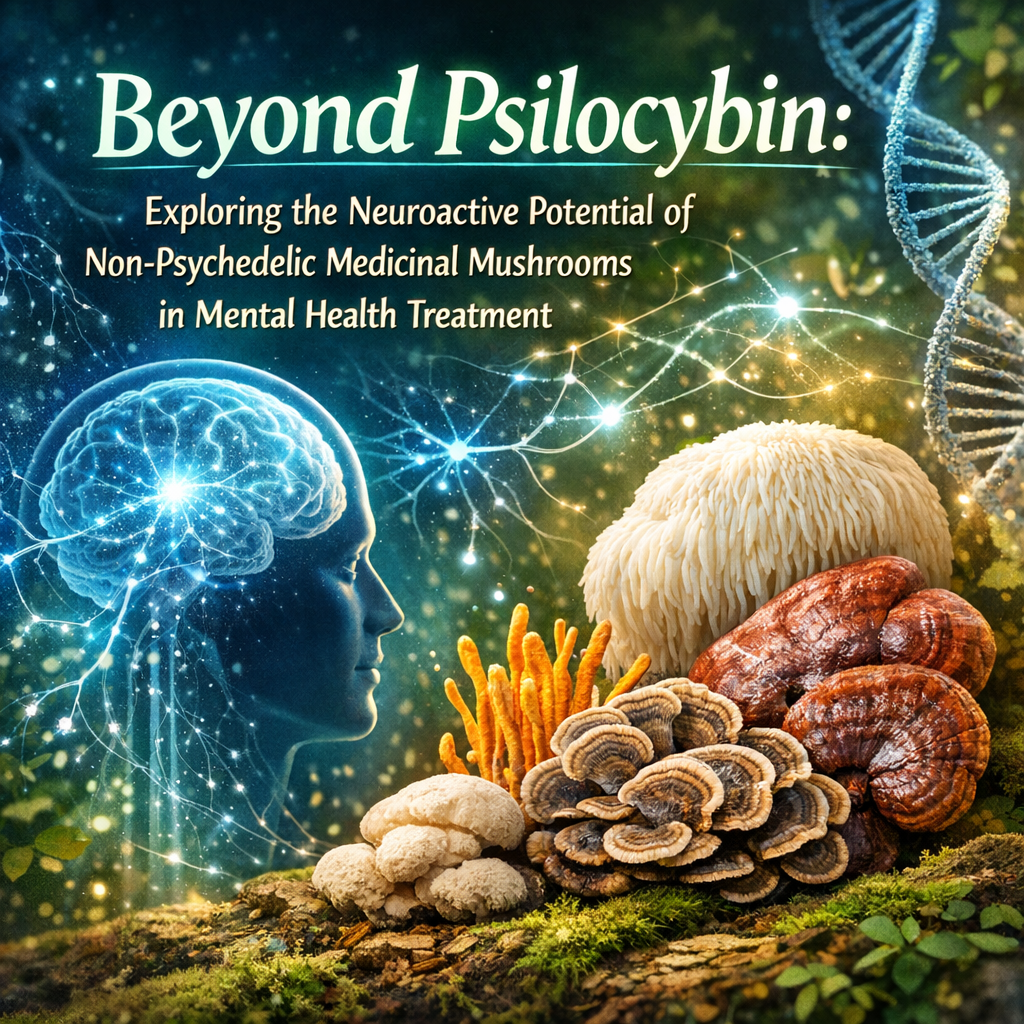
The burgeoning field of **medicinal mushrooms** has captured the interest of both the scientific community and the general public, especially following the rise of **psilocybin** and its potential to revolutionize **mental health treatment**. However, while psilocybin mushrooms have dominated headlines for their psychoactive properties, a spectrum of **non-psychedelic medicinal mushrooms** offers profound **neuroactive potential** without altering consciousness. These fungi, including **Lion’s Mane**, **Reishi**, and **Cordyceps**, among others, are emerging as promising contributors to **mental wellness** and **cognitive health**.
Lion’s Mane mushroom (Hericium erinaceus) has gained recognition for its potential in promoting **nerve growth factor (NGF)** synthesis, which aids in the maintenance, survival, and regeneration of neurons. Recent studies have highlighted its capability to enhance cognitive function, suggesting its usefulness for **neurodegenerative conditions** such as **Alzheimer’s disease**. The mushroom contains hericenones and erinacines—compounds advancing **neuroplasticity** and contributing to improved **mental clarity** and focus.
Reishi (Ganoderma lucidum) is often revered as the “mushroom of immortality.” Though long associated with longevity, contemporary research underscores its **neuroprotective qualities**. Reishi contains triterpenes and polysaccharides which exhibit **anxiolytic** and **mood-regulating** effects, making it a candidate for managing **stress-related disorders** and enhancing overall **mental resilience**.
Cordyceps (Cordyceps militaris and Cordyceps sinensis) has traditionally been used to boost energy and endurance. Recent findings suggest its **adaptogenic** properties can modulate stress and improve mood and vitality. Cordycepin, an active compound in Cordyceps, appears promising in balancing **neurotransmitter** levels, thus potentially alleviating symptoms of **depression** and **anxiety**.
While psilocybin has become a focal point for psychedelic-assisted **psychotherapy**, these non-psychedelic mushrooms provide complementary benefits that align with the growing trend of integrating natural remedies into mental health treatments. Their non-addictive, non-hallucinogenic characteristics make them appealing for individuals seeking natural ways to support their mental health without the necessity of altered states. The potential benefits of these mushrooms extend not only to individuals with diagnosed mental health disorders but also to those seeking enhanced **mental clarity**, **mood stability**, and **stress resilience** in the course of their daily lives.
Features
Multiple scientific investigations reinforce the neuroactive potential of non-psychedelic medicinal mushrooms. For instance, a 2019 study published in the *International Journal of Molecular Sciences* delved into Lion’s Mane’s capacity to stimulate NGF synthesis, revealing its prowess in possibly reversing cognitive deficits. Another study in *Biomedical Research* demonstrates Lion’s Mane’s impact on relieving mild cognitive impairment, bolstering its reputation as a nootropic powerhouse [source](https://www.ncbi.nlm.nih.gov/pmc/articles/PMC6686111/).
In parallel, research probing Reishi mushrooms discovered significant therapeutic potential. A randomized controlled trial published in the *Journal of Ethnopharmacology* examined Reishi’s effects on mood disorders, showcasing its significant contributions to reducing anxiety and depressive symptoms in patients [source](https://www.sciencedirect.com/science/article/pii/S037887411730511X). These outcomes are attributed to its active components, which lend to the regulation of the **hypothalamic-pituitary-adrenal (HPA) axis**, crucial in the **stress response**.
Cordyceps’ role in mental health care is backed by research in *Phytotherapy Research*, highlighting its alleviative impacts on fatigue and mood enhancement. Cordycepin’s influence on **serotonin modulation** enhances its potential as a candidate for treating depression and anxiety [source](https://onlinelibrary.wiley.com/doi/abs/10.1002/ptr.6119). As more clinical trials bring these findings into mainstream acceptance, the case for Cordyceps in mental health regimens continues to strengthen.
While traditional clinical practices evolve, these mushrooms offer a holistic approach, aligning with the increasing desire for natural therapeutic options. The confluence of ancient wisdom and modern science is driving a shift toward embracing these mushrooms for their vast medicinal properties, underscoring a future where natural compounds can stand alongside pharmaceuticals in the mental health domain.
Conclusion
The exploration of non-psychedelic medicinal mushrooms opens new horizons in **mental health treatment**, providing more avenues for holistic intervention. While ongoing research is essential to fully substantiate these mushrooms’ therapeutic roles, their integration into wellness regimes already signifies a paradigm shift towards harnessing nature’s remedies for cognitive health and emotional well-being. By tapping into the rich biodiversity of fungi, we may unlock new pathways to mental resilience and health.
**Concise Summary**
The rising interest in **medicinal mushrooms** extends beyond **psilocybin** to include non-psychedelic mushrooms like **Lion’s Mane**, **Reishi**, and **Cordyceps**. These mushrooms offer promising **neuroactive potential** for improving mental wellness, supporting **cognitive health**, and managing stress without altering consciousness. **Lion’s Mane** promotes neuron regeneration, potentially benefiting **neurodegenerative conditions**. **Reishi** helps regulate mood and exhibits **neuroprotective qualities**, while **Cordyceps** enhances **mood** and balances **neurotransmitters**, aiding **depression** and **anxiety**. Their integration into health regimes showcases a trend toward natural treatments for mental resilience and emotional well-being.

Dominic E. is a passionate filmmaker navigating the exciting intersection of art and science. By day, he delves into the complexities of the human body as a full-time medical writer, meticulously translating intricate medical concepts into accessible and engaging narratives. By night, he explores the boundless realm of cinematic storytelling, crafting narratives that evoke emotion and challenge perspectives. Film Student and Full-time Medical Writer for ContentVendor.com