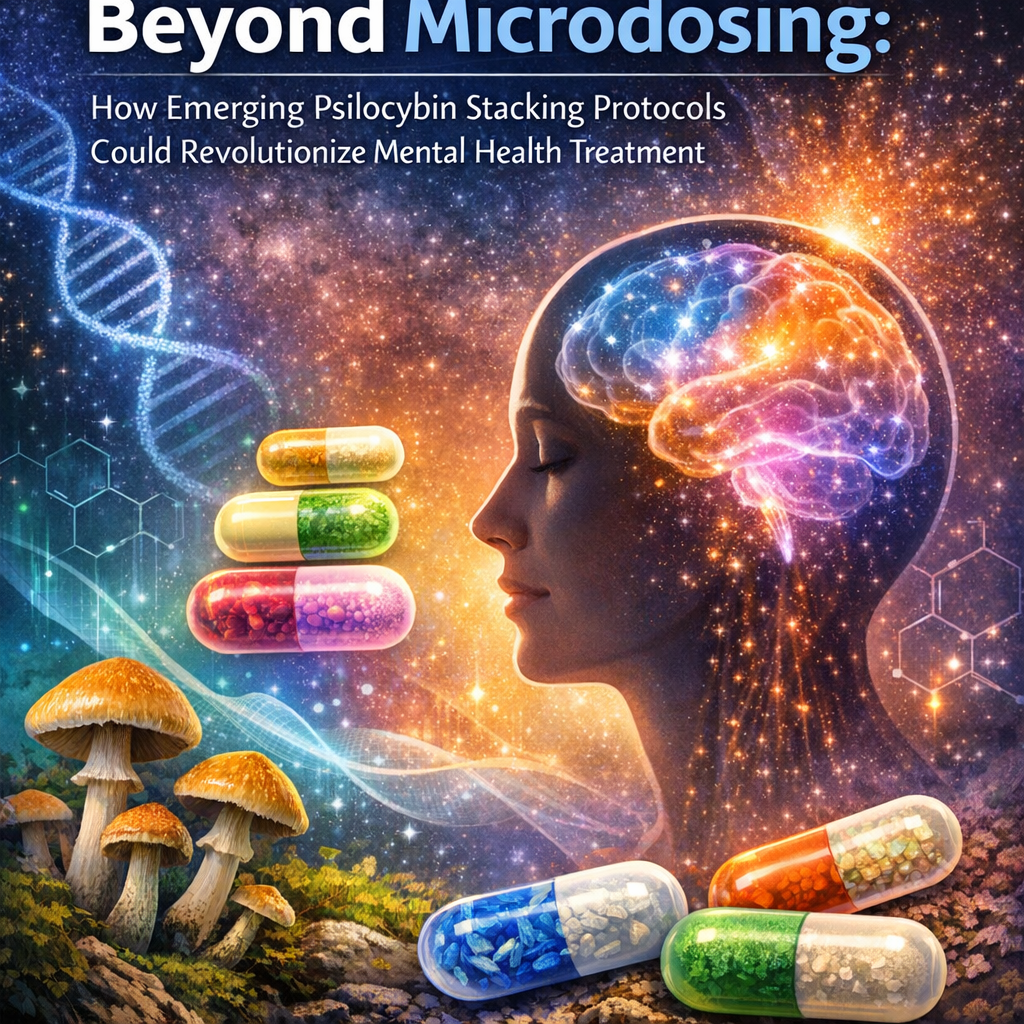
Beyond Microdosing: How Emerging Psilocybin Stacking Protocols Could Revolutionize Mental Health Treatment
In recent years, the mental health field has seen a resurgence of interest in **psilocybin**, the psychedelic compound found in certain mushrooms. **Psilocybin microdosing**, where individuals take sub-perceptual doses, has gained popularity for its benefits, such as enhanced **creativity** and improved emotional balance. However, a growing interest in **psilocybin stacking protocols** is emerging. These protocols combine psilocybin with other nootropic substances and vitamins to tailor therapeutic effects to individual needs.
The concept of psilocybin stacking relies on the idea that combining specific natural supplements yields a synergistic effect, potentially offering more comprehensive benefits than psilocybin alone. For instance, adding adaptogens like **lion’s mane mushroom**, known for cognitive-enhancing properties, or **vitamin B3** (niacin), which aids in energy production, may amplify psilocybin’s effectiveness. Such combinations could revolutionize treatments for various mental health issues, including **depression**, **anxiety**, and **PTSD**.
As many seek alternatives to conventional pharmaceuticals, psilocybin stacking offers promising potential for addressing mental health challenges holistically. Importantly, these protocols are based on an understanding of pharmacodynamics and how compounds interact neurologically and systemically, marking a significant shift away from a one-size-fits-all approach. This personalized mental health strategy is garnering increasing scientific interest and anecdotal support. While regulatory frameworks are catching up with the pace of psilocybin research, stacking protocols may become integral to personalized mental health care, offering new hope for sustainable and effective solutions.
Features:
One groundbreaking aspect of psilocybin stacking protocols is their potential to unlock new therapeutic opportunities for mental health treatment. Research, though nascent, is rapidly unfolding. Notably, a study conducted by **Johns Hopkins University** found that psilocybin, administered in controlled settings, could provide rapid and sustained relief from depression ([source](https://pubmed.ncbi.nlm.nih.gov/33165612/)). This study, among others, has paved the way to explore how combining psilocybin with other supplements could enhance mental health outcomes.
A complementary approach is demonstrated in anecdotal reports and smaller clinical trials exploring the combination of psilocybin and lion’s mane mushroom. Lion’s mane promotes nerve growth factor (NGF) in the brain, crucial for cognitive function and **neuroplasticity** ([source](https://www.ncbi.nlm.nih.gov/pmc/articles/PMC5782459/)). By stacking lion’s mane with psilocybin, users report increased clarity, focus, and mental resilience. Preliminary research suggests a synergistic action that could offer enhanced therapeutic effects beyond psilocybin alone.
Researchers are also investigating the combination of psilocybin with vitamin B3 ([source](https://www.ncbi.nlm.nih.gov/pmc/articles/PMC4210951/)), which facilitates the distribution of psilocybin’s active components throughout the nervous system. Vitamin B3 is known to dilate blood vessels and may improve cognitive functions by aiding cellular energy production, potentially augmenting psilocybin effects. These explorations indicate that psilocybin stacking could not only heighten beneficial effects but also reduce potential side effects, leading to safer and more efficient therapeutic protocols.
Conclusion:
As psilocybin stacking protocols continue to emerge, they hold the promise of a paradigm shift in mental health treatment. By moving beyond microdosing to incorporate targeted natural supplements, these protocols may offer more robust and personalized approaches for mental health challenges. With ongoing research and clinical trials, psilocybin stacking is poised to become an innovative and effective solution in the quest to improve mental well-being and resilience. However, it is crucial for individuals to consult with healthcare professionals before engaging in psilocybin stacking to ensure safety and efficacy.
**Concise Summary:**
Psilocybin stacking protocols, combining psilocybin with other supplements like lion’s mane mushroom and vitamin B3, are emerging as potential game-changers in mental health treatment. Unlike simple microdosing, these protocols aim to create synergistic effects, offering personalized therapeutic approaches for depression, anxiety, and PTSD. Early studies and anecdotal evidence support their efficacy, suggesting that stacking could heighten benefits and reduce side effects. As research progresses, this innovative strategy could significantly enhance mental well-being, though professional consultation remains essential.

Dominic E. is a passionate filmmaker navigating the exciting intersection of art and science. By day, he delves into the complexities of the human body as a full-time medical writer, meticulously translating intricate medical concepts into accessible and engaging narratives. By night, he explores the boundless realm of cinematic storytelling, crafting narratives that evoke emotion and challenge perspectives. Film Student and Full-time Medical Writer for ContentVendor.com