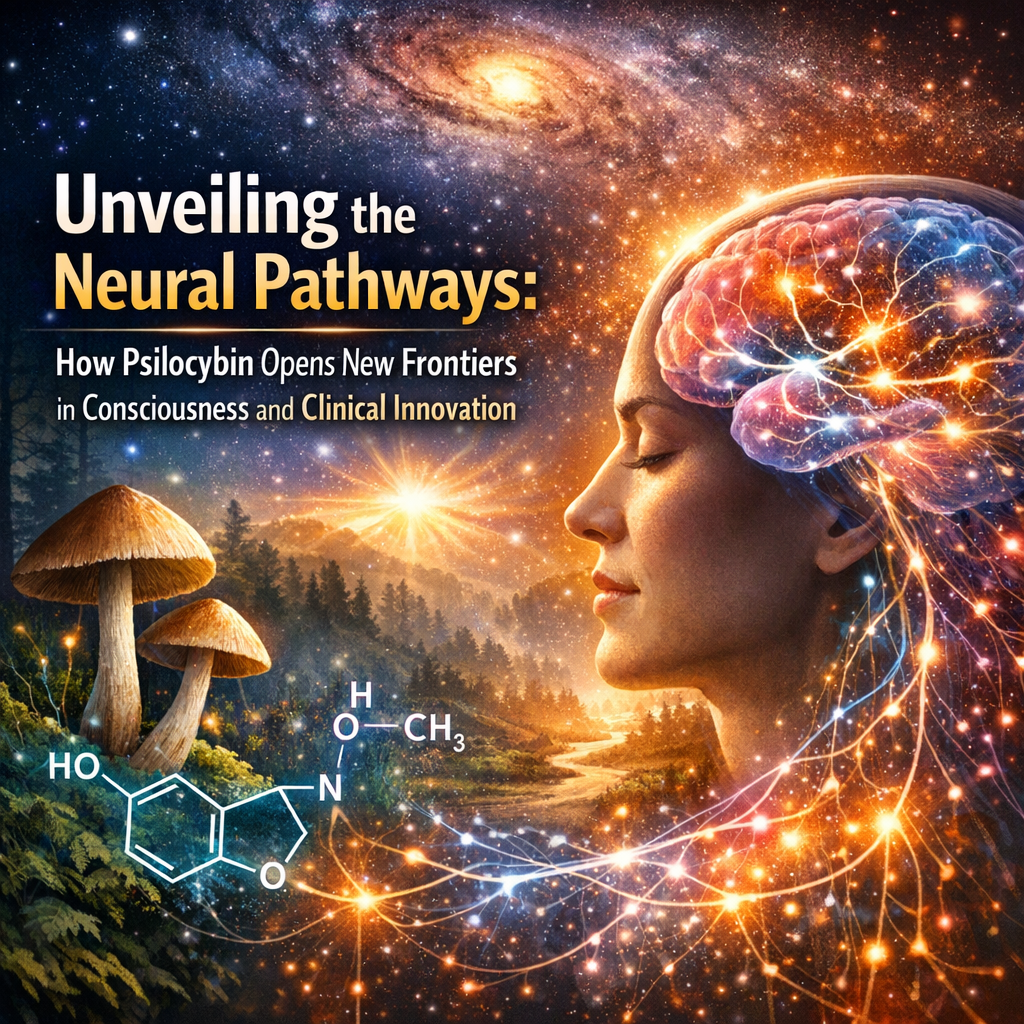
Unveiling the Neural Pathways: How Psilocybin Opens New Frontiers in Consciousness and Clinical Innovation
In recent years, the allure of **psilocybin**, a naturally occurring compound found in certain mushrooms, has transcended its origins in Indigenous and traditional rituals, entering the spotlight of modern medicine. Psilocybin, which interacts uniquely with **neural pathways**, is garnering attention for its potential to not only expand human **consciousness** but also to introduce groundbreaking clinical innovations. The resurgence of interest in the therapeutic potential of psilocybin, driven largely by promising preliminary research, is prompting scientists, clinicians, and the public to reconsider its place in both mental health treatment and a broader understanding of human consciousness.
In essence, psilocybin is a psychedelic compound that affects **serotonin receptors** in the brain, particularly the **5-HT2A receptor**, a pertinent target for numerous psychiatric medications. This interaction appears to facilitate a state of increased neural connectivity and flexibility, often described as “resetting” or “opening” the brain in novel ways. Studies suggest that this altered state of consciousness can foster profound personal insights and emotional breakthroughs, potentially accelerating psychotherapy progress. As these compounds challenge conventional neuropharmacology theories, they often reveal the brain’s forgotten or ignored capabilities.
The potential for clinical innovation using psilocybin lies mainly in its impact on mental health disorders. For instance, research conducted by **Johns Hopkins University** has demonstrated promising results in treating **depression** and **anxiety**—conditions that often show resistance to traditional treatments. Further investigations are re-evaluating psilocybin’s role in treating **PTSD**, **addiction**, and **end-of-life anxiety**. As such, psilocybin could prove to be a transformative tool—a natural alternative for addressing conditions that have historically proved difficult to treat.
In addition to its therapeutic benefits, psilocybin has also sparked a deeper exploration into the nature of consciousness itself. Its profound effects on perception, cognition, and mood offer not only symptomatic relief but also the possibility of philosophical and psychological exploration of what consciousness truly entails. Moving forward, as more studies illuminate the intricate dance between psilocybin and neural activity, its potential applications in clinical practice and philosophical inquiry are just beginning to be understood and harnessed.
Features: Exploring Scientific Studies and Clinical Trials
Evidence is mounting in favor of psilocybin’s therapeutic efficacy. A pivotal study by researchers at **Imperial College London** provided a crucial cognitive neuroscientific perspective. The double-blind, placebo-controlled study published in *The New England Journal of Medicine* demonstrated that psilocybin-assisted therapy might be as effective, if not more so, than **escitalopram**, a commonly prescribed antidepressant, at improving depressive symptoms [link](https://www.nejm.org/doi/full/10.1056/NEJMoa2032994). Participants reported significant emotional relief and cognitive clarity under psilocybin’s influence, highlighting the compound’s extraordinary potential to reset the brain’s network.
Further, **Johns Hopkins University School of Medicine’s** study, published in the journal *Psychopharmacology*, investigated the effects of psilocybin on tobacco addiction [link](https://link.springer.com/article/10.1007/s00213-014-3749-x). The preliminary trials suggested that psilocybin-assisted therapy yielded an 80% abstinence rate six months after treatment, a significant improvement compared to conventional therapies. The study posits that psilocybin may catalyze self-insight and motivation, essential elements in overcoming addiction.
The search for replicable results continues with a global thrust. In a renowned study conducted by the **University of Zurich**, researchers used psilocybin to explore the emotional experience of social exclusion [link](https://academic.oup.com/cercor/article/26/3/1133/2366904). The results revealed that psilocybin reduces the pain associated with social rejection by modulating the **amygdala**, providing potential pathways to address social anxiety disorders and autism spectrum conditions.
These cutting-edge studies are not just academic exercises but launchpads for reimagining mental health treatment. As they unfold, they challenge outdated perceptions and address unmet needs in psychiatric care. Psilocybin’s propensity to bolster brain plasticity while treating symptoms at the source rather than superficially may revolutionize how disorders are approached.
Conclusion
As we stand on the brink of a potential shift in therapeutic paradigms, psilocybin emerges not only as a potential treatment for stubborn mental health conditions but also as a tool for expanding human consciousness. The integration of psilocybin into mainstream medicine could very well signify a new era in psychiatric and psychological healing, offering a harmonious blend of ancient wisdom and modern scientific inquiry. With further research, it holds promise to unravel, and perhaps re-knit, the complex fabric of the human mind.
### Concise Summary
**Psilocybin**, a compound found in certain mushrooms, is gaining attention for its potential to transform mental health treatment and expand consciousness. It interacts uniquely with serotonin receptors, enhancing **neural connectivity**. Promising research highlights its efficacy in treating resistant conditions like **depression**, anxiety, PTSD, and **addiction**. Studies from top institutions like Johns Hopkins University and Imperial College underscore its potential compared to traditional antidepressants. Moreover, **psilocybin** opens pathways to explore consciousness and might significantly impact psychiatric paradigms, blending ancient wisdom with scientific inquiry for a new era in mental health.

Dominic E. is a passionate filmmaker navigating the exciting intersection of art and science. By day, he delves into the complexities of the human body as a full-time medical writer, meticulously translating intricate medical concepts into accessible and engaging narratives. By night, he explores the boundless realm of cinematic storytelling, crafting narratives that evoke emotion and challenge perspectives. Film Student and Full-time Medical Writer for ContentVendor.com