Petabyte-Scale Brain Mapping: How AI is Decoding Psychedelic-Induced Neuroplasticity
Introduction
The intersection of **artificial intelligence (AI)** and **neuroscience** is paving the way for expansive advancements in our understanding of **brain function**, especially concerning **neuroplasticity** induced by **psychedelics** like **psilocybin**. With the maturation of applying **machine learning** to **petabyte-scale brain data**, researchers are progressively unveiling the mysterious pathways through which these substances facilitate transformations in the brain’s architecture. This marks a dynamic period in neuroscientific exploration where the confluence of technology and biology is solving complex questions about the mind.
**Psychedelics**, notably **psilocybin**, have gained attention not just for their significant effect on consciousness, but also due to their potential **therapeutic benefits**. These compounds interact with **serotonin receptors** like the **5-HT2A receptor**, initiating a cascade of **neurochemical** events that can enhance connectivity and plasticity. Researchers believe that the reshaping of **neural networks** underlies therapeutic effects in conditions like **depression, PTSD**, and **addiction**.
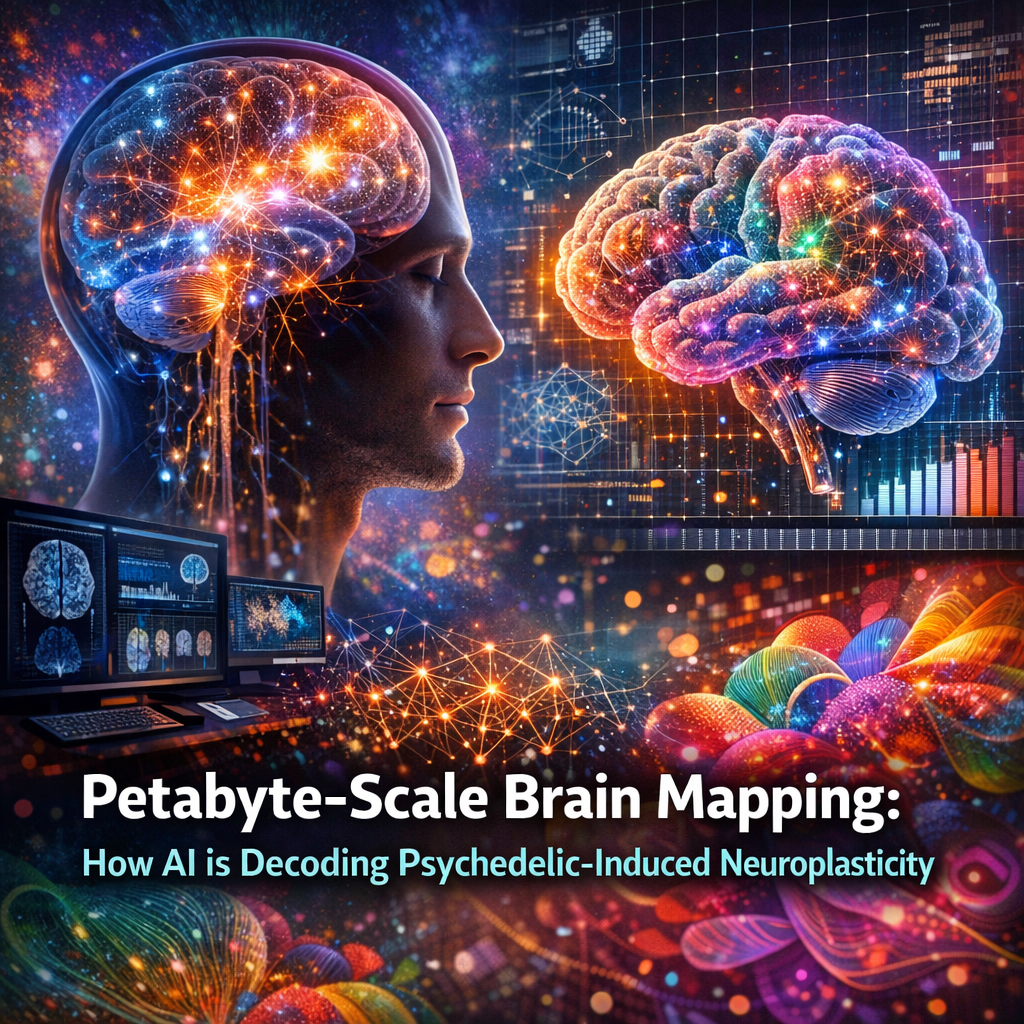
At this pivotal moment, **AI** emerges as a crucial tool. **Brain mapping**, which demands processing extensive data, is an area where AI’s computational power excels. Using AI algorithms, researchers can effectively analyze patterns across vast datasets, known as **petabyte-scale data**, to identify the structural and functional changes in the brain induced by psychedelics. High-resolution mapping allows scientists to visualize how these substances can instigate new patterns of thought and behavior by reshaping **synaptic connections**.
Employing AI-driven brain mapping not only advances our understanding of how **psychedelics** induce **neuroplasticity** but also accelerates the development of innovative therapeutic approaches. This pursuit isn’t simply academic; it paves the way for more individualized and efficacious treatments for mental health disorders, conditions that have traditionally defied satisfactory medical interventions. As this technology evolves, researchers are hopeful it will deliver transformative insights into brain function and the mechanisms behind psychedelic therapy.
Features
Recent professional and medical studies offer insights into the potential mechanisms through which **psychedelic-induced neuroplasticity** can be mapped and understood. A pioneering study conducted by **Carhart-Harris et al. (2018)** highlighted how **psilocybin** increases neural plasticity by altering **brain connectivity patterns**. Using **functional MRI (fMRI)** technology, researchers observed ‘entropy’ in brain activity, indicating increased randomness and flexibility in communication between brain regions. Such changes are believed to help disrupt rigid thought patterns, benefiting conditions like **depression** [Carhart-Harris, Scientific Reports](https://www.nature.com/articles/s41598-017-13282-7).
Mapping these complicated changes necessitates AI to fully understand large-scale neural data. One promising approach employs deep learning algorithms to segment and classify these extensive datasets. The **Allen Institute for Brain Science** has led initiatives to integrate AI with brain imaging studies, citing a notable increase in speed and accuracy regarding data interpretation generated during high-resolution imaging sessions [Allen Institute for Brain Science](https://alleninstitute.org).
Another significant study by **Preller and Vollenweider (2019)** explored how psychedelics promote neural plasticity through enhanced **synaptic growth** and connectivity. AI analysis of brain scans revealed the potential for new synapses to form during **psychedelic therapy**, supporting the idea that these substances could be utilized for therapeutic regeneration and repair in psychiatric disorders [Biological Psychiatry Journal](https://www.biologicalpsychiatryjournal.com).
Similarly, AI’s predictive capabilities offer exciting possibilities. Algorithms trained on **psychedelic neuroimaging data** can forecast patient-specific responses to therapies, allowing for customized treatment plans. This preemptive strategy reduces risks linked to generalized treatment plans and maximizes therapeutic outcomes.
These advancements depend on the continual refinement of AI technologies and their integration with neuroscience research. By cross-referencing insights from imaging data with genetic, epigenetic, and proteomic information, researchers are paving the way for a holistic understanding of brain plasticity. The future holds promise for identifying the precise conditions under which psychedelics catalyze optimal neural adaptations, offering a new frontier in mental health treatment protocols.
Conclusion
The convergence of **AI** and **neuroscience** is forging an exciting frontier in understanding **psychedelic-induced neuroplasticity**. By applying AI’s unparalleled ability to process and analyze **petabyte-scale data**, researchers are illuminating the intricate mechanisms by which **psychedelics** reshape the brain’s architecture. This emerging knowledge not only enhances our conceptual understanding of the human mind but also holds potential to revolutionize therapeutic interventions for mental health disorders, offering hope and healing to millions globally.
Concise Summary
The incorporation of artificial intelligence in neuroscience is significantly advancing the understanding of brain function, especially regarding neuroplasticity induced by psychedelics like psilocybin. By harnessing AI’s potential to process petabyte-scale brain data, researchers are revealing the pathways through which psychedelics enhance connectivity and plasticity, beneficial for conditions like depression and PTSD. Studies indicate AI-driven brain mapping accelerates therapeutic approaches, offering customized treatment plans by predicting individual responses. With ongoing AI and neuroscience integration, a new frontier in mental health treatment is emerging, promising refined interventions and transformative insights into brain function and psychedelic therapy.

Dominic E. is a passionate filmmaker navigating the exciting intersection of art and science. By day, he delves into the complexities of the human body as a full-time medical writer, meticulously translating intricate medical concepts into accessible and engaging narratives. By night, he explores the boundless realm of cinematic storytelling, crafting narratives that evoke emotion and challenge perspectives. Film Student and Full-time Medical Writer for ContentVendor.com