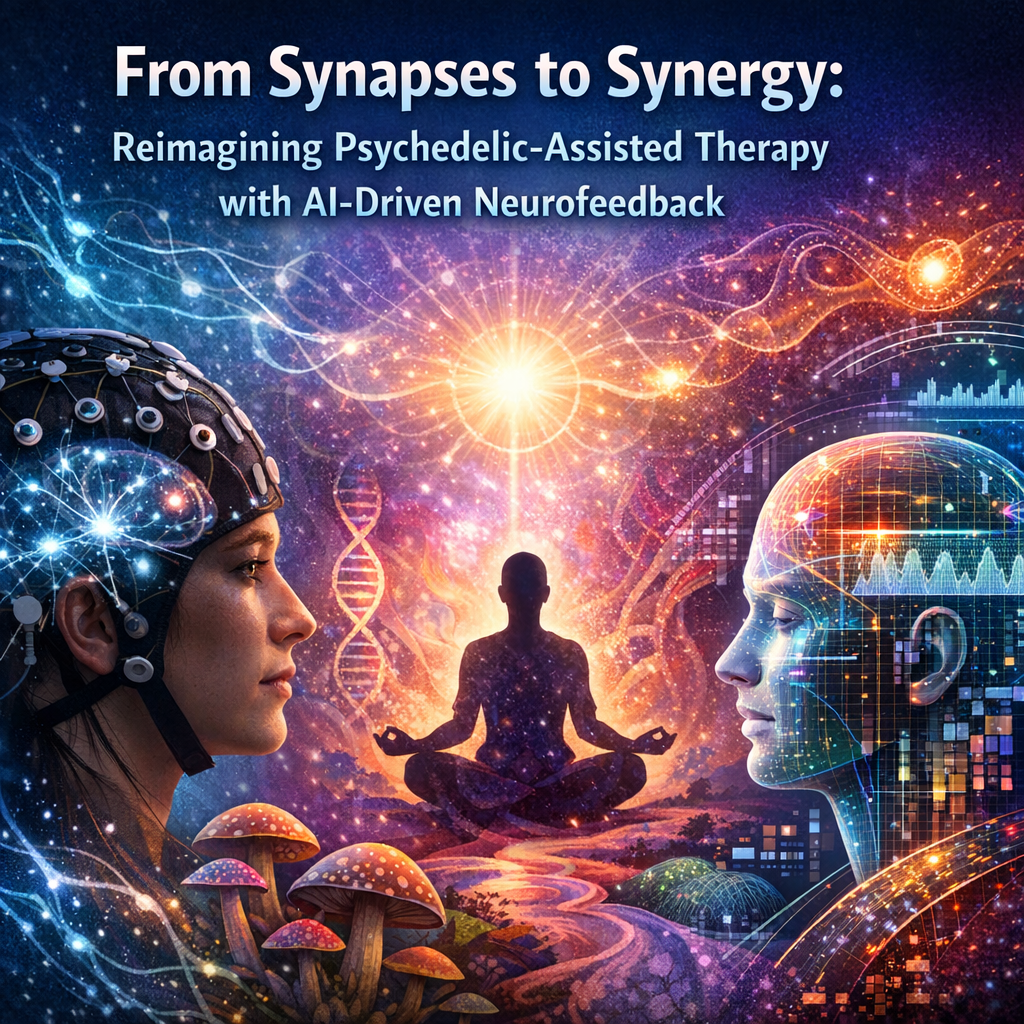
From Synapses to Synergy: Reimagining Psychedelic-Assisted Therapy with AI-Driven Neurofeedback
In recent years, the mental health landscape has witnessed a **paradigm shift**, with a growing emphasis on exploring unconventional treatment methodologies. Among these, **psychedelic-assisted therapy** has emerged as a promising frontier. This cutting-edge approach employs substances like **psilocybin**, the active compound in **magic mushrooms**, to catalyze profound psychological transformations. Now, as digital advancements permeate the medical field, **artificial intelligence (AI)** steps into the arena, promising to revolutionize psychedelic therapy further. Enter **AI-driven neurofeedback**, an innovative synthesis of technology and therapy poised to enhance **mental health treatment outcomes**.
The foundation of **psychedelic therapy** lies in its ability to influence **synaptic plasticity**—essentially the brain’s capacity to rewire itself. **Psilocybin** influences **serotonin receptors**, initiating a cascade of neurochemical events leading to altered perceptions and emotional release. This state of heightened plasticity enables individuals to explore and address deeply entrenched psychological issues, often through guided therapeutic sessions. This therapy has shown promise in treating various mental health challenges, from **depression and anxiety** to **PTSD** and **addiction**.
However, the integration of **AI-driven neurofeedback** into this therapeutic model offers a remarkable opportunity to individualize and optimize treatment outcomes. **Neurofeedback**, a technique already employed in various therapeutic contexts, involves monitoring real-time brain activity to promote the regulation of brain functions. With the introduction of AI, this process becomes exponentially more powerful. **AI algorithms** can analyze vast amounts of brainwave data with unprecedented precision, offering insights into an individual’s unique neural patterns. This data can tailor the therapeutic use of **psychedelics**, ensuring dosage and timing are optimized, thereby enhancing the safety and efficacy of the treatment.
Recent studies have shed light on the synergistic potential of combining AI technology with psychedelic-assisted therapy. A pivotal study conducted by researchers at [**Imperial College London**](https://www.imperial.ac.uk/news/236892/psilocybin-beats-escitalopram-major-study-finds/) explored the effects of **psilocybin** on **depression**, revealing significant improvements in brain connectivity and emotional processing. Their findings suggested that psychedelic therapy encourages a more flexible mode of thinking, critical for breaking the cycle of rumination associated with depression. Similarly, advancements in **AI-driven neurofeedback** have demonstrated the capacity to refine and personalize therapeutic interventions.
One notable study by [**Stanford University**](https://news.stanford.edu/2020/05/18/artificial-intelligence-assisted-neurofeedback/) illustrated the profound effects of AI-enhanced neurofeedback on **neuroplasticity**. Researchers utilized AI algorithms to assess individualized brain data, providing feedback that guided participants toward a more balanced emotional state. The implications of integrating such a personalized approach with psychedelic therapy are profound. When brainwave data is combined with insights gleaned from AI analysis, therapists can craft highly targeted interventions, maximizing therapeutic outcomes while minimizing potential side effects.
In clinical settings, **AI-driven neurofeedback** could serve as a real-time navigator, adapting therapeutic sessions based on immediate neural feedback. This adaptive approach fosters a more responsive interaction between therapist, patient, and the psychedelic compound, allowing sessions to be guided by the patient’s evolving neurological state. Such a dynamic process can potentiate therapeutic breakthroughs, offering individuals more profound insights and facilitating long-lasting emotional healing.
Moreover, AI technology could play a crucial role in enhancing safety protocols. By continuously monitoring brainwave activity, potential adverse reactions could be anticipated and mitigated, ensuring a smoother, more secure therapeutic experience. This safety net could widen the accessibility of **psychedelic-assisted therapy** to more individuals, including those who might otherwise be considered high-risk candidates.
In conclusion, the convergence of **psychedelic-assisted therapy** and **AI-driven neurofeedback** heralds a new era in mental health treatment. By harnessing the brain’s natural ability to evolve and adapt, guided by advanced AI insights, this revolutionary approach holds promise to redefine therapeutic paradigms. As research and technology continue to develop, the blend of ancient wisdom and modern innovation offers hope to those seeking profound healing and deeper self-understanding.
**Concise Summary**
The confluence of **psychedelic-assisted therapy** and **AI-driven neurofeedback** marks a transformative shift in mental health treatment. While psychedelics like **psilocybin** enhance **synaptic plasticity** for deep psychological change, AI refines this by analyzing brainwave data for personalized interventions. Studies from [Imperial College London](https://www.imperial.ac.uk/news/236892/psilocybin-beats-escitalopram-major-study-finds/) and [Stanford University](https://news.stanford.edu/2020/05/18/artificial-intelligence-assisted-neurofeedback/) underline significant therapeutic gains, suggesting enhanced adaptability and safety protocols. This fusion advances mental health care, offering hope for profound healing and revitalizing traditional paradigms.

Dominic E. is a passionate filmmaker navigating the exciting intersection of art and science. By day, he delves into the complexities of the human body as a full-time medical writer, meticulously translating intricate medical concepts into accessible and engaging narratives. By night, he explores the boundless realm of cinematic storytelling, crafting narratives that evoke emotion and challenge perspectives. Film Student and Full-time Medical Writer for ContentVendor.com