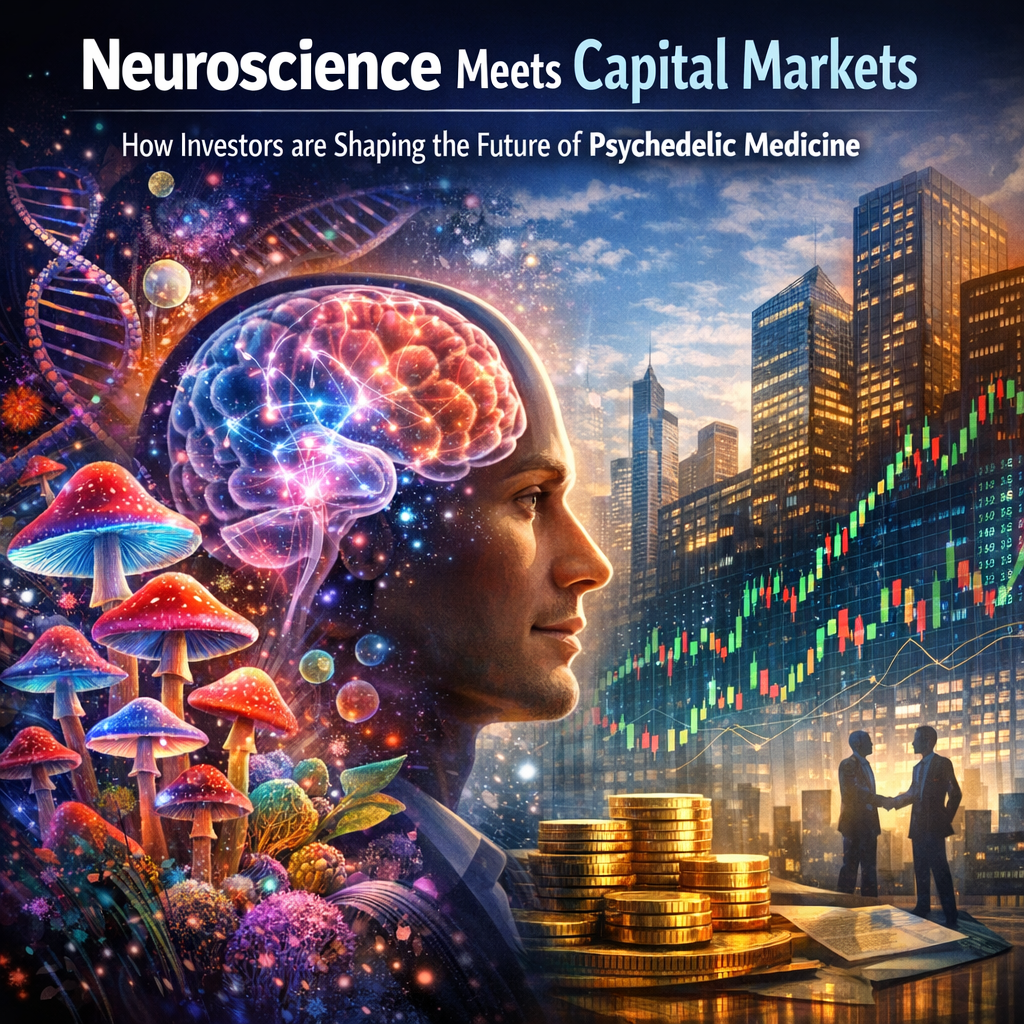
Neuroscience Meets Capital Markets: How Investors are Shaping the Future of Psychedelic Medicine
In recent years, the once-taboo subject of **psychedelics** has entered the mainstream dialogue, largely due to breakthroughs in **neuroscience** and the potential for novel treatments in **mental health**. As mental health concerns like **depression**, **PTSD**, and **anxiety** continue to rise globally, there is an urgent need for innovative therapeutics. This gap has prompted significant interest in the potential of psychedelic substances, like **psilocybin**, to offer natural, effective solutions. The implications are profound: science is beginning to validate what advocates of psychedelics have long suspected—that these substances could revolutionize mental health treatment.
At the same time, the capital markets have taken notice. **Venture capitalists**, angel investors, and even public companies are funneling substantial funds into research, development, and regulatory processes of psychedelics. This financial backing is not solely an altruistic endeavor; it represents the potential for lucrative returns in a burgeoning market projected to reach billions. Analysts and market experts are closely monitoring this development, as early investments in psychedelic medicine could yield substantial benefits analogous to the early periods of biotechnology or cannabis industries.
Significant players, such as **Compass Pathways** and **ATAI Life Sciences**, are leading the charge, taking groundbreaking steps to bring psychedelics into medical legitimacy. These firms are investing heavily in rigorous clinical trials, regulatory approvals, and scalable business models—laying the groundwork for other companies in this nascent sector. Their success is not just reliant on the efficacy of the treatment but also on overcoming the societal stigma that has long surrounded psychedelics. The growing shift towards accepting psychedelics for their therapeutic potential is also a testament to the pivotal role of neuroscience in understanding the intricate mechanisms of the human brain and the therapeutic potential these substances harbor.
The synergy between neuroscience and financial interests is an intriguing dynamic. Investors are not only supporting but also accelerating the pace at which these scientific discoveries can be transformed into accessible healthcare solutions. In the following sections, we will delve into the latest studies underpinning this movement and examine how this collaborative effort between science and capital markets is paving the way for the future of psychedelic medicine.
Features:
One of the most compelling aspects of psychedelic medicine is its strong foundation in neuroscience research. Studies have demonstrated that substances like **psilocybin** can modulate the brain’s neural circuits in unique ways, offering potential therapeutic benefits for a range of mental health disorders. A notable study published in the journal [*Nature*](https://www.nature.com/articles/s41591-018-0245-5) explored how psilocybin-assisted therapy could help patients with treatment-resistant depression. The research observed that psilocybin could significantly affect the brain’s default mode network (DMN), disrupting negative thought patterns typical of depressive states. This neural reset allows for increased emotional flexibility, a crucial step toward recovery.
In another groundbreaking study featured in [*JAMA Psychiatry*](https://jamanetwork.com/journals/jamapsychiatry/fullarticle/2772636), researchers found that psilocybin could effectively reduce symptoms of anxiety and depression in cancer patients. The promising results prompted additional studies to evaluate the compound’s efficacy, safety, and long-term outcomes, reinforcing the possibility of developing psilocybin as a certified medical treatment.
The medical community’s growing interest in psychedelics has not gone unnoticed by investors. Significant capital influx is helping to bridge the gap between laboratory research and real-world clinical application. For example, **Compass Pathways** and **Usona Institute** are at the forefront, conducting comprehensive trials to ensure sustainable and scalable therapeutic models. Compass’s work on synthetic psilocybin has even received a [**Breakthrough Therapy**](https://www.compasspathways.com/news/compass-pathways-receives-breakthrough-therapy-designation-from-fda-for-psilocybin-therapy-for-treatment-resistant-depression) designation from the FDA, expediting the drug development process.
**ATAI Life Sciences**, backed by legendary investors such as **Peter Thiel**, is another pioneer blending science with capital power. With a diversified portfolio focusing on both synthetic and naturally occurring compounds, ATAI is orchestrating a paradigm shift in mental healthcare. Their innovative models include digital therapeutics and predictive analytics, providing a holistic approach to treating various psychiatric disorders [source](https://www.atai.life/research/).
The convergence of neuroscience and capital markets presents an unprecedented opportunity to reshape the landscape of mental health treatment. Together, they bring innovation, scientific rigor, and financial resources to a field ripe with potential.
Conclusion:
The burgeoning intersection of neuroscience research and capital market investment is setting the stage for a fresh era in medical treatment through psychedelics. This collaboration is not merely speculative; it is a pragmatic approach that combines scientific discoveries with financial acumen to catalyze medical innovations. As these two powerful forces converge, they hold the potential to unlock unprecedented advancements in treating mental health disorders, offering hope to millions worldwide affected by such conditions. The investment in understanding and deploying psychedelic medicine is laying the foundation for a more profound comprehension of mental health and heralding a future where mental wellness can be achieved more naturally and sustainably.
**Concise Summary:**
The exploration of **psychedelic medicine** is gaining momentum due to breakthroughs in **neuroscience** and significant investments from the **capital market**. Psychedelics such as **psilocybin** demonstrate promise in treating mental health disorders like **depression** and **anxiety**. Companies like **Compass Pathways** and **ATAI Life Sciences** lead the charge, supported by studies revealing these substances’ capability to modulate brain circuits uniquely. With notable financial backing, the research is transitioning from labs to real-world applications, heralding a potential revolution in mental health treatment that merges science with financial insight.

Dominic E. is a passionate filmmaker navigating the exciting intersection of art and science. By day, he delves into the complexities of the human body as a full-time medical writer, meticulously translating intricate medical concepts into accessible and engaging narratives. By night, he explores the boundless realm of cinematic storytelling, crafting narratives that evoke emotion and challenge perspectives. Film Student and Full-time Medical Writer for ContentVendor.com