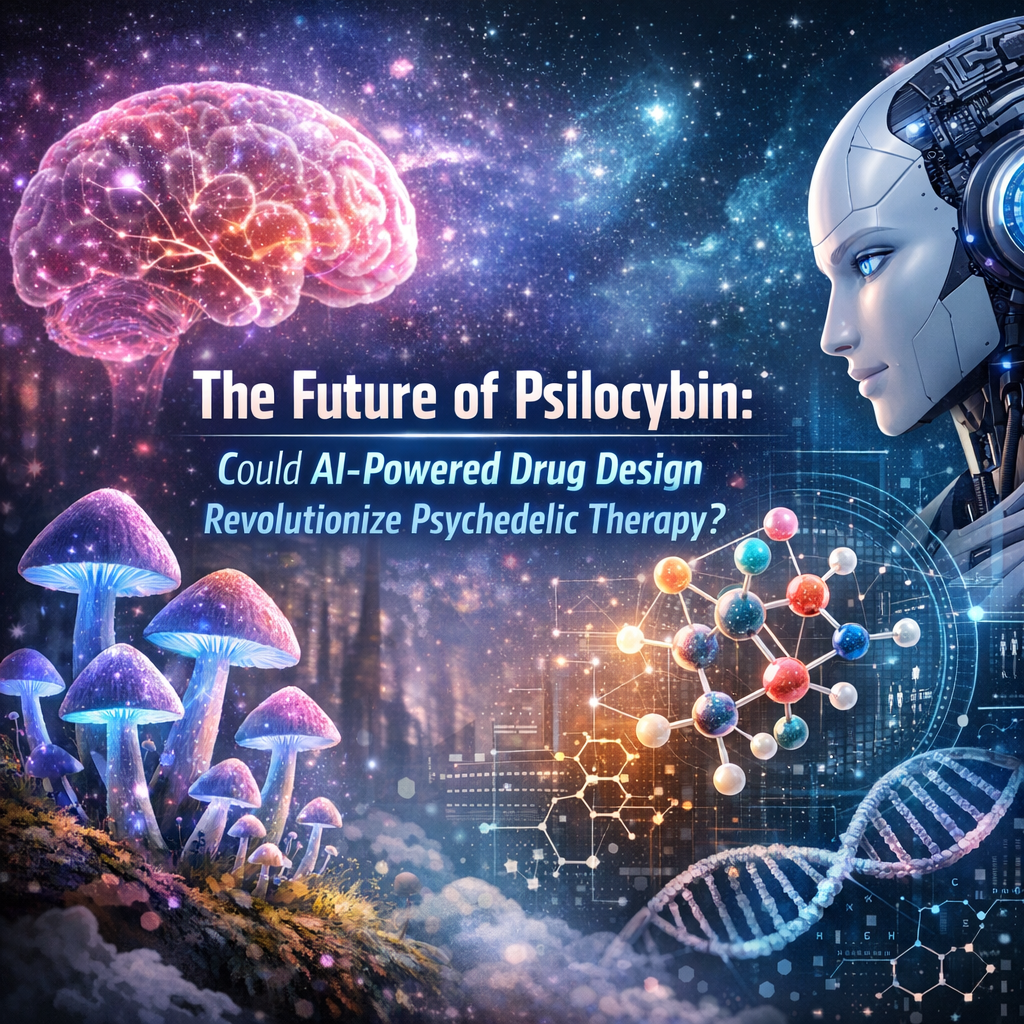
The Future of Psilocybin: Could AI-Powered Drug Design Revolutionize Psychedelic Therapy?
In recent years, **psilocybin**—the active compound found in certain species of mushrooms—has garnered significant attention for its therapeutic potential in treating a variety of mental health disorders. Historically considered fringe due to regulatory constraints, **psilocybin** has moved to the forefront of psychedelic research, heralded as a possible breakthrough for individuals facing **depression**, **PTSD**, and **anxiety disorders**. As interest in this natural compound grows, there is increasing interest in how **technological advancements**, particularly in **artificial intelligence (AI)**, can elevate **psilocybin-based therapies** to new heights.
AI technology, with its capability to rapidly process and analyze vast datasets, promises a transformation in the field of **psychedelic therapy**. Traditional drug development is often lengthy and costly, from inception to market, spanning over a decade and billions in expenditure. **AI-powered drug design** offers a more efficient alternative by quickly identifying and optimizing molecular compounds that could take years to discover through conventional means. For psilocybin and broader psychedelic therapy, this means AI could significantly accelerate the isolation and synthesis of new therapeutic compounds, ensuring treatments are both effective and tailored to individual patient needs.
Moreover, current research indicates that **psilocybin** primarily affects serotonin receptors in the brain, altering perceptions and mood states beneficially. AI can map these complex neural interactions with precision, offering insights that refine not just dosage but also delivery mechanisms of **psilocybin-based therapies**. Such precision could lead to more targeted treatments with minimal side effects, making clinical adoption widespread.
The growing interest in **psychedelics** points to an exciting prospect at the intersection of AI and psilocybin, potentially redefining mental health treatment by offering more personalized and effective options. This convergence of biotechnology and AI forecasts a new era in medical treatment, which could significantly reshape the landscape of psychedelic therapy and bring renewed hope to millions.
Features: AI and Psilocybin in Scientific Studies
The synergy between **AI** and **psilocybin** is not merely theoretical; it is actively explored in various scientific fields. A notable example includes research by [**Imperial College London’s Centre for Psychedelic Research**](https://www.imperial.ac.uk/psychedelic-research-centre), examining psilocybin’s effectiveness in treating depression. Another pioneering study led by [**Yale University**](https://medicine.yale.edu) utilizes AI-powered platforms to design novel psychedelic compounds targeting specific brain receptors—a task almost impossible without computational aid.
One of AI’s most groundbreaking aspects in drug discovery is its ability to perform neural simulations. By using AI algorithms to simulate **psilocybin** interactions within neural pathways, researchers can predict the compound’s effects on brain activity. This simulation capability allows for preclinical testing virtually, saving valuable time and resources before clinical trials begin ([**Nature Biotechnology**](https://www.nature.com/articles/s41587-020-0466-9)).
Furthermore, AI can personalize psychedelic therapy. For individuals diagnosed with diverse conditions like **PTSD** or **generalized anxiety disorder**, one-size-fits-all approaches are often inadequate. AI can analyze patient data for personalized treatment regimens, ensuring interventions are tailored to the individual’s unique neurobiological profile. Additionally, AI-driven platforms can continuously assess treatment outcomes, providing real-time feedback and enabling dynamic adjustments to therapeutic protocols.
Another intriguing AI application in psychedelic research is its use in developing predictive models for treatment efficacy. Machine learning algorithms enable researchers to develop predictive tools to identify individuals likely to benefit most from **psilocybin therapy**, enhancing outcomes and minimizing risks.
In essence, AI and psychedelic research collaboration fosters a wave of innovation likely to revolutionize mental health treatment. By accelerating **psilocybin-based drug** development and making it more targeted and effective, AI is not merely a research facilitator but a pioneering agent propelling psychedelic therapy into mainstream as a reliable, individualized medical solution.
Conclusion
The fusion of **AI technology** and **psilocybin research** promises transformative advances in mental health treatment. As AI continues to refine drug design and delivery mechanisms, the potential for highly personalized and effective psychedelic therapy becomes increasingly reachable. With ongoing studies shedding light on these possibilities, the future for psilocybin as a cornerstone in managing complex mental health conditions looks promising.
**Concise Summary**
Psilocybin, the active ingredient in some mushrooms, shows promise in treating depression, PTSD, and anxiety. The integration of AI in psilocybin research can significantly enhance therapeutic outcomes by expediting compound discovery, offering personalized treatments and precise dosing, and reducing side effects. Studies by institutions like **Imperial College London** and **Yale University** demonstrate this potential in real-time, using AI for drug design and neural simulations, optimizing treatment efficacy. This innovative convergence of AI and biotechnology paves the way for groundbreaking advances in mental health treatment, making **psilocybin-based therapies** more accessible and effective.

Dominic E. is a passionate filmmaker navigating the exciting intersection of art and science. By day, he delves into the complexities of the human body as a full-time medical writer, meticulously translating intricate medical concepts into accessible and engaging narratives. By night, he explores the boundless realm of cinematic storytelling, crafting narratives that evoke emotion and challenge perspectives. Film Student and Full-time Medical Writer for ContentVendor.com