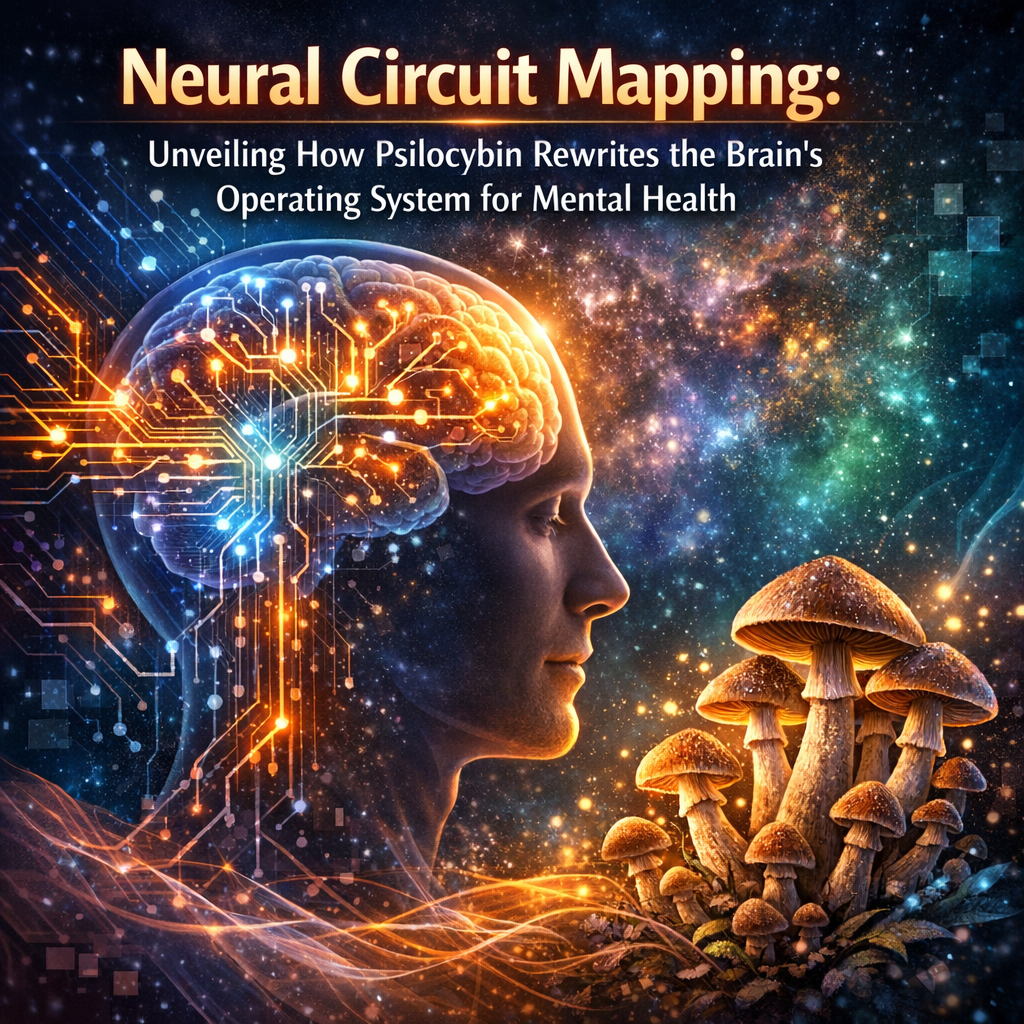
Neural Circuit Mapping: Unveiling How Psilocybin Rewrites the Brain’s Operating System for Mental Health
Introduction
In recent years, there has been a significant shift in the perception and utilization of **psychedelic substances**, particularly **psilocybin**, the active compound in “magic mushrooms.” Once stigmatized and restricted by legal constraints, **psilocybin** is now gaining interest from neuroscientists and mental health professionals. Its ability to impact **neural circuits** at a fundamental level, essentially “rewiring” the brain, has emerged as a potential game-changer in treating mental health conditions such as **depression**, **PTSD**, and **anxiety**.
Psilocybin’s allure lies in its promotion of **neural plasticity**, which reorganizes and optimizes neural communication, altering patterns of thought and behavior. At the core of this research is **neural circuit mapping**, a technology that uses advanced imaging techniques like **fMRI** and **PET scans** to observe psilocybin-induced changes in real-time. This offers insights into how psychedelic-assisted therapies could be tailored to individual neural profiles, marking a paradigm shift away from one-size-fits-all treatments.
While still in early stages, preliminary studies are promising. They suggest **psilocybin** may dislodge entrenched neural patterns linked with mental disorders, offering pathways to mental rejuvenation and resilience. As the field evolves, it holds potential not only for illuminating the workings of the human mind but also for revolutionizing mental health treatment.
Features
The intersection of **psilocybin research** and **neural circuit mapping** is an exciting development in modern neuroscience. Groundbreaking studies are forming the foundation for understanding how psilocybin can recalibrate the brain’s intricate networks to improve mental health. A landmark study at [Imperial College London](https://www.imperial.ac.uk/news/183180/psilocybin-patients-resistant-depression-compounds-brain/) utilized functional magnetic resonance imaging (**fMRI**) to examine psilocybin’s effects. The study revealed that psilocybin reduces activity in the default mode network (**DMN**), associated with self-referential thought and rumination, which are often heightened in those with depression.
Furthermore, the study showed that psilocybin increases communication between typically separate brain regions, leading to increased **entropy** in the brain. This breakdown of rigid, dysfunctional connectivity patterns fosters enhanced cognitive flexibility, allowing new perspectives and cognitive pathways to emerge.
A crucial study from [Johns Hopkins University](https://www.hopkinsmedicine.org/news/newsroom/news-releases/johns-hopkins-researchers-show-therapeutic-promise-of-psychedelic-drug-for-depression) highlighted psilocybin’s therapeutic potential. The study focused on individuals with major depressive disorder and found that two doses of psilocybin, combined with supportive psychotherapy, produced rapid and substantial reductions in depressive symptoms compared to placebo treatments. These findings suggest that psilocybin’s ability to alter neural circuits leads to sustained improvements in emotional well-being.
These studies imply that psilocybin-assisted therapy could surpass traditional pharmacological treatments by targeting not just symptoms, but the neurological roots of mental health conditions. As research progresses, personalized psilocybin therapies tailored to specific neural architectures of patients may maximize efficacy and reduce side effects.
Conclusion
The exploration of psilocybin’s impact through **neural circuit mapping** unveils new horizons in mental health treatment. By disrupting maladaptive patterns and fostering new neural connections, psilocybin offers hope for those unresponsive to traditional therapies. As understanding deepens, psilocybin presents an opportunity to advance mental health care and enrich comprehension of the brain’s possibilities. The future of mental health might be illuminated by the transformative effects of psilocybin’s journey through the brain.
**Concise Summary:**
Psilocybin, the active compound in “magic mushrooms,” is gaining attention for its potential to transform mental health treatment. By enhancing neural plasticity and altering brain circuits, psilocybin offers hope for conditions resistant to traditional therapies. Studies show that it reduces activity in the default mode network and increases communication between brain regions, promoting cognitive flexibility. Research from Imperial College and Johns Hopkins highlights its therapeutic benefits. As psilocybin research evolves, it promises to personalize and revolutionize mental health care, targeting neurological roots rather than just symptoms.

Dominic E. is a passionate filmmaker navigating the exciting intersection of art and science. By day, he delves into the complexities of the human body as a full-time medical writer, meticulously translating intricate medical concepts into accessible and engaging narratives. By night, he explores the boundless realm of cinematic storytelling, crafting narratives that evoke emotion and challenge perspectives. Film Student and Full-time Medical Writer for ContentVendor.com