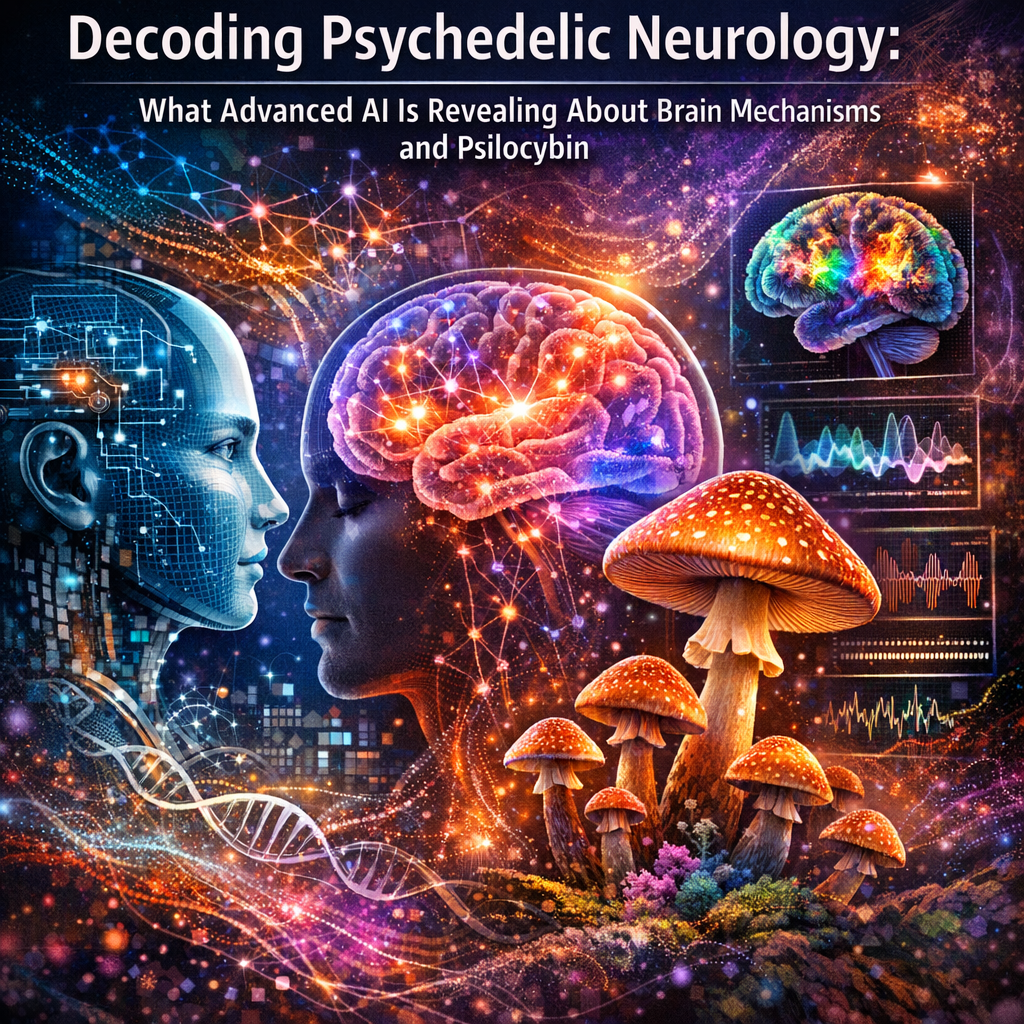
Decoding Psychedelic Neurology: What Advanced AI Is Revealing About Brain Mechanisms and Psilocybin
In recent years, the field of **psychedelics** has experienced a renaissance, driven by groundbreaking research into their therapeutic potential. Among these substances, **psilocybin** — a naturally occurring psychedelic compound found in certain mushrooms — has garnered significant interest. But what exactly happens in the brain when psilocybin is ingested? To decode this complex neurological puzzle, scientists are enlisting the help of advanced **artificial intelligence (AI)**. AI techniques, such as **machine learning** and **neural network analysis**, are ushering in a new era of understanding, providing unprecedented insights into psilocybin’s effects on the human brain.
The field of **neuropharmacology** has long sought to understand how psychedelics like psilocybin influence brain mechanisms. Traditionally, these studies have relied on brain imaging technologies like **functional MRI (fMRI)** and **positron emission tomography (PET)** scans. However, the interpretation of this data poses challenges due to its complexity. Enter AI — with its immense processing power and pattern recognition capabilities — to sift through vast amounts of brain data.
**AI offers potential breakthroughs** by highlighting changes in neural connectivity attributed to psilocybin use. When psilocybin is administered, it appears to temporarily disrupt the **default mode network (DMN)** in the brain. The DMN is associated with self-referential thoughts and the “ego.” Disruption of this network may explain the ego-dissolution and increased interconnectedness often reported during psychedelic experiences. AI assists researchers in visualizing these disruptions and connectivity changes with high precision, offering a clearer picture of psilocybin’s role in altering consciousness.
Furthermore, **AI-driven studies** emphasize the compound’s potential to reset dysfunctional brain networks. Preliminary findings suggest that psilocybin could be a viable treatment for mental health conditions like **depression**, **anxiety**, and **PTSD**, through its ability to facilitate **neuroplasticity** – the brain’s capacity to reorganize and form new neural connections. This is particularly significant given the limited success of traditional therapies for these complex disorders.
The intersection of AI and psychedelics marks an exhilarating frontier in neuroscience, promising to unlock doors to new therapies and a deeper understanding of consciousness. By examining the neural circuits impacted by psilocybin, AI is not only providing answers to long-standing questions but also facilitating the development of personalized treatment strategies that hold promise for countless individuals seeking relief.
Features: Profound Insights Uncovered by Studies
Recent studies harnessing the power of AI to unravel psilocybin’s effects on the brain have yielded promising insights. A notable study published in the journal [*Nature*](https://www.nature.com) employed machine learning algorithms to analyze fMRI scans from participants under the influence of psilocybin. The results demonstrated significant shifts in brain dynamics, characterized by increased connectivity and the emergence of new patterns of neural activity. Prior to the use of AI technology, spotting these nuanced changes posed a daunting task for researchers.
Another groundbreaking study conducted at [Imperial College London](https://www.imperial.ac.uk/psilocybin-research) applied AI to examine the brain’s response to psilocybin in individuals diagnosed with treatment-resistant depression. The study focused on changes in cerebral blood flow and connectivity patterns. AI analysis revealed that after treatment with psilocybin, participants showed marked improvement in symptoms and exhibited changes in brain connectivity reminiscent of a “reset” button.
Yet another pivotal study in the realm of AI and psychedelic research was conducted by a team at [Johns Hopkins University](https://www.hopkinsmedicine.org/psychedelic-research). Utilizing deep learning algorithms to assess brain scans, the researchers identified unique neural signatures associated with mystical experiences often triggered by psilocybin. Understanding these experiences is crucial, as they are often correlated with long-term therapeutic benefits.
These cutting-edge advancements emphasize the potential of AI as a transformative tool in psychedelics research. By providing neuroscientists with the ability to delve deeper into the data, AI not only enhances our understanding of how psychedelics affect the brain but also lays the groundwork for developing novel treatments that harness the brain’s innate capability to heal.
Conclusion: A Pioneering Pathway Forward
As AI continues to push the boundaries of neuroscience, the mysteries surrounding psilocybin’s impact on the brain are gradually coming to light. The fusion of advanced technology and psychedelic research opens up exciting avenues for mental health treatment, offering hope to those grappling with conditions that have long defied conventional therapies. As our understanding deepens, so too does the promise of effective, personalized treatment strategies, heralding a new era of therapeutic possibilities.
**Concise Summary:**
The pioneering intersection of **artificial intelligence (AI)** and psychedelics research is revolutionizing our understanding of **psilocybin’s** effects on the brain. By leveraging advanced AI techniques, such as machine learning and neural network analysis, researchers are uncovering how psilocybin disrupts neural connectivity, particularly the **default mode network (DMN)**, leading to ego-dissolution and altered states of consciousness. This progress may contribute to developing tailored therapies for conditions like depression and PTSD. Recent studies have shown promising results, emphasizing AI’s transformative potential in neuroscience and paving the way for innovative, effective mental health treatments.

Dominic E. is a passionate filmmaker navigating the exciting intersection of art and science. By day, he delves into the complexities of the human body as a full-time medical writer, meticulously translating intricate medical concepts into accessible and engaging narratives. By night, he explores the boundless realm of cinematic storytelling, crafting narratives that evoke emotion and challenge perspectives. Film Student and Full-time Medical Writer for ContentVendor.com