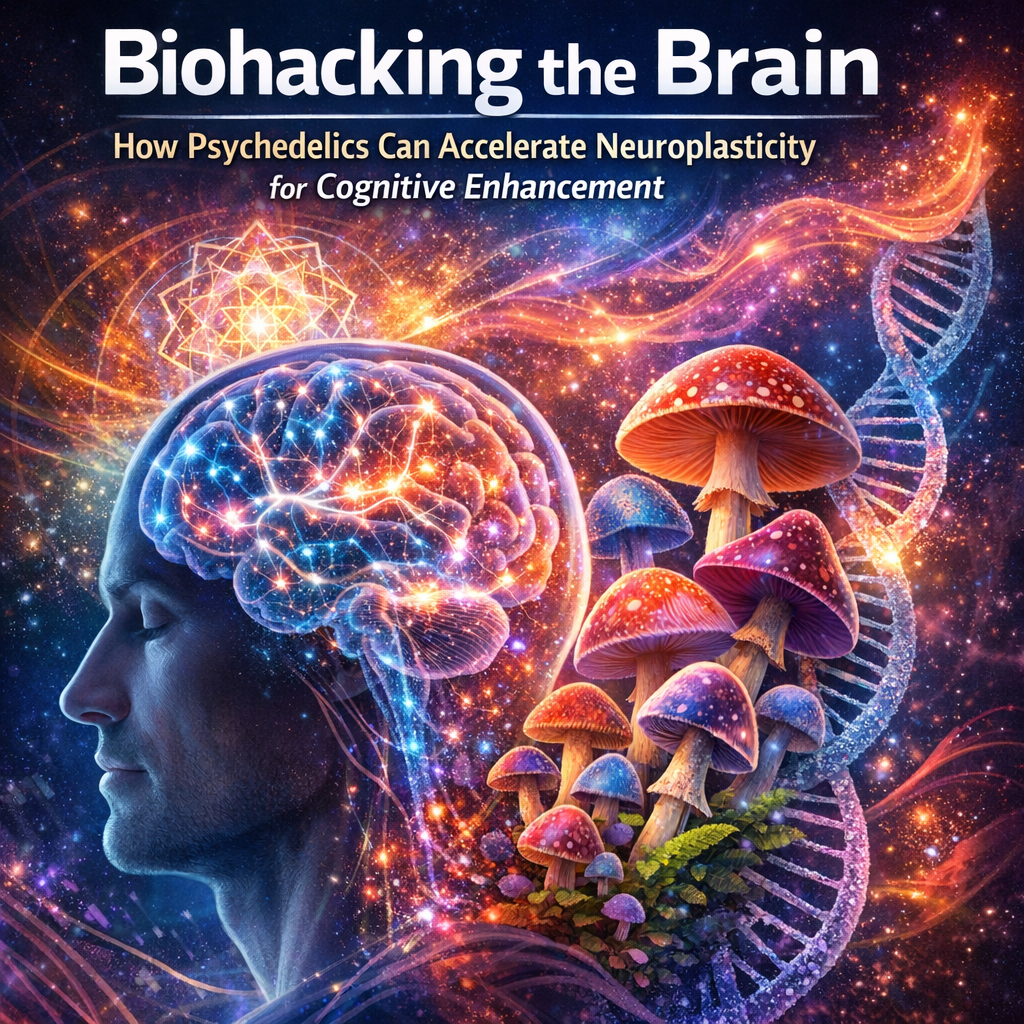
**Biohacking the Brain: How Psychedelics Can Accelerate Neuroplasticity for Cognitive Enhancement**
Introduction:
In recent years, there has been a notable shift in the perception of **psychedelics**, moving away from the taboo-laden stigmas of the past and toward a more discerning and scientifically curious approach. This shift is largely attributable to compelling evidence suggesting that psychedelics could be key players in the field of **neuroplasticity** and **cognitive enhancement**.
Neuroplasticity, the brain’s remarkable ability to reorganize itself by forming new neural connections, is fundamental to learning and memory. Imagine accelerating this natural brain process: it could radically improve mental acuity, problem-solving skills, and even recovery from neurological disorders.
**Psychedelics** such as **psilocybin** (found in “magic mushrooms”) are gaining momentum as potential catalysts for such cognitive shifts. Pharmacologically, these substances function by modulating the **serotonin system**, which plays a pivotal role in mood, perception, and cognition. Traditionally, altering the serotonergic system has been achieved with **selective serotonin reuptake inhibitors (SSRIs)**, but psychedelics operate through more extensive and rapid receptors. This broader activity raises the exciting prospect of ‘biohacking’ our brains—actively tweaking its parameters for better performance.
Over the past decade, multiple anecdotes and preliminary studies have highlighted the potential of psychedelics in facilitating profound introspective experiences, allowing individuals to “reboot” their cognitive processes. The alteration in awareness often leads to enhanced creativity, problem-solving abilities, and emotional resilience. This promise of cognitive enhancement is not merely relegated to vague testimonials; rather, it is backed by burgeoning scientific research intent on demystifying the role psychedelics could play in modern medicine and beyond.
**Psychedelic therapy** is showing promise in addressing mental health issues, but its implications for enhancing normal cognitive functions tap into an entirely different realm of possibilities. By exploring and potentially harnessing the effects of psychedelics on neuroplasticity, we question the very limits of our cognitive capabilities. It is a pioneering journey into human consciousness that might redefine how we think, learn, and grow intellectually.
Features:
Scientific research into **psychedelics** as accelerators of **neuroplasticity** continues to gain momentum. For instance, a pivotal study published in the journal “Cell Reports” highlighted the role of psychedelics in promoting structural and functional changes in neurons. Researchers found that psychedelics, including **psilocybin**, were capable of inducing “neuritogenesis,” the growth of neurites connecting nerve cells, which is a crucial underpinning of a flexible, adaptive brain [(Ly et al., 2018)](https://www.sciencedirect.com/science/article/pii/S2211124718304865).
Additionally, a study conducted by **Johns Hopkins University** in 2016 provided compelling insights into psilocybin’s capacity to engender enduring positive personality changes. Participants who underwent a psilocybin session reported significant elevations in ‘openness’—a personality trait linked to creativity and imagination—demonstrating changes lasting at least a year [(Griffiths et al., 2016)](https://jamanetwork.com/journals/jamapsychiatry/fullarticle/2539763).
The renowned scientist and neuroscientist **Dr. Robin Carhart-Harris** at **Imperial College London** has conducted extensive research on how psychedelics like **psilocybin** might influence brain activity patterns. Dr. Carhart-Harris’ work illuminates how psychedelics dismantle the brain’s existing activity hub, known as the **Default Mode Network (DMN)**, which predominantly exhibits increased activity in states of introspection and self-referential thought [(Carhart-Harris et al., 2012)](https://journals.sagepub.com/doi/abs/10.1177/0269881112439253). By disrupting the DMN, psilocybin temporarily suspends entrenched thought patterns, providing the brain an opportunity to forge new connections and pathways.
Moreover, ongoing research at institutions such as **UC Davis** and **MAPS** (Multidisciplinary Association for Psychedelic Studies) further substantiates the **neuroplastic** potential of psychedelics, suggesting significant implications for both therapeutic and enhancement purposes. Their studies aim to unravel how these substances could potentially recalibrate cognitive functions in pioneering ways.
The tapestry of current research weaves an impressive narrative about psychedelics as facilitators of neuroplasticity. This narrative carries profound implications for treating cognitive deficits and for those seeking to enhance brain function in a rapidly evolving world.
Conclusion:
As evidence mounts, the concept of using psychedelics to biohack our cognitive processes shifts from fanciful to feasible. By fostering neuroplasticity, these substances could unlock latent potentials within the human mind, setting the stage for profound personal and societal transformation. However, responsible exploration, rigorous scientific validation, and nuanced understanding remain crucial in ushering psychedelics safely into cognitive enhancement and broader medical practices.
Concise Summary:
The rising interest in psychedelics stems from their potential to accelerate **neuroplasticity**, the brain’s ability to form new neural connections. **Psychedelics** like **psilocybin** modulate the **serotonin system**, promising enhancements in creativity, problem-solving, and emotional resilience. Backed by scientific research, including notable studies from **Johns Hopkins University** and **Imperial College London**, these substances are investigated for their capacity to alter the **Default Mode Network (DMN)** and promote cognitive enhancement. As evidence grows, psychedelics could transform how we approach neuroplasticity, necessitating careful scientific exploration for safe adoption in cognitive improvement.

Dominic E. is a passionate filmmaker navigating the exciting intersection of art and science. By day, he delves into the complexities of the human body as a full-time medical writer, meticulously translating intricate medical concepts into accessible and engaging narratives. By night, he explores the boundless realm of cinematic storytelling, crafting narratives that evoke emotion and challenge perspectives. Film Student and Full-time Medical Writer for ContentVendor.com