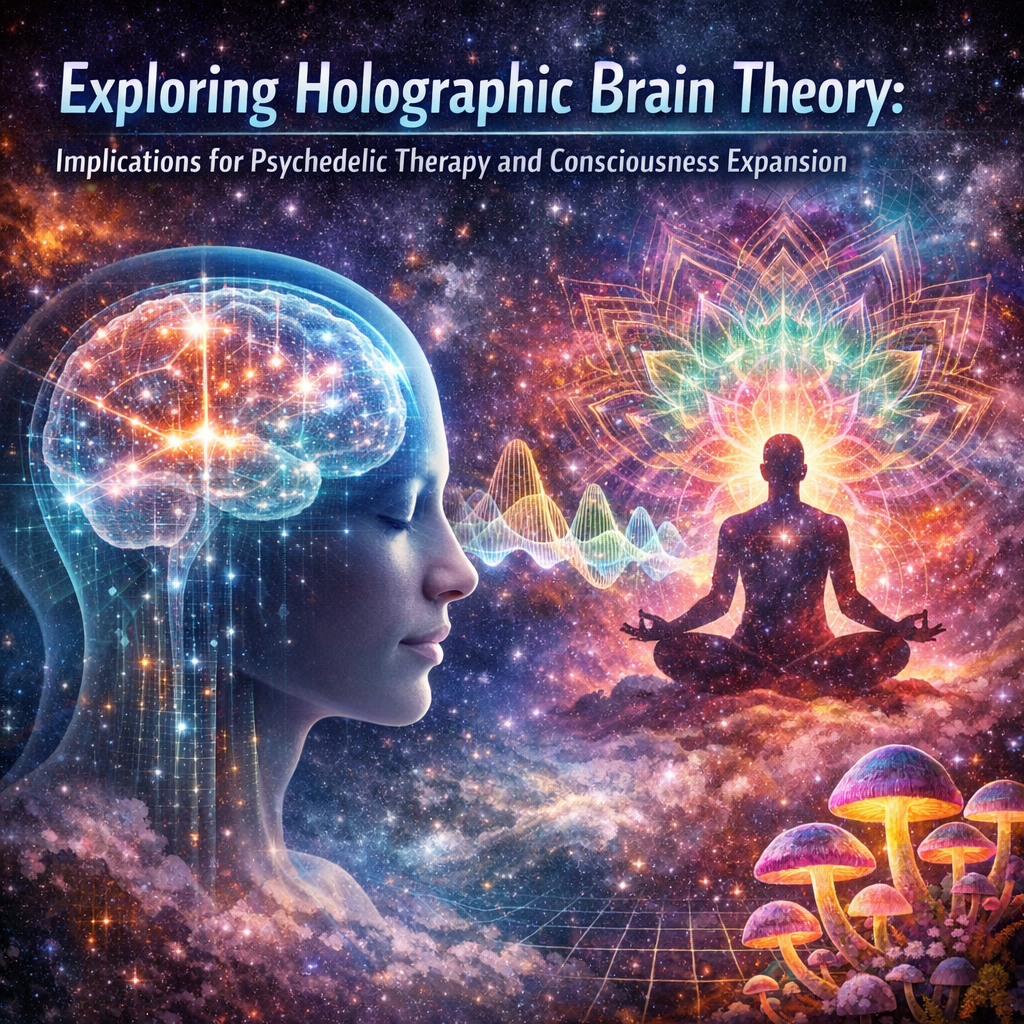
Exploring Holographic Brain Theory: Implications for Psychedelic Therapy and Consciousness Expansion
The **human brain** is a marvel of complexity, with its intricate networks and enigmatic capabilities constantly challenging researchers. Among the various theories attempting to decode this organ’s intricacies, the **Holographic Brain Theory** stands out for its radical departure from conventional thinking. Proposed by neurophysiologist **Karl Pribram** and physicist **David Bohm** in the mid-20th century, this theory posits that the brain processes information in a manner akin to a **hologram**. According to this view, **information** is distributed rather than localized, suggesting that the brain could function as a holistic entity rather than a sum of discrete parts.
This holographic perspective on brain functioning has profound implications for our understanding of **consciousness**, **memory**, and **perception**. It provides a conceptual framework where consciousness is not merely a byproduct of physical processes but an integral part of a universal order, resonating with how holograms depict whole images from any fragment. One of the exciting frontiers in this domain is the intersection of the Holographic Brain Theory with **psychedelic therapy**. **Psychedelics**, particularly **psilocybin**, offer a window into altered states of consciousness. They are being investigated for their potential to catalyze profound shifts in perception, breaking down barriers of conventional thinking, and aiding **mental health treatments**. When viewed through the lens of the Holographic Brain Theory, psychedelics could be seen as tools that temporarily reorganize the brain’s informational pathways, facilitating consciousness expansion and emotional healing.
In recent years, the renaissance of psychedelic research has led to groundbreaking studies exploring psilocybin’s efficacy in treating conditions such as **depression**, **PTSD**, and **anxiety**. The synergistic interaction between psychedelics and the brain’s holographic properties could elucidate mechanisms underlying profound therapeutic experiences. Furthermore, this intersection could provide insights into the nature of consciousness itself, potentially unraveling mysteries about how our subjective experiences arise from neural computations. As this emerging field continues to evolve, it invites us to rethink not only the treatment methodologies of mental illnesses but also our fundamental understanding of **reality** and our place in it.
Professional and Medical Studies on Psychedelics and the Holographic Brain Theory
Recent advances in neuroscience have bolstered the discussion of the Holographic Brain Theory by providing empirical data on brain connectivity and function during altered states of consciousness. A study by Carhart-Harris et al. at Imperial College London utilizes **functional magnetic resonance imaging (fMRI)** to observe brain activity under the influence of psychedelics like psilocybin. Their [findings](https://www.nature.com/articles/s41598-017-13282-7) reveal that psilocybin dissolves typical connectivity hierarchies, allowing for increased global connectivity that might mimic a holographic state of information processing.
Moreover, research conducted at [Johns Hopkins Medicine](https://www.hopkinsmedicine.org/psychiatry/research/johns-hopkins-center-for-psychedelic-consciousness-research/index.html) has demonstrated psilocybin’s capacity to produce substantial decreases in depression and anxiety symptoms, often outperforming traditional pharmacotherapies. These studies suggest that the profound shifts in perception and emotion facilitated by psychedelics could be attributed to the brain’s holographic characteristics, temporarily altering its typical patterns of information processing.
Furthermore, clinical trials have begun to map the therapeutic potential of psychedelics in conjunction with psychotherapy. Studies from [MAPS](https://maps.org/research/) indicate potential resilience against symptoms of PTSD and other psychological traumas. Integration of Pribram’s neurophysiological findings into modern psychedelic therapy illuminates a path to more effective psychiatric treatments while also informing a deeper comprehension of human consciousness.
Conclusion
The interplay between **Holographic Brain Theory** and psychedelic therapy offers a transformational approach to both treatment and understanding of consciousness. As research progresses, further investigations may substantiate how psilocybin and other psychedelics facilitate a reorganization of brain processes, supporting therapeutic outcomes. Embracing this theory not only enhances psychiatric interventions but also invites us to redefine our perception of consciousness, potentially leading to groundbreaking breakthroughs in both science and philosophy. This journey into the holographic nature of the mind continues to propel us toward a future where the boundaries of consciousness can be expanded and explored more fully.
**Concise Summary:** The Holographic Brain Theory, proposed by Karl Pribram and David Bohm, suggests the brain functions like a hologram, processing information holistically rather than in discrete parts. This perspective holds profound implications for understanding consciousness, especially when coupled with psychedelic therapy. Research shows psychedelics like psilocybin can alter brain connectivity, potentially mimicking holographic processing and supporting mental health treatments for depression, PTSD, and anxiety. This emerging field not only promises enhanced psychiatric methods but also invites a reevaluation of consciousness and reality’s fundamental nature, fostering groundbreaking scientific and philosophical insights.

Dominic E. is a passionate filmmaker navigating the exciting intersection of art and science. By day, he delves into the complexities of the human body as a full-time medical writer, meticulously translating intricate medical concepts into accessible and engaging narratives. By night, he explores the boundless realm of cinematic storytelling, crafting narratives that evoke emotion and challenge perspectives. Film Student and Full-time Medical Writer for ContentVendor.com