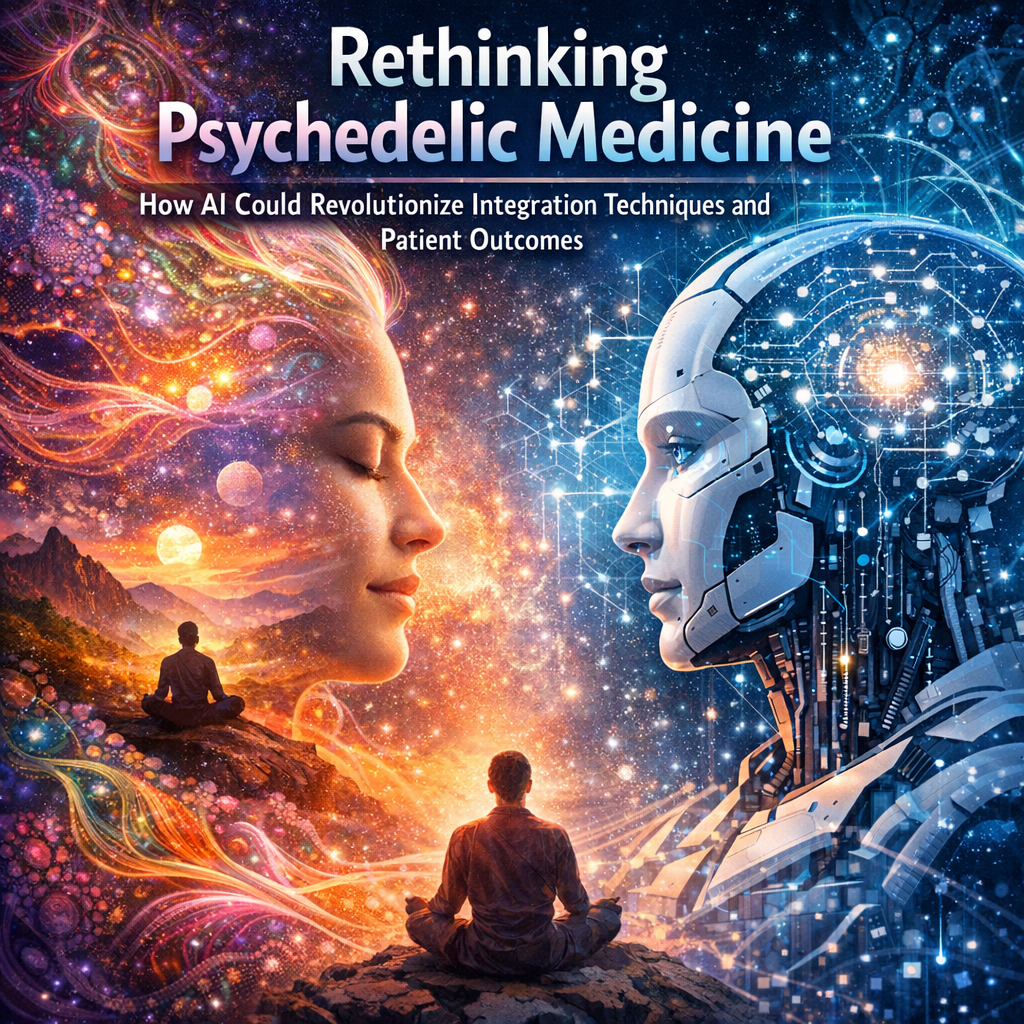
Rethinking Psychedelic Medicine: How AI Could Revolutionize Integration Techniques and Patient Outcomes
In recent years, the resurgence of interest in **psychedelic therapies**, particularly **psilocybin**, has opened a new frontier in **mental health treatment**. This renewed focus is not just restricted to countercultures but increasingly includes mainstream medical communities, driven by groundbreaking research and promising **patient outcomes**. However, while the potential of **psychedelics** in treating mental health disorders such as **depression**, **PTSD**, and **anxiety** is enormous, the key to maximizing their **efficacy** lies in effective **integration techniques**. Integration is the process by which insights and experiences from **psychedelic sessions** are incorporated into a patient’s daily life, ensuring long-lasting therapeutic effects. Until now, this process has largely relied on traditional psychotherapeutic methods. But with the advent of **artificial intelligence (AI)**, there’s potential for a revolutionary shift in how psychedelic integration is approached.
**AI**, with its powerful data analysis capabilities, can offer unprecedented insights into personalizing integration techniques. By analyzing patterns from vast amounts of data collected from patient experiences, treatment outcomes, and clinical trials, AI can help develop tailored integration plans that optimize therapeutic benefits. Furthermore, AI’s machine learning algorithms can continuously adapt and refine their recommendations, offering a dynamic, evolving support system for both patients and healthcare providers. This could lead to more precise and effective therapeutic interventions, enhancing patient outcomes significantly.
The intersection of AI and psychedelics is not just an exciting new frontier in cognitive science but a potentially transformative step in mental health treatment. Implementing AI-powered tools in psychedelic therapy could streamline the process of integration, making it more accessible and effective for a broader range of patients. This approach also opens up opportunities for remote and self-guided therapy, which could vastly expand the reach of psychedelic medicines to those in underserved or hard-to-reach areas. The promise of AI in this space is immense, and its application could mark the dawn of a new era in psychedelic therapy, characterized by precision, personalization, and scalability, providing not only relief but a real pathway to healing for millions around the world.
Features:
Recent studies and professional insights highlight a growing recognition of AI’s potential in refining **psychedelic therapies**. One pivotal study conducted by researchers at [**Johns Hopkins University**](https://www.hopkinsmedicine.org) found that psilocybin-assisted therapy can lead to significant reductions in symptoms of depression and anxiety. The data from these sessions, if analyzed with AI, can reveal patterns and insights critical to developing new integration techniques. AI can sift through extensive data sets to identify which integration practices yield the best results, for whom, and under what conditions.
Furthermore, a study published in [**Nature Medicine**](https://www.nature.com/nm/) demonstrated how AI algorithms could predict patient outcomes by analyzing brain imaging data before and after psychedelic treatments. This predictive capability allows for more informed decision-making, helping therapists to tailor integration practices to achieve optimal results. Another research paper, released by the [**Journal of Psychopharmacology**](https://journals.sagepub.com/home/jop), discusses the potential of AI in managing and monitoring patient progress in real-time, providing therapists with instant feedback and allowing for adjustments to integration techniques as needed.
In essence, AI can function as a sophisticated diagnostic tool, able to assess a patient’s mental health condition comprehensively and continuously. This capability can lead to more precise dosing strategies, better preparation for psychedelic experiences, and superior integration support. With tools like AI-driven mobile applications, patients can now receive personalized guidance in real-time, helping them to process and incorporate psychedelic experiences more effectively into their daily lives.
This convergence of technology and psychedelics holds significant promise not only for reducing the burden of mental illnesses but also for fostering a deeper understanding of the human mind. As research continues to advance, we can expect to see AI becoming an integral part of the toolkit used by mental health professionals to deliver psychedelic therapies with increased accuracy, safety, and success.
Conclusion:
The marriage of AI and psychedelics represents a promising leap forward in the realm of mental health treatment. By enhancing the integration process through data-driven insights, AI has the potential to significantly improve patient outcomes and broaden access to **psychedelic therapies**. As we continue to explore this cutting-edge intersection of technology and medicine, we move closer to a future where the healing potential of psychedelics is fully realized, offering renewed hope for those in need of mental health support.
Concise Summary
The integration of **AI** in **psychedelic therapies** promises a significant breakthrough in **mental health treatment**. By utilizing AI’s data analysis capabilities, personalized and effective integration practices can be developed, improving **patient outcomes** for disorders like **depression**, **PTSD**, and **anxiety**. Studies at [**Johns Hopkins University**](https://www.hopkinsmedicine.org) and [**Nature Medicine**](https://www.nature.com/nm/) show AI’s potential in tailoring **psilocybin-assisted therapies**. This convergence of **technology** and **medicine** broadens access to treatments, offering hope and healing by ensuring that the therapeutic benefits of **psychedelics** are maximized, personalized, and scalable.

Dominic E. is a passionate filmmaker navigating the exciting intersection of art and science. By day, he delves into the complexities of the human body as a full-time medical writer, meticulously translating intricate medical concepts into accessible and engaging narratives. By night, he explores the boundless realm of cinematic storytelling, crafting narratives that evoke emotion and challenge perspectives. Film Student and Full-time Medical Writer for ContentVendor.com