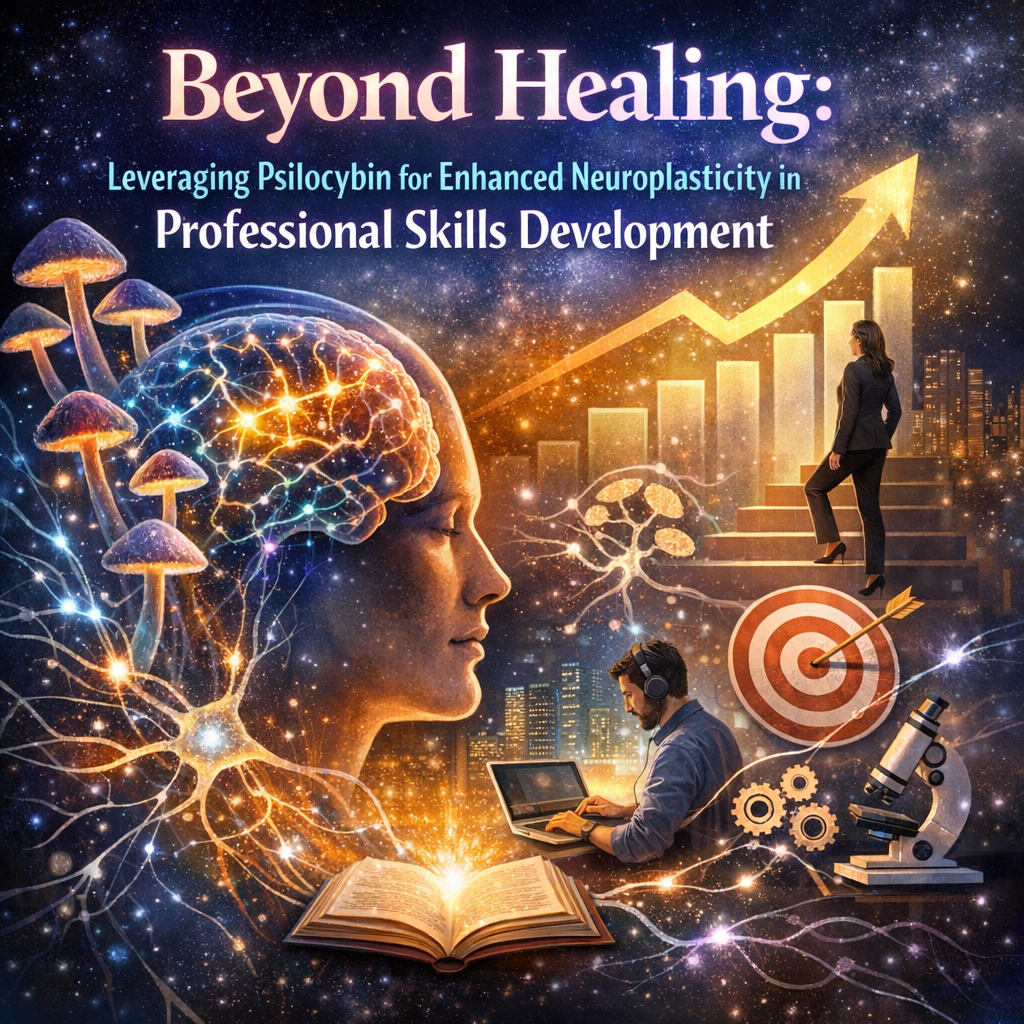
Beyond Healing: Leveraging Psilocybin for Enhanced Neuroplasticity in Professional Skills Development
In recent years, the exploration of **psilocybin**, the psychoactive compound found in certain species of mushrooms, has moved from the fringes of scientific curiosity to the forefront of revolutionary medical treatments. Traditionally associated with spiritual experiences and recreational use, psilocybin is now being lauded for its potential **neuroplastic** benefits. **Neuroplasticity**, the brain’s ability to reorganize itself by forming new neural connections, is crucial for learning and adapting to new information. While psilocybin has been widely studied for its therapeutic effects on mental health conditions such as **depression** and **PTSD**, its potential to enhance neuroplasticity opens new avenues for personal and professional development.
As modern professionals face an increasingly complex and rapidly changing work environment, the demand for **cognitive flexibility** and continuous skill adaptation is higher than ever. The concept of lifelong learning extends beyond formal education and into the workplace, where the ability to acquire and integrate new skills can determine career trajectories. Here, the role of psilocybin becomes intriguing. Emerging research suggests that psilocybin can enhance neuroplasticity, thereby improving one’s ability to learn and apply new professional skills effectively.
The core mechanism by which psilocybin enhances **neuroplasticity** is thought to involve the stimulation of **serotonin receptors**, particularly the **5-HT2A receptor**, which plays a significant role in cognitive processing and mood regulation. This receptor activation leads to increased production of brain-derived neurotrophic factor (**BDNF**) and other growth factors, encouraging the growth and reorganization of neural pathways. Consequently, an individual’s brain becomes more adept at forming new connections, facilitating learning and memory retention. Psilocybin’s potential to assist professionals in adapting to new job roles, mastering complex tasks, or undergoing career shifts is, thus, a topic garnering significant attention.
In this article, we delve into how psilocybin catalyzes neuroplasticity, examine existing studies supporting these claims, and explore its implications for enhancing professional skills development. We will highlight significant research findings, discuss their relevance, and outline the potential future applications of psilocybin in professional settings that require high levels of cognitive flexibility and skill adaptation.
Features:
Recent studies have started to unveil the extent to which psilocybin can influence neuroplasticity. One pivotal study conducted by researchers at **Imperial College London** revealed that psilocybin prompts increased activity in parts of the brain that are responsible for high-level thought, imagination, and introspection. Notably, the study found that the compound facilitates synaptic rewiring, essentially fostering an environment where the brain can remodel itself to allow for long-term adaptive changes. [Source](https://www.imperial.ac.uk/news/199346/psilocybin-changes-brain-connectivity-using-functional/)
These structural changes have profound implications for professional development. Enhanced neuroplasticity means a better ability to process complex information, make decisions, and solve problems—skills crucial in today’s workplace. For instance, individuals in fast-paced technology sectors can leverage psilocybin’s effects to keep up with evolving innovations and methodologies. Similarly, professionals in leadership roles may find psilocybin-assisted learning particularly beneficial in developing emotional intelligence and transformative leadership skills. These improvements stem from the enhanced connectivity and flexibility within the brain, making psilocybin not just a tool for healing but also for optimizing professional performance.
Moreover, the effects of psilocybin on **creativity** should not be overlooked. By disrupting default network activities associated with rigid thought patterns, psilocybin facilitates out-of-the-box thinking, which is critical for strategic planning and innovation. A study published in the journal *Psychopharmacology* found that subjects reported increased creativity and more original thought processes when engaging with psilocybin. [Source](https://link.springer.com/article/10.1007/s00213-012-2731-y).
Conclusion:
Psilocybin is transitioning from being solely a subject of medical treatments for mental health to a potent catalyst for professional skills development. By enhancing neuroplasticity, it empowers individuals to learn, adapt, and innovate more effectively. As science continues to explore the vast potential of psilocybin, its integration into professional training and development programs may soon become a cornerstone of career growth strategies.
References:
1. **Imperial College London** Study on Psilocybin and Brain Connectivity – [Imperial News](https://www.imperial.ac.uk/news/199346/psilocybin-changes-brain-connectivity-using-functional/)
2. **Psychopharmacology Journal** on Psilocybin and Creativity – [Springer Link](https://link.springer.com/article/10.1007/s00213-012-2731-y)
Concise Summary:
Psilocybin, a compound found in mushrooms, is gaining attention for its ability to enhance neuroplasticity, facilitating new neural connections. This property aids in learning and adapting, crucial for modern professional growth. By activating serotonin receptors, particularly 5-HT2A, psilocybin boosts BDNF production, enhancing brain flexibility. Researched at Imperial College London, psilocybin fosters creativity and complex problem-solving. It shows promise in leadership and technology sectors, enhancing emotional intelligence and adaptability. As studies progress, psilocybin could become integral in professional development programs, marking a shift from solely treating mental health to enhancing professional skills.

Dominic E. is a passionate filmmaker navigating the exciting intersection of art and science. By day, he delves into the complexities of the human body as a full-time medical writer, meticulously translating intricate medical concepts into accessible and engaging narratives. By night, he explores the boundless realm of cinematic storytelling, crafting narratives that evoke emotion and challenge perspectives. Film Student and Full-time Medical Writer for ContentVendor.com