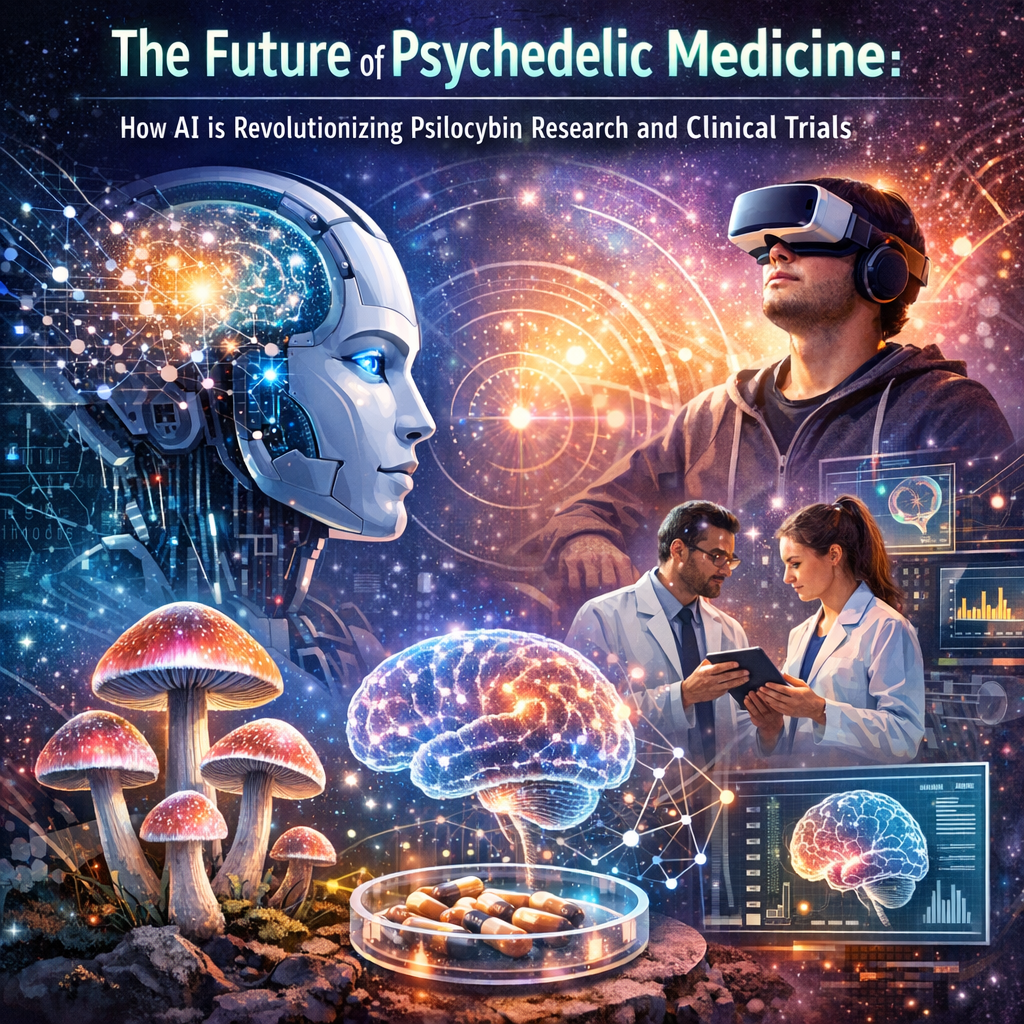
The Future of Psychedelic Medicine: How AI is Revolutionizing Psilocybin Research and Clinical Trials
In recent years, **psilocybin**—the active compound found in “magic mushrooms”—has emerged from the shadows of recreational use into the illuminating arena of medical research. Equipped with potential therapeutic benefits, it is being investigated for treatments ranging from **depression** to **PTSD**. However, rigorous scientific scrutiny and a systematic approach in its application are vital for psilocybin to find its rightful place in mainstream medicine. This is where **Artificial Intelligence (AI)** steps in as a game-changer.
The burgeoning field of **psychedelic medicine** faces multiple challenges. Traditional research methods are time-consuming and resource-intensive, often hampered by the complex regulatory environment surrounding psychedelics. AI offers solutions by streamlining research processes and providing data-driven insights. Through artificial intelligence, vast datasets can be analyzed more efficiently, uncovering patterns and insights that may otherwise remain hidden to human researchers. One might wonder why AI is particularly well-suited for this role. The answer lies in its capacity to manage complexity, a crucial asset when deciphering the effects of psychedelics on the human brain. Utilizing **machine learning algorithms**, AI can model and predict neurological outcomes and responses to psilocybin, crafting personalized treatment plans with unprecedented accuracy.
Companies and research institutions are already harnessing AI for **drug discovery**, patient screening, and even optimizing dosages to tailor therapeutic protocols. For instance, AI technologies can process **MRI** and **EEG scans** to assess brain activity patterns pre-and post-psilocybin treatment, advancing our understanding of its mechanistic action.
Moreover, **AI-driven platforms** are reinventing clinical trials. Traditional trials face recruitment hurdles and lengthy timelines, but AI can match patient profiles to trial criteria with remarkable precision, ensuring diverse and suitable participant selections. Algorithms can also continuously monitor participant data in real-time, adjusting trials for efficacy and safety as they progress.
This intersection of AI and psilocybin research represents a paradigm shift, promising to unlock the full therapeutic potential of psychedelics far more quickly and accurately than ever before. By revolutionizing the scope and speed of clinical trials and yielding robust, personalized treatment pathways, AI not only accelerates psilocybin research but also solidifies its viability as a treatment option in the meticulous landscape of modern medicine.
Features:
Numerous professional and academic studies are shedding light on how AI is transforming psilocybin research. A pivotal example is the research collaboration between technological and medical institutions such as [Imperial College London](https://www.imperial.ac.uk/psychedelic-research-centre/research/), known for pioneering work in understanding how psychedelics affect the brain. Using AI-driven data analysis tools, researchers have been able to map the brain’s network dynamics under the influence of psilocybin. This detailed mapping offers new insights into how altered neural connectivity may contribute to the alleviation of depression and other mental health disorders.
Another critical study led by researchers at [Johns Hopkins University](https://hopkinspsychedelic.org/) applied AI-based monitoring to study the effects of psilocybin on emotional and cognitive processes. Machine learning algorithms analyzed massive sets of patient data to predict treatment responses, bringing a new level of precision and personalization to psychedelic therapies. The outcome demonstrated that AI could reliably differentiate between treatment responders and non-responders, refining the application of psilocybin in therapeutic settings.
AI applications in psychedelic research aren’t confined to treatment alone. **Drug discovery** is undergoing its own revolution. Companies like [ATAI Life Sciences](https://www.atai.life/our-programs/) are leveraging AI to design and test novel psychedelic compounds, rapidly advancing beyond traditional models. These algorithms can predict compound interactions with brain receptors, accelerating the discovery of the most promising therapeutic candidates.
The contributions of AI extend to solving logistical challenges in clinical trials. AI tools revolutionize participant selection and enhance real-time monitoring capabilities, significantly improving the trial’s validity and reliability. The benefits translate into more precise and dynamic trials, aligned with rigorous safety and ethical standards. As AI capabilities continue to expand, their integration into psilocybin research heralds a new era for psychedelic medicine.
Conclusion:
The integration of AI into psilocybin research and clinical trials represents a transformative leap toward the future of psychedelic medicine. The synergy between AI and psilocybin holds the promise of personalized, effective, and safe treatments by accelerating research timelines, enhancing the precision of trials, and unveiling the full therapeutic potential of these compounds. As the field progresses, continued collaboration between technology and medical science will be crucial in reshaping mental health care.
**Concise Summary:**
The incorporation of **AI** into **psilocybin research** is revolutionizing the field of **psychedelic medicine**, offering solutions to traditional research challenges like regulatory hurdles and lengthy timelines. Through AI, large datasets are analyzed efficiently, personalizing and enhancing treatment protocols. This technological synergy allows for precise, swift clinical trials, robust drug discovery, and innovative therapeutic applications, positioning psilocybin as a viable treatment in modern medicine. Collaborative efforts between technological and medical industries, as demonstrated by [Imperial College London](https://www.imperial.ac.uk/psychedelic-research-centre/research/) and [Johns Hopkins University](https://hopkinspsychedelic.org/), emphasize the promising future of AI in this transformative field.

Dominic E. is a passionate filmmaker navigating the exciting intersection of art and science. By day, he delves into the complexities of the human body as a full-time medical writer, meticulously translating intricate medical concepts into accessible and engaging narratives. By night, he explores the boundless realm of cinematic storytelling, crafting narratives that evoke emotion and challenge perspectives. Film Student and Full-time Medical Writer for ContentVendor.com