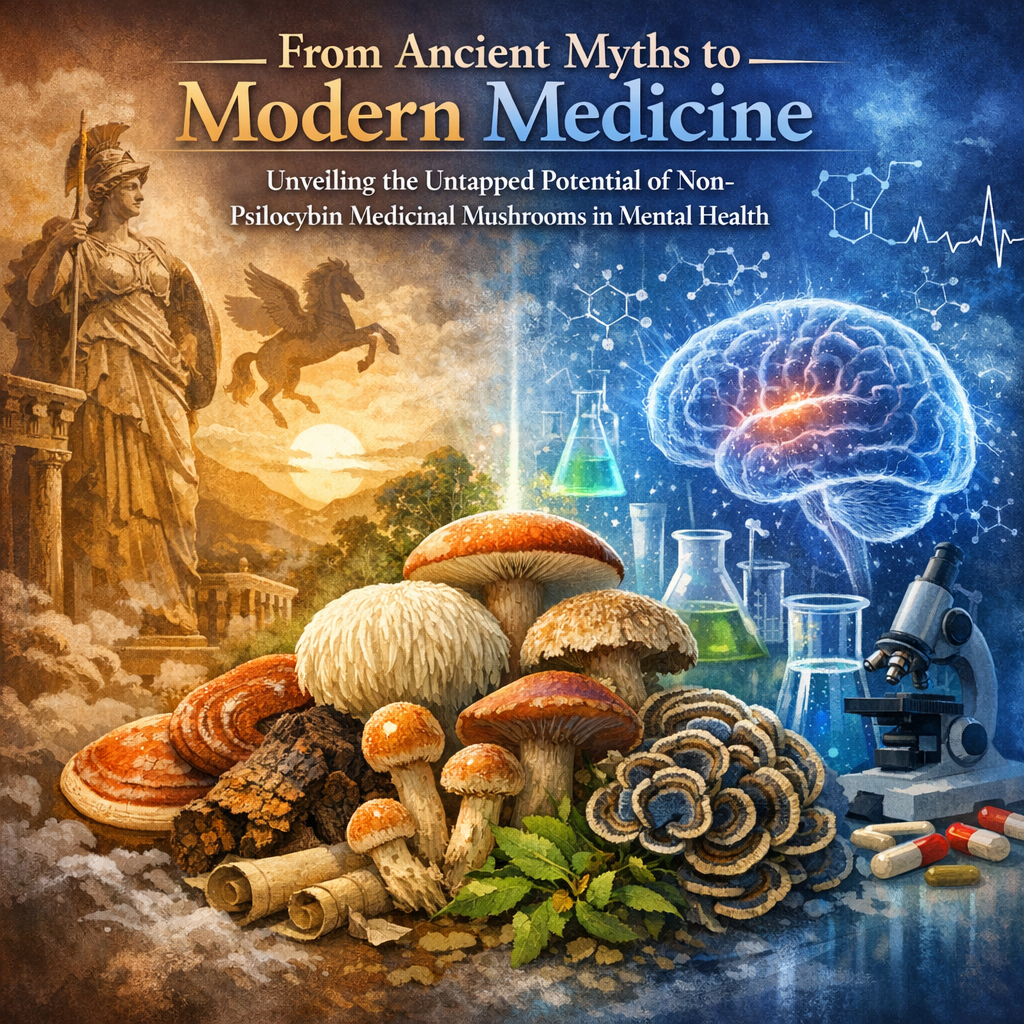
From Ancient Myths to Modern Medicine: Unveiling the Untapped Potential of Non-Psilocybin Medicinal Mushrooms in Mental Health
For centuries, **mushrooms** have been consumed for their rich flavors, nutritional value, and rumored healing properties. However, it is only in recent decades that scientists have started to delve deeper into the **medicinal attributes** of certain **fungi**, excluding the well-known psychedelic varieties. While **psilocybin mushrooms** dominate the conversation surrounding fungi and mental health, a plethora of non-psychedelic mushrooms also hold promise for mood enhancement and **mental well-being**.
Traditionally, mushrooms like **Lion’s Mane**, **Reishi**, and **Cordyceps** have been staples in Eastern medicine. Lion’s Mane, a distinctive furry mushroom, is celebrated not just for its unusual appearance but also for its potential **cognitive benefits**. Reishi, known as the “Mushroom of Immortality,” is renowned for its **calming properties** and **immune support**. Meanwhile, Cordyceps, often associated with vitality, offers **stamina** and **energy enhancement**.
The therapeutic use of these mushrooms is widespread in various practices, from traditional Chinese medicine to Ayurvedic healing systems. Ancient tales often depict fungi as mystical beings possessing curative powers, underscoring their esteemed status across cultures. Legend speaks of Reishi as a spiritual herb that promotes longevity and peace of mind. Such myths, while fascinating, are now being substantiated with scientific scrutiny.
Recent studies illuminate the mechanisms behind these mushrooms’ effects on the brain and body. Unlike **psilocybin**, which alters perception and consciousness, non-psychedelic mushrooms work subtly to promote **neuron health**, reduce **inflammation**, and balance **neurotransmitters**. These benefits offer hope for non-disruptive therapeutic alternatives to pharmaceuticals, especially as **mental health issues** continue to surge worldwide.
While ancient cultures mythologized medicinal mushrooms, modern science is peeling back the layers of folklore to reveal tangible **neuroprotective** and **adaptogenic properties**. As we explore this interface between ancient traditions and contemporary medicine, it becomes paramount to evaluate these compounds in clinical settings. With **depression**, **anxiety**, and **cognitive decline** on the rise, harnessing the therapeutic potential of these natural wonders could be an essential step forward.
Research Features
Research into **non-psychedelic medicinal mushrooms** is rapidly expanding, with several noteworthy studies highlighting their potential in mental health management. One of the most compelling is the work surrounding Lion’s Mane (**Hericium erinaceus**). A study published in the [Journal of Agricultural and Food Chemistry](https://pubs.acs.org/doi/10.1021/jf930306u) detailed how Lion’s Mane promotes the synthesis of **nerve growth factor (NGF)**, which is crucial for the survival and function of neurons. By stimulating NGF, Lion’s Mane may help protect against **neurodegenerative diseases** and support cognitive function, including memory and concentration.
**Reishi** (**Ganoderma lucidum**) also shows promise as an adjunct in mental health care. A clinical trial published in the [International Journal of Medicinal Mushrooms](https://www.ingentaconnect.com/content/dennis/ijmm/2011/00000013/00000004/art00006) examined Reishi’s impact on patients with **neurasthenia**, a stress-related condition characterized by fatigue and anxiety. Participants who consumed Reishi reported significant reductions in symptoms compared to the placebo group, highlighting its potential **adaptogenic effects**.
Another promising candidate is **Cordyceps** (**Cordyceps militaris**), esteemed for its vitality-enhancing properties. Research in the [Journal of Ethnopharmacology](https://www.sciencedirect.com/science/article/abs/pii/S0378874118302900) examined Cordyceps’ impact on reducing fatigue and enhancing mood. The findings suggested that this mushroom may normalize **cortisol levels** and improve overall emotional well-being by acting on the **hypothalamic-pituitary-adrenal (HPA) axis**, an integral player in the stress response.
These findings underscore the potential of non-psilocybin mushrooms as complementary therapeutic agents. Ongoing research aims to further delineate their biochemical pathways and clinical efficacy, paving the way for broader medicinal use. While current results are promising, further long-term clinical trials are necessary to fully understand their implications and optimize their applications in mental health care.
Conclusion
In an era marked by significant mental health challenges, the ancient wisdom and emerging science of **non-psilocybin medicinal mushrooms** offer a promising intersection. As the medical community continues to explore their untapped potential, these natural compounds could offer complementary herbs to traditional mental health treatments, ensuring a holistic approach to well-being. Embracing these fungi, rooted in history and vetted by modern science, might just unlock a new chapter in mental health care.
**Concise Summary**
Non-psilocybin medicinal mushrooms, such as Lion’s Mane, Reishi, and Cordyceps, offer promising alternatives in mental health care. These mushrooms have been integral to traditional medicine and are now supported by scientific research. They work by promoting neuron health, reducing inflammation, and balancing neurotransmitters, which can improve mental well-being without altering consciousness. Studies show Lion’s Mane helps cognitive function, Reishi reduces stress-related symptoms, and Cordyceps enhances mood. While preliminary findings are promising, further clinical trials are needed to fully harness their potential in addressing worldwide mental health issues.

Dominic E. is a passionate filmmaker navigating the exciting intersection of art and science. By day, he delves into the complexities of the human body as a full-time medical writer, meticulously translating intricate medical concepts into accessible and engaging narratives. By night, he explores the boundless realm of cinematic storytelling, crafting narratives that evoke emotion and challenge perspectives. Film Student and Full-time Medical Writer for ContentVendor.com