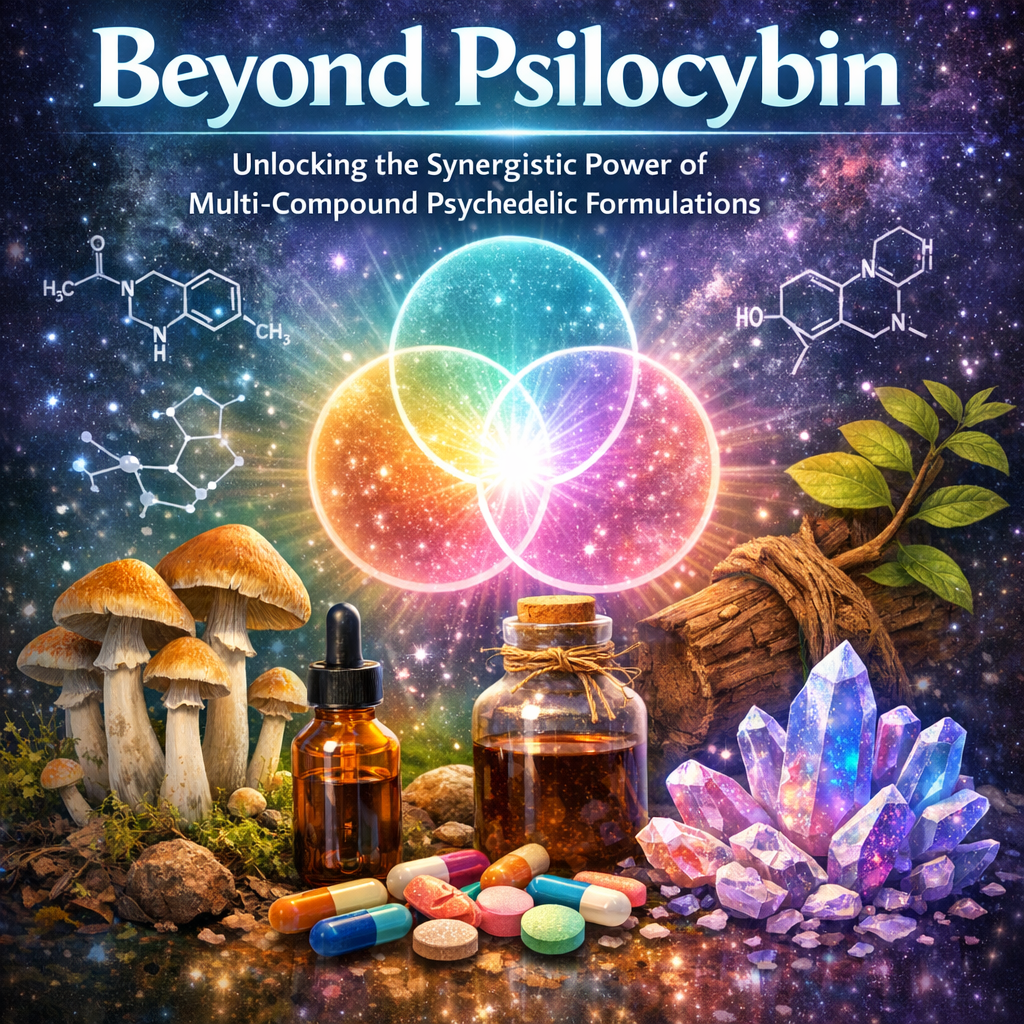
Beyond Psilocybin: Unlocking the Synergistic Power of Multi-Compound Psychedelic Formulations
In recent years, the resurgence of interest in **psychedelics**, particularly **psilocybin**, has opened up new avenues for medical and psychological treatments. Psilocybin, the psychoactive compound found in **magic mushrooms**, has shown promising results in treating conditions such as **depression**, **anxiety**, **PTSD**, and **addiction**. However, while psilocybin has been the focus of much research and media attention, there is a growing body of evidence suggesting that other compounds found in psychedelic mushrooms may also hold substantial therapeutic potential.
Traditionally, the study of psychedelics has largely concentrated on single compounds, a method that can overlook the complex interactions within these naturally occurring substances. **Multi-compound psychedelic formulations**—the blending of different psychoactive compounds—offer a new frontier in mushroom-based therapy, tapping into the **synergistic effects** that might arise when multiple compounds are used together. This is analogous to the “entourage effect” observed with various **cannabinoids** in cannabis research, where the therapeutic effect of the plant is enhanced when compounds work in concert rather than in isolation.
The significance of multi-compound formulations lies in their potential to provide a more holistic approach to treatment. By leveraging the complete profile of a psychedelic mushroom, practitioners and researchers can explore the full spectrum of its therapeutic capabilities. For instance, research into psilocybin-containing mushrooms like **Psilocybe cubensis** suggests the presence of other active compounds such as **baeocystin** and **norbaeocystin**, which may have unique effects on brain chemistry and cognitive function. Early findings imply that these compounds, when combined with psilocybin, could enhance the therapeutic outcomes or even target conditions that psilocybin alone may not effectively address.
Exploring multi-compound formulations offers a promising path to develop more potent and targeted psychedelic therapies. Further investigation into this area can help establish a comprehensive understanding of how these compounds interact and potentially unlock new treatment possibilities for complex mental health issues. This could lead to the development of specialized treatments tailored to the specific profiles of individual patients, optimizing effectiveness and safety.
Features
Recent studies are beginning to highlight the importance of exploring multi-compound psychedelic formulations. One noteworthy study published in the journal *Scientific Reports* suggested that while psilocybin is the primary psychoactive substance in magic mushrooms, the effects of other compounds should not be underestimated. The research points to the possibility that these additional compounds may modify psilocybin’s effects, possibly smoothing out the psychedelic experience or reducing potential side effects ([source](https://www.nature.com/articles/s41598-019-42522-5)).
Further exploration into the role of mushroom-derived compounds such as baeocystin and norbaeocystin is ongoing. A landmark study conducted by the Beckley/Imperial Research Programme examined how these compounds might contribute to the overall psychoactive profile of mushroom experiences. Their findings suggest that they could potentially play a role in creating a more balanced therapeutic profile, supporting claims that whole mushroom extracts might be more effective than isolated psilocybin ([source](https://beckleyfoundation.org/news/beckley-imperial-research-on-the-effects-of-magic-mushrooms)).
In a clinical context, the **Johns Hopkins Center for Psychedelic and Consciousness Research** has been at the forefront of this exploration, advocating for the examination of combined formulations. Their ongoing studies indicate that such multi-compound formulations might offer enhanced therapeutic values, particularly in treating conditions like refractory depression, where patients have not responded well to conventional treatments. These findings suggest a potential shift in future treatment protocols, favoring a broader spectrum of psychoactive compounds ([source](https://hopkinspsychedelic.org/)).
Critically, while the promise of multi-compound formulations is evident, researchers caution the necessity of rigorous scientific exploration. Understanding the interactions of these compounds requires detailed, controlled studies to ensure safety and efficacy. Despite the obstacles, the potential benefits of multi-compound formulations could usher in a new era of psychedelic therapy, one that offers personalized and more effective treatment options for patients.
Conclusion
In conclusion, as the exploration of psychedelics advances beyond the singular focus on psilocybin, multi-compound formulations may pave the way for innovative therapeutic strategies. By unlocking the synergistic potential of multiple active compounds within psychedelic mushrooms, the potential for more comprehensive and effective treatments emerges, addressing a broader range of psychological and neurological conditions. Ongoing research and clinical trials will be paramount in bringing these promises to fruition, ensuring that multi-compound psychedelic therapies become a cornerstone of modern medical treatments.
Concise Summary
The resurgence in interest in psychedelics, especially psilocybin, has highlighted the potential of multi-compound formulations, which combine various psychoactive compounds found in **psychedelic mushrooms**. These formulations, akin to the “entourage effect” in cannabis, could offer more comprehensive and effective treatments by leveraging the full spectrum of therapeutic capabilities these mushrooms possess. Research suggests that compounds like baeocystin and norbaeocystin could enhance or modify psilocybin’s effects, offering new treatment avenues for conditions such as **depression** and **PTSD**. Rigorous exploration is needed to ensure safety, efficacy, and the development of personalized therapies.

Dominic E. is a passionate filmmaker navigating the exciting intersection of art and science. By day, he delves into the complexities of the human body as a full-time medical writer, meticulously translating intricate medical concepts into accessible and engaging narratives. By night, he explores the boundless realm of cinematic storytelling, crafting narratives that evoke emotion and challenge perspectives. Film Student and Full-time Medical Writer for ContentVendor.com