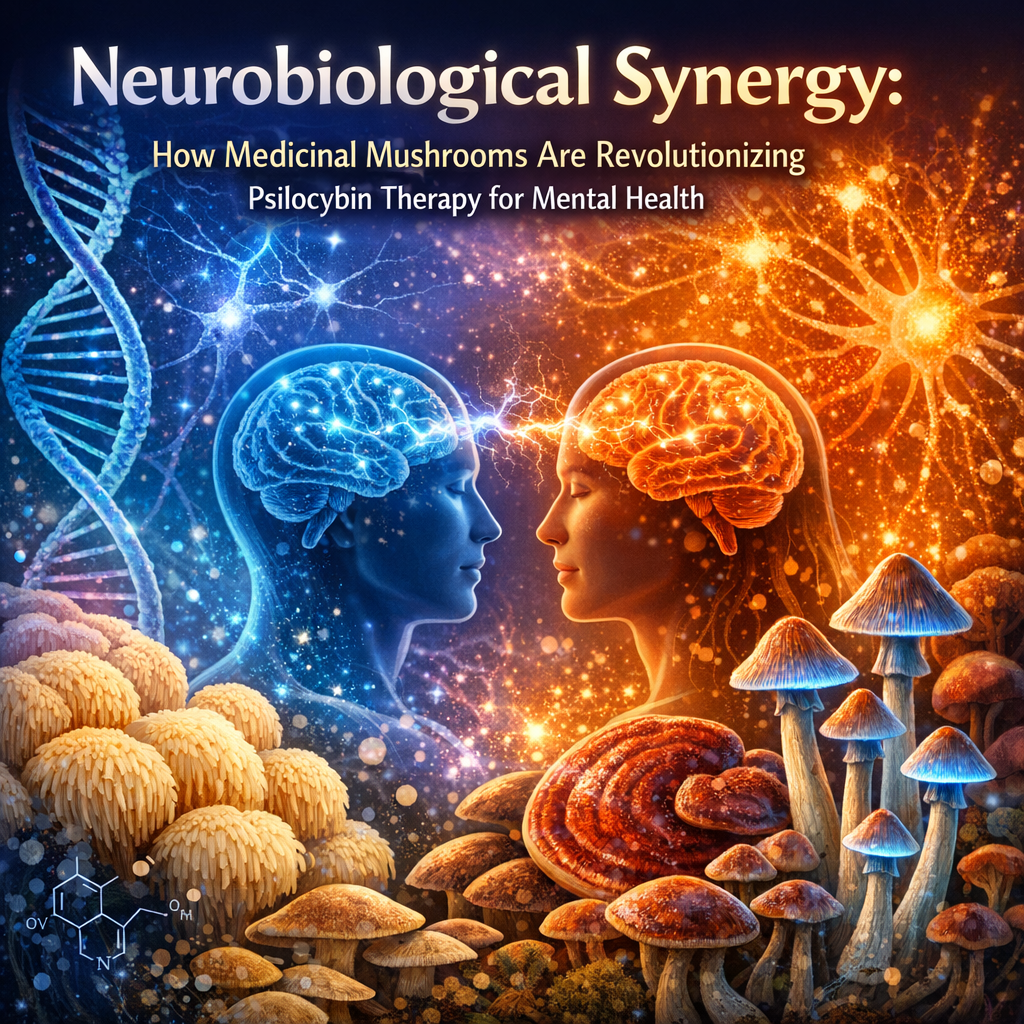
Neurobiological Synergy: How Medicinal Mushrooms Are Revolutionizing Psilocybin Therapy for Mental Health
In recent years, the potential of **psilocybin**, a psychedelic compound found in certain mushrooms, has garnered significant attention in the field of mental health. Known for its impacts on consciousness and cognitive processes, psilocybin is being extensively researched as a therapeutic agent for conditions like **depression**, **anxiety**, and **PTSD**. However, a lesser-known yet exciting development in this domain is the synergistic use of psilocybin alongside other **medicinal mushrooms**. These fungi, traditionally celebrated in Eastern medicine, are now becoming integral to revolutionary treatments due to their neurobiological benefits and natural healing properties.
Medicinal mushrooms, such as **Lion’s Mane**, **Reishi**, and **Turkey Tail**, have been studied for their potential to support the brain’s neuroplasticity and foster neurogenesis. In tandem with psilocybin, they could potentially maximize therapeutic outcomes by enhancing the brain’s capacity to repair and regenerate neural pathways. This combination, often referred to as “stacking,” involves consuming small, harmonious doses of these substances to create a complementary effect that is greater than the sum of its parts.
Lion’s Mane, in particular, has been observed to stimulate the production of **Nerve Growth Factor (NGF)**, a protein involved in the maintenance and growth of neurons. When combined with psilocybin, known for its ability to create temporary neural rewiring, Lion’s Mane could potentiate the integration of new pathways formed during psilocybin experiences. This could be especially beneficial in therapeutic settings, where individuals work to overcome deeply ingrained thought patterns associated with mental health disorders.
Moreover, the adaptogenic properties of mushrooms like **Reishi** can complement psilocybin’s effects by bringing a sense of grounding and balance to the heightened states of consciousness psilocybin often fosters. This stabilizing effect may help mitigate any potential anxiogenic effects (anxiety-inducing) that might arise during psychedelic therapy, offering a more comprehensive and manageable healing experience.
As the interest in psychedelic therapy grows, integrating these intelligent fungi into treatment protocols is emerging as a promising frontier in mental health care. By capitalizing on the natural synergy between psilocybin and medicinal mushrooms, practitioners are developing innovative approaches that prioritize holistic healing, emphasizing both acute therapeutic effects and long-term well-being.
Features
Research supporting the therapeutic applications of **psilocybin** is burgeoning, with several notable [studies](https://www.sciencedaily.com/releases/2016/12/161201141631.htm) highlighting its potential benefits. For example, a study conducted by researchers at Johns Hopkins University found that psilocybin therapy produced sustained decreases in depression and anxiety in patients with life-threatening cancer diagnoses. The study reported that these effects were considerably profound, with many participants experiencing significant improvements in mood and outlook.
Complementing these impressive findings, medicinal mushrooms also boast a wealth of scientific backing. **Lion’s Mane**, a standout among its peers, has been the subject of multiple [studies](https://link.springer.com/article/10.1615/IntJMedMushrooms.v10.i4.40), suggesting its capability to enhance cognitive function and relieve mild symptoms of anxiety and depression. A study published in the International Journal of Medicinal Mushrooms demonstrated how Lion’s Mane could improve cognitive function and safeguard against cognitive decline.
Simultaneously, a [review](https://www.frontiersin.org/articles/10.3389/fphar.2018.00040/full) on adaptogenic mushrooms such as Reishi documented their immune-modulating and stress-adaptive properties, highlighting their potential in enhancing the body’s response to stress and environmental changes. These properties can complement the emotional openness induced by psilocybin, fostering a setting conducive to psychological healing and growth.
Given the promising implications of these findings, ongoing research and clinical trials continue to examine the synergistic potential of combining psilocybin with other mushrooms. The safety profile of psilocybin, often enhanced by its concurrent use with stabilizing mushrooms, positions this multi-faceted therapeutic approach as a viable option in integrative mental health care.
Conclusion
The fusion of **psilocybin therapy** with **medicinal mushrooms** holds groundbreaking potential in revolutionizing mental health treatment. As scientific inquiry and clinical experiences continue to unfold, this holistic approach could redefine traditional paradigms, fostering innovative and personalized healing paths. By embracing the natural synergy between these potent fungi, we stand on the cusp of a new era in therapeutic interventions that prioritize both mental and emotional wellbeing.
**Concise Summary**
The synergy between psilocybin and medicinal mushrooms like Lion’s Mane, Reishi, and Turkey Tail is transforming mental health treatments. Psilocybin, known for its psychedelic effects, is being researched for depression, anxiety, and PTSD. Combining it with medicinal mushrooms, which enhance neuroplasticity, could optimize therapy outcomes by promoting neural pathway repair. Lion’s Mane, stimulating Nerve Growth Factor, complements psilocybin’s neural rewiring, while Reishi’s adaptogenic properties stabilize therapy experiences. Studies show their potential, prompting further research into this promising treatment approach, which emphasizes holistic health by integrating these fungi for improved mental and emotional well-being.

Dominic E. is a passionate filmmaker navigating the exciting intersection of art and science. By day, he delves into the complexities of the human body as a full-time medical writer, meticulously translating intricate medical concepts into accessible and engaging narratives. By night, he explores the boundless realm of cinematic storytelling, crafting narratives that evoke emotion and challenge perspectives. Film Student and Full-time Medical Writer for ContentVendor.com