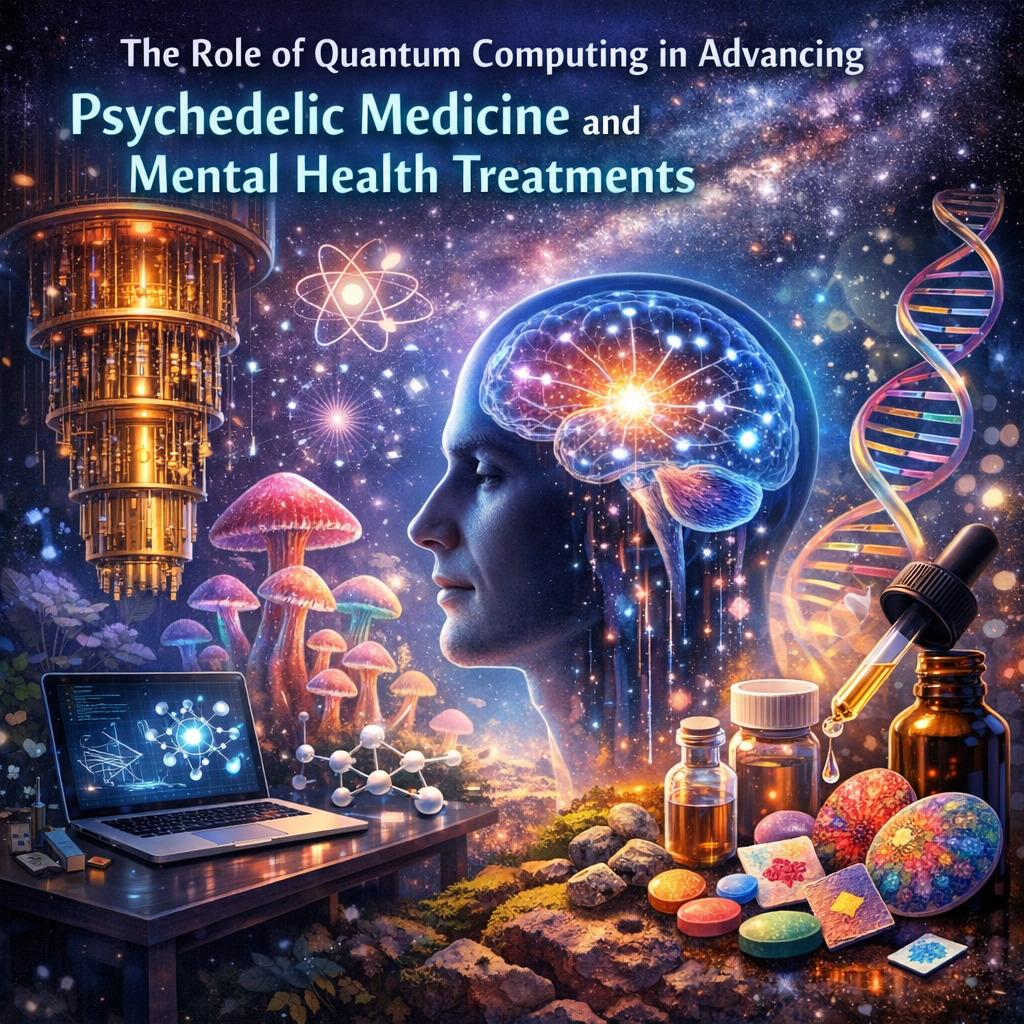
The Role of Quantum Computing in Advancing Psychedelic Medicine and Mental Health Treatments
Introduction
The world of mental health treatment is undergoing a significant transformation, driven by advancements in psychedelic medicine and the emergence of groundbreaking technologies like quantum computing. This convergence offers new hope for tackling some of the most complex mental health challenges that have long eluded conventional treatments. Psychedelic compounds, such as psilocybin, the active ingredient in “magic mushrooms”, have shown immense potential in treating depression, anxiety, PTSD, and other mental health conditions. However, to fully harness their power, there is a pressing need for more nuanced understanding and precise applications.
Enter quantum computing—a technology that, unlike traditional computers, leverages the principles of quantum mechanics to process information at unprecedented speeds and scales. Quantum computers are capable of tackling problems that are virtually impossible for classical computers to solve. In the realm of psychedelic medicine, quantum computing holds promise for accelerating drug discovery, personalizing treatment, and modeling the complex interplay of psychedelic compounds within the human brain.
By simulating molecular interactions at a quantum level, researchers can gain insights into the mechanisms of action of psychedelic substances. This could lead to the development of more effective treatment protocols that are tailored to individual genetic and neurochemical profiles. Moreover, the use of quantum algorithms may significantly reduce the time and cost associated with clinical trials, enabling faster translation of research findings into therapeutic applications.
The intersection of quantum computing and psychedelic medicine is a reflection of the broader trend toward precision medicine—a medical model that emphasizes the customization of healthcare, with medical decisions and treatments tailored to individual patients. As we stand on the brink of this new era in mental health treatment, it becomes imperative to explore how these advancements can be harnessed to improve outcomes and transform lives.
Features
Several professional and medical studies are paving the way for the integration of quantum computing and psychedelic medicine. A notable example is a study published in the journal Nature Communications that explored the application of quantum computing to optimize molecular structures. Through the use of quantum algorithms, the researchers were able to simulate the interactions of molecules with higher accuracy, which is critical in understanding the effects of psychedelic compounds at a molecular level. This study underscores the potential of quantum computing to refine our understanding of how psychedelic substances interact with neurological pathways, paving the way for the development of targeted therapies.
Another significant study, published in Frontiers in Psychiatry, investigated the therapeutic benefits of psilocybin on treatment-resistant depression. The study highlighted the need for a deeper understanding of the neural mechanisms influenced by psilocybin, a challenge where quantum computing could play a significant role. By enabling the simulation of brain networks and neurotransmitter interactions, quantum technology could provide a clearer picture of how psychedelics alter consciousness and mood, leading to more effective treatment designs.
Furthermore, pharmaceutical companies are beginning to explore the intersection of quantum computing and drug discovery. For example, in collaboration with quantum computing leaders, some pharma companies are working on algorithms that could identify promising psychedelic compounds more swiftly and with greater precision than ever before. This partnership could potentially revolutionize the speed and efficiency of bringing new mental health treatments to market.
Through these studies and collaborations, it is evident that quantum computing is not merely a theoretical tool; it is an emerging reality with substantial implications for psychedelic medicine. By facilitating a deeper understanding of complex biological systems and expediting the discovery and development process, quantum computing has the potential to unlock new dimensions of mental health care that are more effective, personalized, and accessible.
Conclusion
The integration of quantum computing in psychedelic medicine signifies a paradigm shift in mental health treatment. By enhancing our understanding of psychedelic compounds and enabling the design of personalized therapies, quantum computing could transform the future of mental health care. As research continues to advance, this innovative intersection holds the promise of providing new hope and healing for individuals affected by mental health challenges.
Concise Summary
The convergence of quantum computing and psychedelic medicine offers new possibilities for revolutionizing mental health treatment. Quantum computing, with its enhanced data processing capabilities, can accelerate the drug discovery process, personalize treatments, and model complex interactions of psychedelic compounds within the brain. Research studies have demonstrated how quantum algorithms can refine the understanding and efficacy of psychedelics in treating conditions like depression and anxiety. As pharmaceutical companies and researchers explore this intersection, the potential to transform mental health care into a more precise and effective domain becomes increasingly evident.
References
1. Nature Communications: Quantum Computing for Molecular Optimization
2. Frontiers in Psychiatry: Psilocybin and Depression
3. Journal of Psychedelic Studies: Quantum Computing and Drug Discovery

Dominic E. is a passionate filmmaker navigating the exciting intersection of art and science. By day, he delves into the complexities of the human body as a full-time medical writer, meticulously translating intricate medical concepts into accessible and engaging narratives. By night, he explores the boundless realm of cinematic storytelling, crafting narratives that evoke emotion and challenge perspectives. Film Student and Full-time Medical Writer for ContentVendor.com