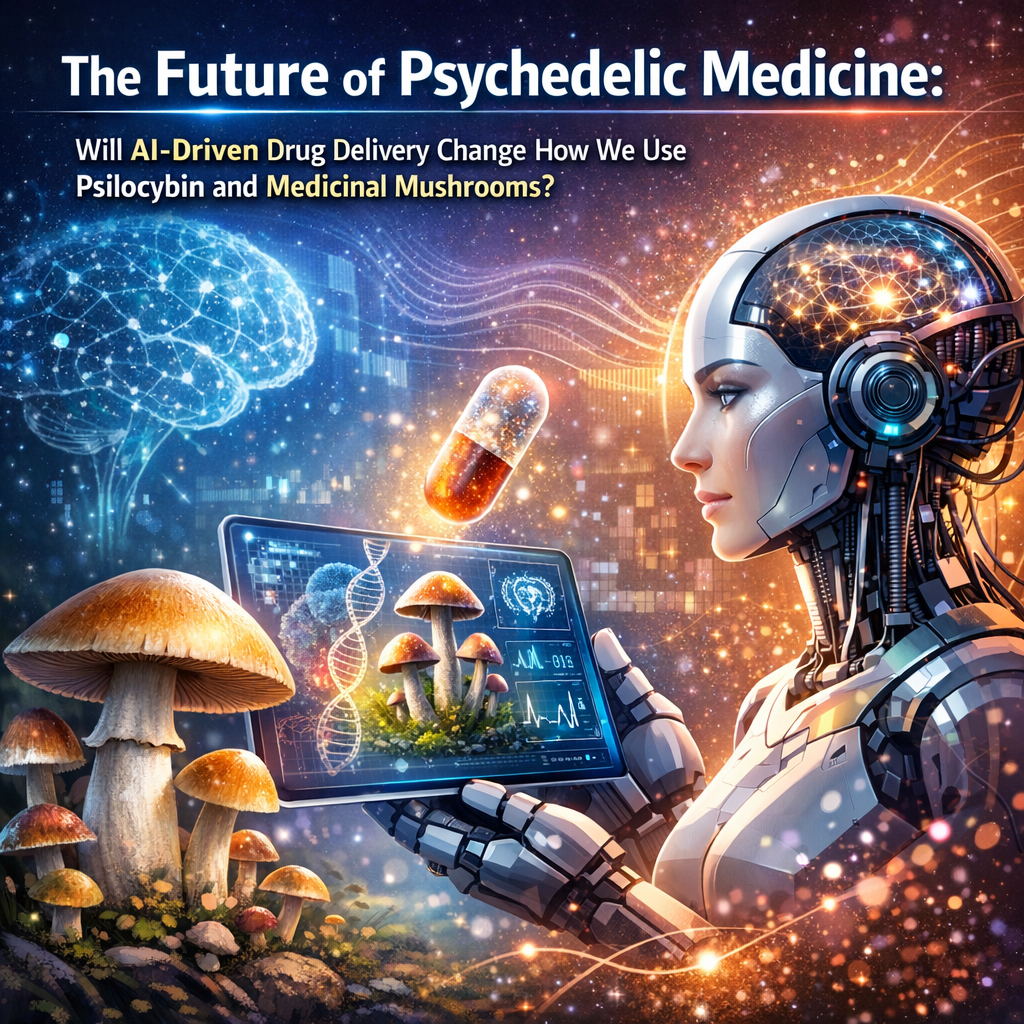
The Future of Psychedelic Medicine: Will AI-Driven Drug Delivery Change How We Use Psilocybin and Medicinal Mushrooms?
Introduction
The burgeoning field of **psychedelic medicine** is undergoing a metamorphosis, driven by converging advancements in **artificial intelligence (AI)**, biotechnology, and pharmacology. At the intersection of this transformation lies the potential for **AI-driven drug delivery systems** to revolutionize how **psilocybin** and other **medicinal mushrooms** are utilized for therapeutic purposes. Once the subject of counterculture movements and controversial debates, **psychedelic compounds** are now making their way into mainstream medicine, thanks to a growing body of scientific research validating their efficacy in treating mental health disorders, such as **depression**, **PTSD**, and **anxiety**.
Psilocybin, a naturally occurring psychedelic found in certain mushrooms, is particularly promising due to its ability to promote **neural plasticity**, leading to tangible improvements in mental health outcomes. As researchers delve deeper into understanding the compound’s mechanisms, AI technology is poised to play a crucial role in personalizing and optimizing psychedelic treatments. This synergy could herald a new era where integration of AI in drug delivery maximizes the therapeutic potential of psilocybin, while minimizing its risks.
**AI-driven drug delivery systems** offer the potential to revolutionize how we approach psychedelic therapy. By leveraging data analytics, **machine learning algorithms** can predict individual responses to psilocybin based on genetic and environmental factors. This level of personalization has the potential to transform patient outcomes by ensuring that they receive the precise dosage and treatment regimen tailor-fitted to their specific biological makeup. As AI algorithms continue to evolve, they promise to refine predictive models, optimize compound synthesis, and potentially identify novel applications for psilocybin and other medicinal mushrooms.
Moreover, AI technology could facilitate more efficient and ethical clinical trials by analyzing vast datasets to identify patterns and correlations that human researchers might miss. With the integration of AI in psychedelic medicine, the future may hold not only more effective treatments but also a deeper understanding of consciousness itself.
Features
Recent studies underscore the potential of AI to revolutionize the delivery of psychedelic compounds like psilocybin. A landmark study published in the journal Nature Medicine highlighted how AI could be used to predict clinical outcomes and personalize treatments based on individual data points (source: [Nature Medicine](https://www.nature.com/articles/s41591-021-01336-3)). By harnessing machine learning algorithms, researchers can integrate multi-omic data (such as genomics, proteomics, and metabolomics) with real-world evidence to map out patient-specific treatment pathways.
Additionally, AI’s role in drug discovery has already demonstrated impressive results. By employing **advanced computational models**, researchers can screen thousands of compounds rapidly and efficiently, potentially identifying new therapeutic candidates derived from **psychedelic mushrooms**. This AI-driven approach to drug discovery has the potential to significantly shorten lead times from initial discovery to clinical application, which is especially crucial in the fast-paced arena of psychedelic medicine.
Incorporating AI in drug delivery systems also provides the capability to monitor and adjust drug dosages in real-time, maximizing therapeutic efficacy while reducing adverse effects. Smart delivery systems paired with wearable technology can collect data continuously, providing insights into patient responses. This ingestible biosensor technology, as demonstrated in the *Journal of Controlled Release*, can adjust the release of active compounds based on fluctuating physiological conditions (source: [Journal of Controlled Release](https://www.journalofcontrolledrelease.com/article/S0168-3659(21)00644-8/fulltext)).
Beyond optimizing delivery mechanisms and drug synthesis, AI is central to advancing the understanding of the neural correlates of psychedelic experiences. Functional MRI (fMRI) data analyzed through AI algorithms can reveal how psilocybin affects brain connectivity, offering new insights into its role in treating disorders such as depression and PTSD. According to a study in *Cell Reports*, AI-driven analysis of brain imaging data has provided robust evidence supporting the use of psilocybin in the intervention of treatment-resistant mental health disorders (source: [Cell Reports](https://www.cell.com/cell-reports/fulltext/S2211-1247(21)01189-X)).
Conclusion
In conclusion, the convergence of **AI technology** and **psychedelic medicine** offers unprecedented opportunities to redefine therapeutic paradigms for treating mental health disorders. By enhancing the precision, safety, and efficacy of psilocybin and other medicinal mushrooms, AI-driven drug delivery systems can unlock new frontiers in medical innovation. As this symbiosis between AI and psychedelics evolves, we stand on the cusp of a new era that holds the promise of more personalized, effective, and humane treatment solutions.
References
1. Nature Medicine: [AI-Assisted Drug Discovery and Personalization](https://www.nature.com/articles/s41591-021-01336-3)
2. Journal of Controlled Release: [Smart Drug Delivery Systems](https://www.journalofcontrolledrelease.com/article/S0168-3659(21)00644-8/fulltext)
3. Cell Reports: [AI Analysis in Psilocybin Research](https://www.cell.com/cell-reports/fulltext/S2211-1247(21)01189-X)
**Concise Summary:**
The integration of **AI-driven drug delivery systems** in psychedelic medicine holds the potential to transform how psilocybin and medicinal mushrooms are used therapeutically. By employing **machine learning algorithms** and advanced computational models, treatments can be personalized based on individual genetic and environmental factors. This approach not only promises optimized dosing and novel drug discoveries but also enhances the precision and safety of treatments. AI aids in efficient clinical trials, monitors patient responses, and provides insights into brain connectivity, ultimately advancing treatment for mental health disorders like depression and PTSD.

Dominic E. is a passionate filmmaker navigating the exciting intersection of art and science. By day, he delves into the complexities of the human body as a full-time medical writer, meticulously translating intricate medical concepts into accessible and engaging narratives. By night, he explores the boundless realm of cinematic storytelling, crafting narratives that evoke emotion and challenge perspectives. Film Student and Full-time Medical Writer for ContentVendor.com