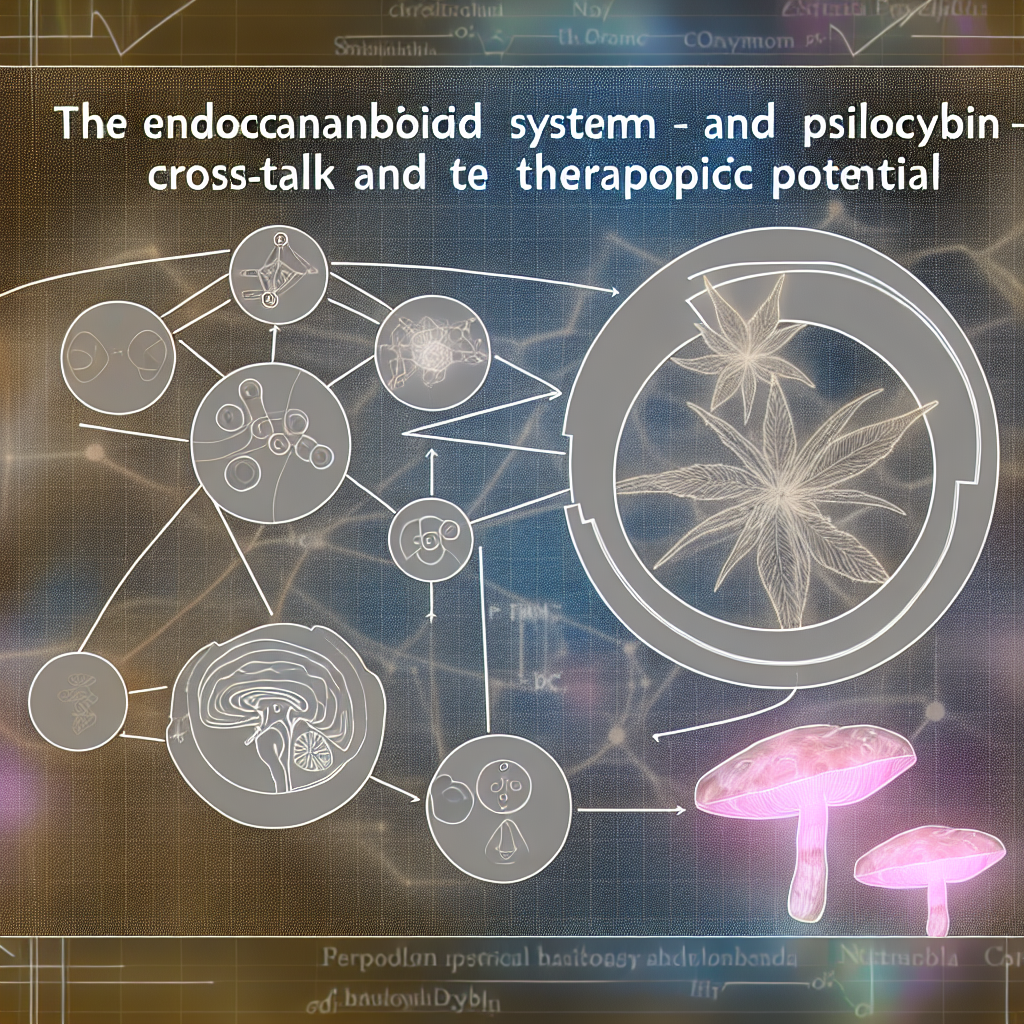
The Endocannabinoid System and Psilocybin – Cross-Talk and Therapeutic Potential
Introduction
In recent years, there’s been an increasing interest in **natural** and **alternative therapies**, particularly involving the therapeutic use of **psychoactive compounds** like **psilocybin** and **cannabinoids**. The **endocannabinoid system (ECS)** is a complex cell-signaling system crucial for regulating various physiological processes, including **mood**, **memory**, **appetite**, and **immune response**. Understanding the intricate relationship between the ECS and psychoactive substances such as psilocybin could unlock new pathways for therapeutic interventions in **mental health** and **pain management**.
**Psilocybin**, the active compound in certain mushroom species, has captivated researchers and mental health professionals for its potential to alleviate conditions like **depression**, **anxiety**, and **PTSD**. Meanwhile, the ECS is renowned for mediating the effects of **cannabis**, contributing to **stress relief**, **mood enhancement**, and **pain reduction**.
The cross-talk between psilocybin and the ECS is an exciting area of exploration. Preliminary evidence suggests psilocybin may exert therapeutic effects by modulating ECS activity. For instance, psilocybin influences **serotonin receptors** in the brain, potentially interacting with **cannabinoid receptors** to create a symbiotic therapeutic effect. This suggests psilocybin might enhance the natural responsiveness of the ECS, potentially augmenting the benefits of cannabinoids.
By exploring the interaction between these systems, researchers aim to uncover more effective and holistic treatment regimens for various **neuropsychiatric** and **inflammatory conditions**. Integrating psilocybin therapy with cannabinoids may offer a dual-action approach, engaging multiple pathways at once for a **synergistic effect**.
Features
Investigations into the combined potential of psilocybin and the ECS have laid the groundwork for several promising studies. One key research area is psilocybin’s potential to alleviate symptoms of **treatment-resistant depression**. A study published in the [New England Journal of Medicine](https://www.nejm.org/doi/full/10.1056/NEJMoa2032994) found that psilocybin, along with psychological support, significantly reduced depressive symptoms in participants. Although the study did not specifically focus on the ECS, the involvement of **serotonin** and other neurotransmitter systems suggests a link worth investigating.
Moreover, cannabinoids like **CBD** exhibit remarkable **anti-inflammatory** and **anxiolytic properties**. The ECS’s role in managing stress and inflammation is well-documented, providing another opportunity to explore how psilocybin might enhance or complement these effects. A relevant study in the [Journal of Psychopharmacology](https://journals.sagepub.com/doi/full/10.1177/0269881118756240) highlighted how CBD, when combined with low doses of **THC**, could reduce anxiety and improve mood states, aligning with psilocybin’s supposed benefits.
**Neurogenesis**, the process of generating new neurons in the brain, is another field where psilocybin and cannabinoids exhibit potential overlap. A study from the [Journal of Neurochemistry](https://onlinelibrary.wiley.com/doi/10.1111/jnc.14098) indicated that cannabinoids could promote neurite outgrowth, synaptogenesis, and hippocampal neurogenesis. Given that psilocybin is also suggested to promote neurogenesis, their mutual reinforcement could be invaluable for treating **degenerative** and **mood disorders**.
The synergy between psilocybin and the ECS holds promise for **pain management**. Both compounds are individually noted for their **analgesic properties**. A comprehensive review in [Frontiers in Pharmacology](https://www.frontiersin.org/articles/10.3389/fphar.2018.01265/full) emphasizes the potential for psychedelic compounds like psilocybin to recalibrate central pain networks, a process that could be amplified through ECS modulation.
Conclusion
As research deepens into the interplay between psilocybin and the ECS, the prospect of developing more effective, holistic therapies becomes increasingly tangible. Their combined effects on mood, inflammation, and neurogenesis present an intriguing frontier for research and clinical applications. Embracing the synergy of these compounds offers significant potential to address some of the most challenging neuropsychiatric and inflammatory conditions, signaling a new era of integrative medicine.
Concise Summary
The emerging exploration of the interaction between the endocannabinoid system (ECS) and psilocybin highlights new therapeutic potentials. By modulating ECS activity, psilocybin may enhance cannabinoid benefits, presenting a promising dual-action approach for neuropsychiatric conditions. Studies show psilocybin’s potential in treatment-resistant depression, complementing CBD’s anti-inflammatory effects. Further research may unlock synergistic effects on neurogenesis and pain management, opening doors to holistic, integrative therapies for complex mental and inflammatory disorders.

Dominic E. is a passionate filmmaker navigating the exciting intersection of art and science. By day, he delves into the complexities of the human body as a full-time medical writer, meticulously translating intricate medical concepts into accessible and engaging narratives. By night, he explores the boundless realm of cinematic storytelling, crafting narratives that evoke emotion and challenge perspectives. Film Student and Full-time Medical Writer for ContentVendor.com