Mushroom Air Filtration Systems Preventing Contamination in Grow Tents
Introduction
In recent years, the rising interest in **medicinal mushrooms**—including lion’s mane, reishi, turkey tail, and even psilocybin mushrooms—has sparked a surge in both home and professional cultivation. These powerful fungi offer promising potential in the treatment of conditions like **depression**, **anxiety**, **inflammation**, and **neurodegenerative disorders**.
However, any seasoned grower knows that the biggest threat to successful cultivation is not nurturing the fungi itself, but rather dealing with contamination. Resulting mainly from airborne **mold spores**, **bacteria**, and **pathogens**, contamination can destroy entire grow tent cycles within days.
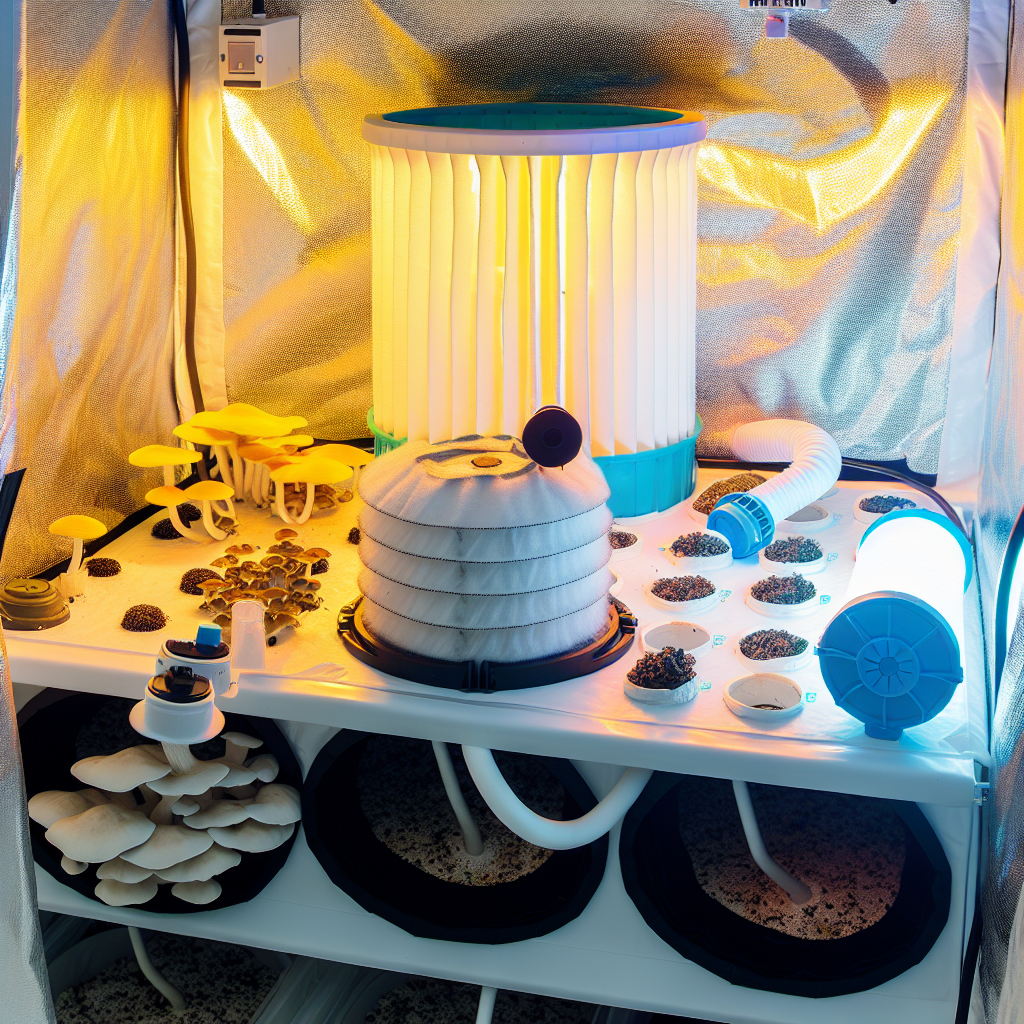
To address this, growers are increasingly implementing air filtration systems engineered specifically for mushroom cultivation. These systems feature **multi-stage purification methods**—including **HEPA filters**, **activated carbon**, and **UV filtration**—to remove pathogens, dust, mold spores, and competing fungi. As a result, the mycelium and fruiting bodies are cultivated in controlled, contaminant-free environments that optimize yield and medicinal consistency.
Just as sterile conditions are required in the pharmaceutical and biotechnology sectors, clean-air practices are becoming a priority for mushroom growers, especially for those cultivating psilocybin mushrooms in legal frameworks. By maintaining air quality elegance, growers not only protect their investment but also ensure high therapeutic value in the end product.
This article will dive into the science and application of mushroom air filtration systems, citing recent studies and offering practical solutions for both home and commercial cultivators.
Features
The integration of sophisticated air filtration systems into mushroom grow tents is not just advanced hobbyism—it’s a critical preventative measure against biological threats. Multiple scientific studies suggest that maintaining purified air environments supports consistent yields and bioactive compound production in **medicinal mushrooms**.
A 2020 study in the journal Applied Microbiology and Biotechnology emphasized the vulnerability of mushroom cultivation to **airborne contaminants** such as Penicillium, Trichoderma, and Aspergillus. These molds can outcompete mushroom mycelium or produce toxic byproducts. The study concluded that using **HEPA filters** combined with positive pressure airflow significantly minimizes contamination during the most sensitive stages: inoculation and fruiting.
In line with practices seen in **GMP (Good Manufacturing Practice)** environments, companies such as Compass Pathways and the Usona Institute are implementing high-grade air control systems in their **pharmaceutical-grade psilocybin production**. For home growers, similar principles can be applied through modular systems and sterilization tools widely available to the public.
One innovation in the field is the collaboration of two technologies: **HEPA filters** with **UV germicidal irradiation (UVGI)**. A 2021 study published in Environmental Science & Technology found that HEPA-UV combos could eliminate over 99.97% of microbial particles, surpassing traditional air filters. Such systems, now available in compact, plug-and-play units, bring **clinical-grade air purity** to personal grow setups.
Beyond sterilization, air filtration positively impacts **biochemical consistency** in mushrooms by reducing oxidative stress and preserving the integrity of active compounds. For example, a study on lion’s mane found that environmental contamination impacted levels of **hericenones** and **erinacines**, which are key to its neuroprotective effects. Maintaining clean air led to more stable compound yields (NCBI Study).
Emerging best practices for air purification include modular systems equipped with:
– Pre-filters for dust and particulates
– HEPA filters for bacteria and mold spores
– Activated carbon filters for removing odors and VOCs
– UV lights to sterilize pathogens
These systems not only benefit the mushrooms but also improve air quality for humans working in confined indoor grow spaces, reducing allergen and respiratory risk over time.
Conclusion
Ensuring a sterile and contamination-free grow tent is about more than just increasing yield—it’s essential for cultivating safe, bioactive-rich, and medicinally viable mushrooms. As popularity rises for natural and psychedelic-assisted therapies, adopting **air filtration systems** is no longer a choice but a critical standard in **mushroom cultivation**.
By embracing **multi-stage clean air technologies**, growers—from bedroom cultivators to medical suppliers—can align with professional purification protocols, preserving both the health of the user and the integrity of the medicine.
References
– Applied Microbiology and Biotechnology. “Airborne contamination in mushroom cultivation: risks and mitigation strategies.”
– Compass Pathways. “Research and development.”
– Environmental Science & Technology. “Effectiveness of HEPA-UV air purification: A microbial perspective.”
– National Center for Biotechnology Information. “Neurotrophic factors in Hericium erinaceus.”
Concise Summary
Airborne contamination is a major problem for both hobbyist and professional **mushroom cultivators**, especially in the rising field of **medicinal mushroom production**. Utilizing multi-stage **air filtration systems**—including **HEPA**, **UV**, and **carbon filters**—has proven effective in safeguarding grow tents from spores, bacteria, and mold. These systems boost yield quality, support consistent bioactive compound development, and align with pharmaceutical production standards. Recent research shows that maintaining sterile environments not only benefits the mushrooms but also ensures user safety, making air filtration essential for growers focused on therapeutic outcomes.

Dominic E. is a passionate filmmaker navigating the exciting intersection of art and science. By day, he delves into the complexities of the human body as a full-time medical writer, meticulously translating intricate medical concepts into accessible and engaging narratives. By night, he explores the boundless realm of cinematic storytelling, crafting narratives that evoke emotion and challenge perspectives. Film Student and Full-time Medical Writer for ContentVendor.com