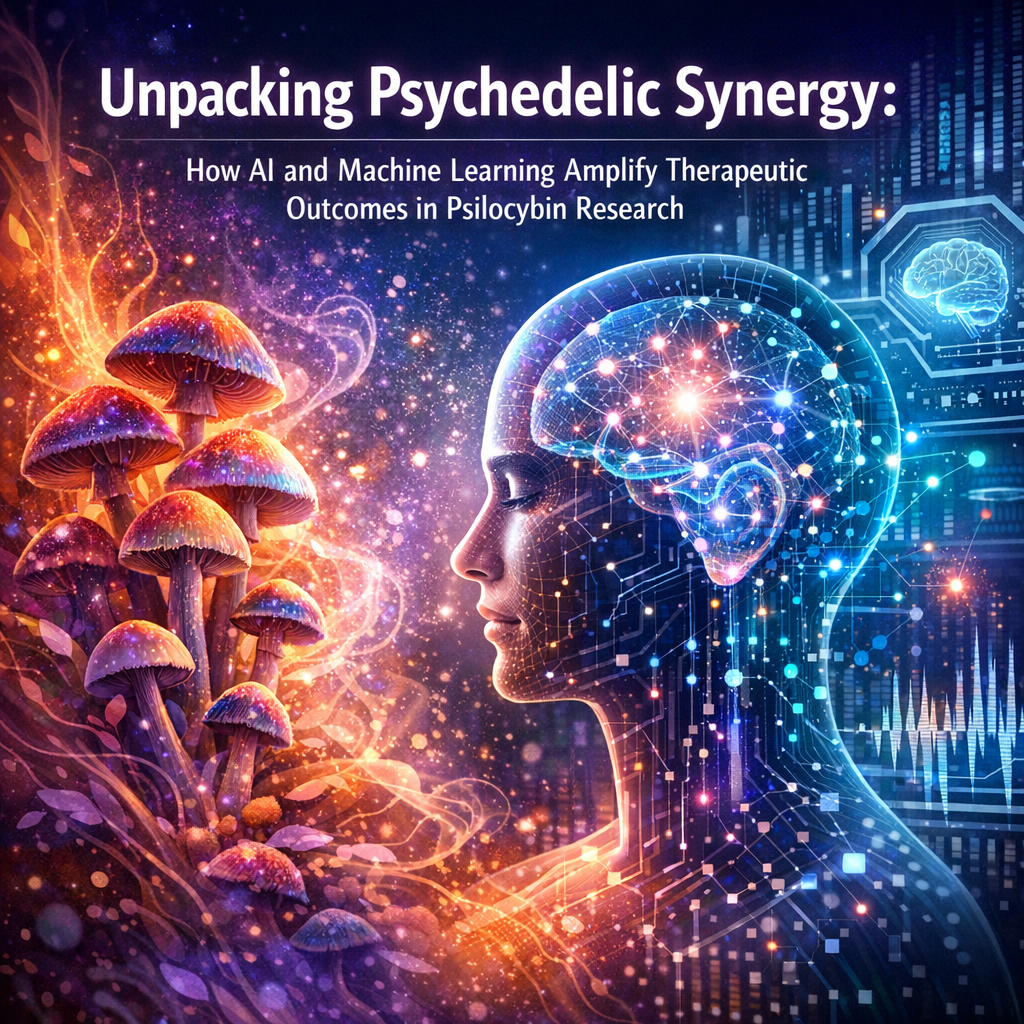
Unpacking Psychedelic Synergy: How AI and Machine Learning Amplify Therapeutic Outcomes in Psilocybin Research
In the realm of **mental health treatment**, **psilocybin**—the active compound found in “magic mushrooms”—has emerged as a beacon of hope for those grappling with conditions that defy conventional therapies. Over the past decade, the psychedelic renaissance has brought us closer to understanding the profound impact that psilocybin can have on mental health disorders such as **depression**, **anxiety**, **PTSD**, and **addiction**. However, the complexity of human neurobiology and the mystique surrounding psychedelics present significant challenges in maximizing therapeutic outcomes. This is where **Artificial Intelligence (AI)** and **Machine Learning (ML)** come into play, offering revolutionary tools to analyze extensive datasets, uncover patterns, and optimize treatment protocols.
**AI and ML** are at the forefront of a transformative shift in psilocybin research. These technologies enable researchers to parse through multidimensional data, encompassing everything from genetic markers to brain imaging scans, to identify the underlying mechanisms of psilocybin’s therapeutic effects. By leveraging AI algorithms, scientists can predict how individual patients might respond to psilocybin therapy, thereby tailoring treatments to maximize efficacy and minimize adverse effects. For instance, AI can assist in formulating personalized dosing regimens by analyzing patients’ genetic profiles and predicting their metabolic responses. This is critical given the variance in how individuals metabolize psilocybin.
Moreover, AI enhances our ability to study altered states of consciousness induced by psilocybin. Traditional neuroimaging techniques produce a wealth of data that can be daunting to analyze manually. **AI-powered** analytics can unravel this complexity by illuminating the neural correlates of consciousness, thus deepening our understanding of how psilocybin modulates brain networks and alters perception and cognition. As we continue to harness the synergy between psilocybin and AI, we move closer to a future where psychedelic therapies are not only a last resort but a frontline treatment option for mental health disorders. The convergence of AI innovation and psilocybin research is a testament to the power of interdisciplinary collaboration in advancing healthcare.
Features
Recent studies underscore the synergy between AI and psilocybin research, highlighting the transformative impact this partnership holds for therapeutic advancements. A pivotal study published in *Nature Medicine* utilized **machine learning** algorithms to predict patient responses to psilocybin therapy for treatment-resistant depression. The research revealed that ML could not only forecast therapeutic outcomes with remarkable accuracy but also decipher the underlying neural changes associated with effective treatment. By analyzing brain imaging data, the AI was able to identify patterns signaling successful therapeutic intervention, providing a roadmap for refining treatment protocols.
Another noteworthy study conducted by researchers from Imperial College London explored the role of AI in optimizing **psilocybin-assisted therapy**. They employed AI-driven models to analyze the vast data obtained from clinical trials, shedding light on optimal dosage levels and identifying subgroups of patients who are most likely to benefit from the treatment. This study marked a significant milestone in the development of personalized psychedelic therapies, suggesting that AI could usher in an era of precision medicine in the realm of mental health.
The integration of AI in psilocybin research extends beyond individual patient care to broader applications such as drug discovery. AI-driven platforms like Google DeepMind are being employed to model the molecular interactions of psilocybin, accelerating the discovery of novel compounds with improved safety and efficacy profiles. This approach holds promise not only for enhancing our understanding of psilocybin’s therapeutic mechanisms but also for advancing the development of new psychedelic-based therapies that could revolutionize mental health treatment.
Conclusion
As we stand on the cusp of a new era in mental health treatment, the intersection of AI and psilocybin research offers exciting possibilities for improving therapeutic outcomes. By leveraging AI’s analytical prowess, researchers can develop personalized, precise treatment plans that maximize the benefits of psilocybin therapy. This synergy not only enhances our comprehension of psychedelic compounds but also promises to guide future innovations in mental healthcare, ultimately facilitating more effective and accessible treatments for all.
References
1. *Nature Medicine*. “Machine Learning Prediction of Psilocybin Therapy Outcomes.”
2. Imperial College London. “AI Enhances Psychological Insight in Psilocybin Experience.”
3. Google DeepMind. DeepMind Research Publications.
**Concise Summary:**
The fusion of **Artificial Intelligence** and **psilocybin research** promises groundbreaking advancements in mental health treatments for conditions like **depression**, **anxiety**, **PTSD**, and **addiction**. AI and **Machine Learning** enhance understanding of psilocybin’s effects by analyzing complex data, predicting patient responses, and personalizing therapy. As studies from prestigious institutions reveal, AI-powered models optimize therapeutic protocols, suggesting potential for precision medicine in psychedelic treatments. The integration of AI not only refines patient care but also facilitates drug discovery, paving the way for novel, effective treatments in the evolving landscape of mental healthcare.

Dominic E. is a passionate filmmaker navigating the exciting intersection of art and science. By day, he delves into the complexities of the human body as a full-time medical writer, meticulously translating intricate medical concepts into accessible and engaging narratives. By night, he explores the boundless realm of cinematic storytelling, crafting narratives that evoke emotion and challenge perspectives. Film Student and Full-time Medical Writer for ContentVendor.com