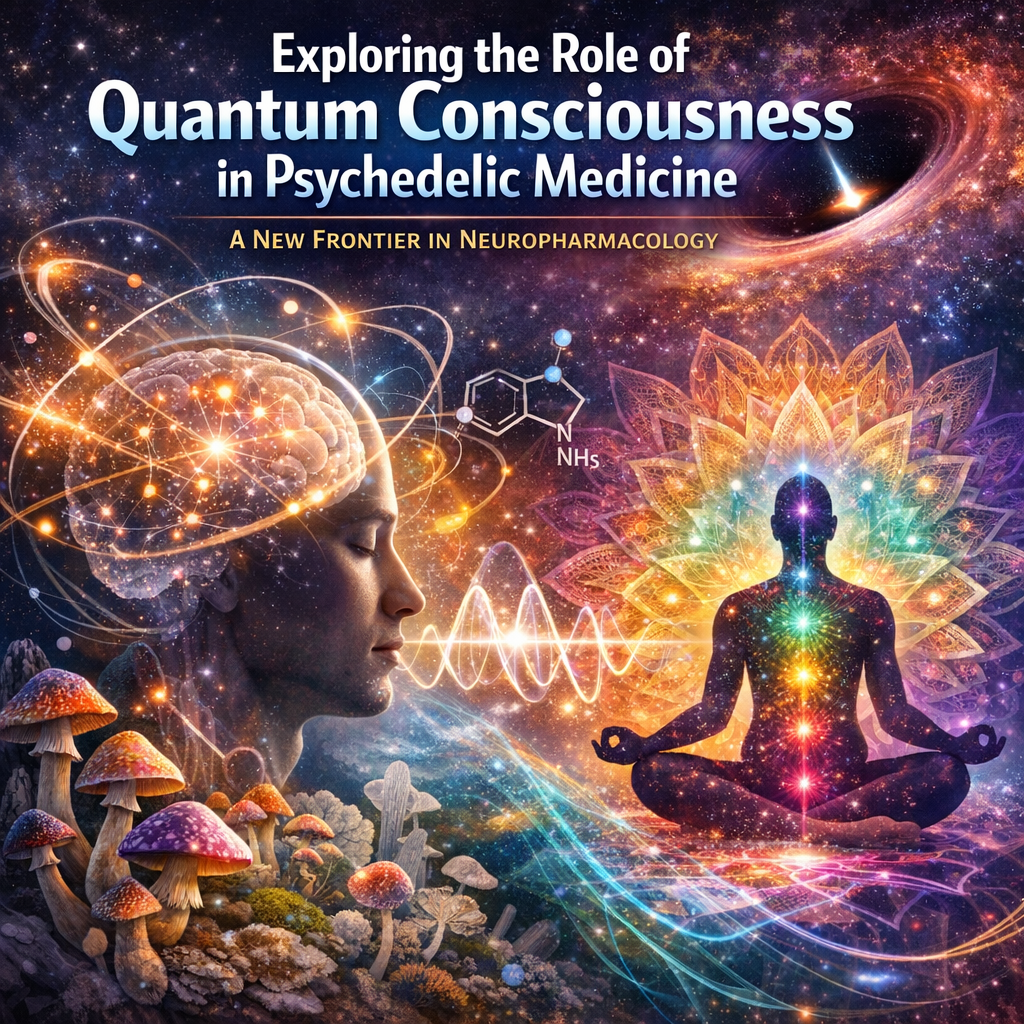
Exploring the Role of Quantum Consciousness in Psychedelic Medicine: A New Frontier in Neuropharmacology
Introduction
The arena of **psychedelic medicine** is witnessing rapid advancements, embracing unconventional ideas to enhance the understanding of consciousness and the treatment of psychological disorders. A fascinating concept gaining attention is the integration of **quantum consciousness theory** into psychedelic medicine. **Quantum consciousness** postulates that consciousness emerges from quantum processes within the brain’s microstructures, thereby influencing perception, cognition, and healing in ways traditional approaches cannot fully explain.
Psychedelic substances like **psilocybin**, found in “magic mushrooms,” **LSD**, and **DMT**, have exhibited remarkable therapeutic potential in treating mental health issues such as **depression**, **anxiety**, and **PTSD**. These substances facilitate profound shifts in consciousness, promoting **neuroplasticity** and rewiring maladaptive neural pathways. The intersection of these psychotropic compounds and quantum consciousness may unlock novel mechanisms in **neuropharmacology** that transcend conventional models of understanding the brain-mind relationship.
At the core of this burgeoning field is the hypothesis that quantum processes occur in brain structures known as **microtubules**, integral components of the neuron’s cytoskeleton. Microtubules have been proposed by physicist Roger Penrose and anesthesiologist Stuart Hameroff in their **orchestrated objective reduction (Orch OR) theory** to be the locus for quantum information processing in the brain. Under the influence of psychedelics, these microtubules may function as biological quantum computers, modulating consciousness in profound and therapeutic ways.
While still highly theoretical, these ideas invite robust dialogue and intensive research into how substances like psilocybin can interact with brain microstructures at a quantum level. Understanding these interactions might illuminate why individuals experience heightened self-awareness, vivid psychological insights, and long-lasting behavioral changes after psychedelic therapy sessions. As scientific inquiries continue to delve deeper into these unconventional paradigms, new frontiers in treating psychiatric conditions through **psychedelic-assisted therapies** may emerge, promising more personalized and effective therapeutic outcomes.
Features
Exploring the role of quantum consciousness in psychedelic medicine necessitates examining contemporary research bridging quantum physics, neuroscience, and psychopharmacology. Significant efforts have focused on understanding how psychedelics alter brain function and consciousness, a quest that has garnered interest in quantum brain hypotheses.
Pioneering studies, such as those conducted at [**Imperial College London**](https://www.imperial.ac.uk/psychedelic-research-centre/), have used advanced neuroimaging techniques to unveil how psychedelics like psilocybin radically alter brain network dynamics. The research suggests a dissolution of longstanding neural patterns, particularly within the **default mode network (DMN)**, which is often overactive in individuals with depression. This disruption is hypothesized to stem from agents at the quantum level promoting enhanced connectivity and communication across brain regions, resulting in a temporary “reset” mechanism.
Moreover, the culmination of research on the **Orch OR theory** presents a plausible explanation for these phenomena. The theory posits that consciousness could arise from quantum computations in microtubules, potentially modulated by psychedelics. When subjects consume psychedelics, it’s possible these compounds enhance quantum coherence within neuronal microtubules, fostering altered states of consciousness experienced during trips. The insights and emotional breakthroughs achieved in these states could thereby seed lasting mental health benefits.
Studies on animal models using sophisticated entanglement measures aim to verify quantum effects in the brain. Notable publications in journals such as [**Quantum Biosystems**](https://www.quantumbiosystems.org/) have indicated that coherent photons or other quantum states could propagate across neural microtubules, influencing perception and mood. Collaborative efforts between physicists and neuroscientists are increasingly focusing on designing experiments and devices to measure quantum events in the brain directly.
Although these interpretations of quantum consciousness remain speculative and require rigorous validation, they offer radical prospects for psychedelic medicine. By framing psychedelic experiences through a quantum lens, there’s potential to revolutionize therapeutic strategies for mental ailments. Enhanced interdisciplinary research efforts—integrating insights from quantum mechanics, cognitive neuroscience, and psychopharmacology—promise a groundbreaking frontier in understanding and utilizing the profound effects of psychedelics in healing the human mind.
Conclusion
As science gradually unravels the complex relationship between quantum processes and consciousness, integrating these insights with psychedelic medicine holds promise for revolutionizing mental health treatment. Understanding psychedelics through the perspective of quantum consciousness not only broadens the scientific horizon but also deepens the potential for personalized and effective therapeutic interventions. While the science is still unfolding, the potential impact of this frontier cannot be understated, offering a beacon of hope for innovative treatments in neuropharmacology.
References
– [**Imperial College London – Psychedelic Research Group**](https://www.imperial.ac.uk/psychedelic-research-centre/)
– [**Scientific Reports – LSD, psilocybin, & brain connectivity**](https://www.nature.com/articles/s41598-019-54891-8)
– [**Quantum Biosystems**](https://www.quantumbiosystems.org/)
– [**Orchestrated Objective Reduction theory (Orch OR)**](https://www.tandfonline.com/doi/abs/10.1080/03009480902738994)
Concise Summary
This article explores the burgeoning field of integrating quantum consciousness theory into psychedelic medicine, positing that quantum processes within brain microstructures might explain the profound therapeutic effects of psychedelics on mental health issues like depression and PTSD. Through advanced neuroimaging and quantum brain hypotheses, evidence suggests psychedelics could reset neural patterns and enhance brain connectivity. While speculative, these ideas invite deeper research across quantum physics, neuroscience, and psychopharmacology, potentially transforming therapeutic strategies with enduring impacts on mental health treatment.

Dominic E. is a passionate filmmaker navigating the exciting intersection of art and science. By day, he delves into the complexities of the human body as a full-time medical writer, meticulously translating intricate medical concepts into accessible and engaging narratives. By night, he explores the boundless realm of cinematic storytelling, crafting narratives that evoke emotion and challenge perspectives. Film Student and Full-time Medical Writer for ContentVendor.com