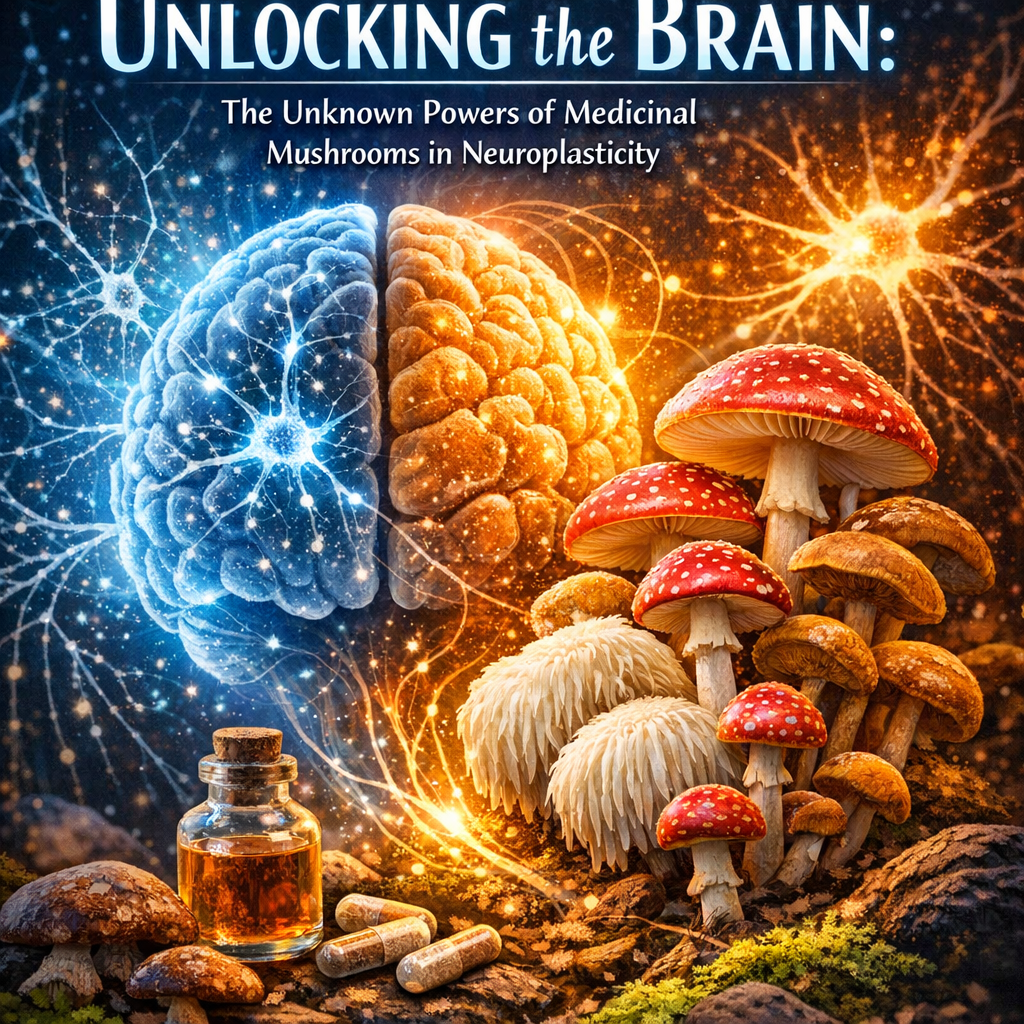
Unlocking the Brain: The Unknown Powers of Medicinal Mushrooms in Neuroplasticity
*Introduction*
In recent years, the interest in natural remedies for cognitive enhancement and mental health has grown exponentially. Among the myriad of natural options available, **medicinal mushrooms** have emerged as a promising contender in enhancing brain function and fostering **neuroplasticity**. Neuroplasticity, the brain’s ability to reorganize itself by forming new neural connections, underlies learning, memory, and recovery from brain injury or stroke. As we strive to combat neurological disorders and cognitive decline, understanding and harnessing neuroplasticity becomes pivotal.
Medicinal mushrooms, long revered in **Eastern medicine** for their health benefits, are now gaining recognition in the West for their potential to boost cognitive function. Species like **Lion’s Mane** (_Hericium erinaceus_), **Reishi** (_Ganoderma lucidum_), and **Cordyceps** (_Cordyceps militaris_) offer a rich tapestry of compounds that could stimulate neuroplasticity. These mushrooms contain bioactive compounds such as **polysaccharides**, **erinacines**, and **hericenones** that are believed to cross the blood-brain barrier and stimulate the production of nerve growth factors like **BDNF** (brain-derived neurotrophic factor) and **NGF** (nerve growth factor).
Lion’s Mane, in particular, has gained the spotlight for its impressive neuroprotective properties. Studies have demonstrated its ability to stimulate the production of NGF, a protein essential for the growth and survival of neurons. The potential of Lion’s Mane, along with other medicinal mushrooms, in supporting cognitive health provides a natural avenue for those seeking to enhance mental acuity and resilience.
With rising concerns about neurodegenerative diseases such as **Alzheimer’s** and **Parkinson’s**, the need for novel, sustainable solutions is more pressing than ever. Medicinal mushrooms offer a beacon of hope, not only for enhancing cognitive function but also for potentially decelerating neurodegenerative processes. The ancient wisdom stored within these fungi might hold key answers to modern medical challenges, inviting further exploration and integration into mainstream healthcare.
*Features*
Numerous studies have highlighted the potential of medicinal mushrooms in promoting neuroplasticity and cognitive health. **Lion’s Mane**, in particular, has been extensively studied for its neuroregenerative capabilities. A double-blind, placebo-controlled study conducted in Japan found that daily consumption of Lion’s Mane extract for 16 weeks significantly improved cognitive function in older adults compared to the placebo group. This [study published in Phytotherapy Research](https://onlinelibrary.wiley.com/doi/abs/10.1002/ptr.2634) suggests that Lion’s Mane may improve mild cognitive impairment, a precursor to conditions like Alzheimer’s.
In addition to Lion’s Mane, **Reishi mushroom** has attracted attention for its neuroprotective effects. Research has shown that Reishi can ameliorate oxidative stress and inflammation in the brain, two factors that contribute to neuronal damage and cognitive decline. A [study published in the International Journal of Medicinal Mushrooms](https://www.ingentaconnect.com/contentone/den/ijmm) revealed how Reishi’s triterpenoids contribute to neuroprotection and may support neuroplasticity.
**Cordyceps**, another powerhouse mushroom, has demonstrated potential for enhancing neural health by improving energy metabolism and blood flow to the brain. A [study in the Journal of Ethnopharmacology](https://www.sciencedirect.com/science/article/pii/S0378874114001730) revealed that Cordyceps supplementation led to improved spatial learning and memory in animal models, indicative of its role in promoting neuroplasticity.
Furthermore, the synergistic effects of combining different medicinal mushrooms can amplify their benefits. The polysaccharides and **beta-glucans** found in these fungi can work in tandem to enhance cognitive functions and protect against neural damage. The broad spectrum of bioactive compounds in these mushrooms provides a multi-faceted approach to brain health, showcasing their potential to not only support but enhance cognitive abilities.
*Conclusion*
The exploration of medicinal mushrooms in promoting neuroplasticity is still in its nascent stage, but the existing research is promising. As we continue to uncover the mysteries of these powerful fungi, they may become integral to our strategies for enhancing brain health and combating neurological diseases. Embracing the ancient wisdom of fungi, coupled with cutting-edge research, could unlock new pathways to nurture and protect our most vital organ – the brain. By integrating these natural wonders into our lives, we may well be on the brink of a cognitive revolution.
**Concise Summary**
Medicinal mushrooms such as **Lion’s Mane**, **Reishi**, and **Cordyceps** show great promise in promoting neuroplasticity and cognitive health. These fungi, revered in Eastern medicine, are gaining Western interest for their bioactive compounds that stimulate nerve growth factors. Studies indicate Lion’s Mane improves cognitive function, Reishi offers neuroprotection, and Cordyceps enhances neural health. With rising concerns about neurodegenerative diseases, these mushrooms offer sustainable solutions. Continued exploration could integrate these fungi into mainstream healthcare, bolstering brain health and possibly revolutionizing cognitive treatment.

Dominic E. is a passionate filmmaker navigating the exciting intersection of art and science. By day, he delves into the complexities of the human body as a full-time medical writer, meticulously translating intricate medical concepts into accessible and engaging narratives. By night, he explores the boundless realm of cinematic storytelling, crafting narratives that evoke emotion and challenge perspectives. Film Student and Full-time Medical Writer for ContentVendor.com